Showing posts with label Sotheby's. Show all posts

Friday, November 25, 2016

ART BIZ | Auctions

Christie's and Sotheby's are highly
competitive, but not in a typical
reactive duopoly mode.
The art market in the United States and globally is well worth study.

Sotheby's and Christie's share a duopoly at the top of the art auction marketplace. (In third place is London's Phillips Auction House.)

Artsy has recently posted an editorial arguing that Sotheby's and Christie's do not behave like a normal duopoly.

Pepsi and Coke tend to follow each other's moves as defensive reactions in an uncertain world. But Sotheby's has not been following Christie's moves to modernize its terms to customers.

So long as Sotheby's doesn't follow suit, Christie's is limited in its ability to change the rules of the game.

I find all this fascinating. I don't know enough about this high-level marketplace to comment on the article, but I will get up to speed if I live long enough. Yes, I will.

Comment below or email the author at john@cityeconomist.com.

Tuesday, November 1, 2016

ART BIZ | Some Forgers Are Good

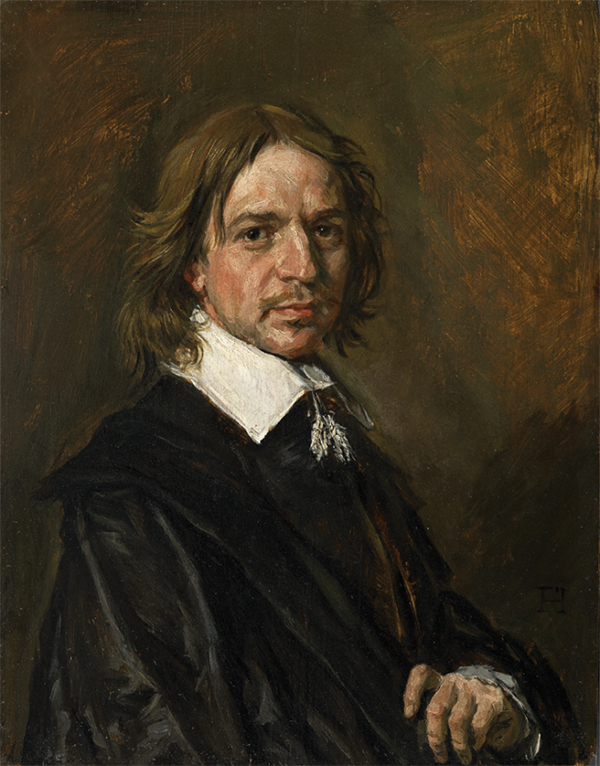
"Portrait of a Man,"
misattributed to
Frans Hals. A fake.
Nov. 1, 2016–The NY Times yesterday has a story on a forgery, titled "Portrait of a Man" that originally fooled Sotheby's and other experts.

It was sold as a discovered portrait by Frans Hals. Sotheby's has now declared the painting to be a fake.

My mother, Hilda van Stockum, was impressed with successful forgers. She used to tell us with relish how some great forgeries were accepted for years as genuine by the art experts, the nomenklatura of the art world.

She asked out loud why their obvious talents weren't directed toward the traditional route of artists, which is to make their name by painting in their own style.

And then she answered her own question by noting that a good forgery can command immediate money in the art marketplace, whereas even one of the greatest painters who ever lived, Vincent van Gogh, took years to win consensus on his greatness, although as I have noted before, his younger brother Theo clearly knew all along that Vincent's work was valuable.

Hitler and Göring
I think that her concern about imperfectness of the art marketplace is what inspired HvS to include her story about the theft of a Rembrandt from the van Arkels' home in The Borrowed House (pp. 170-185).

She based it on news stories about the competition between Hitler and Göring over acquisition of art treasures.

When Janna "realized that you could like and dislike someone at the same time," referring to Erich Stolz getting rich stealing art from Hitler and selling it to Göring, that was my mother's voice I heard.

It's good to hear her voice today, All Saints' Day, on the tenth anniversary of her death.

Related Posts: Vincent van Gogh P&L . The Borrowed House

Saturday, August 20, 2016

ART BIZ | Alec Baldwin Claims Art Sale Switch (Updated Aug. 20, 2016)

Alec Baldwin, Mary Boone
The New York Times has a detailed story by Graham Bowley on what seems to have been a bait-and-switch transaction that serves as a warning to purchasers of art.

Alec Baldwin believes that a gallery owner, Mary Boone, misled him when he purchased what he believed to be Ross Bleckner’s Sea and Mirror (1996). Baldwin first encountered the piece as a picture on an invitation to an exhibition mailed to him by Boone about ten years ago.

Baldwin didn’t buy the work at the time, but carried the picture of it around with him. It sold at Sotheby’s in 2007 for $121,000. In 2010, Baldwin asked Boone to convince the buyer to sell and, according to Baldwin, she provided the piece to him at a premium, $190,000. But in fact he did not get the painting he expected to get. “Ms. Boone sent him another version of the painting."

Boone has repeatedly offered to return his money, but Baldwin is too angry at her for the moment to accept the offer. He feels betrayed by Bleckner, whom he met in East Hampton and considered a friend, as well as Boone. He looked into criminal laws and was told that the art market is so weakly regulated that the alleged fraud would be hard to prove was a criminal act. (To be continued!)

Other ART BIZ posts: Hot Dots and Collage Credit . 100 Priciest Art Sales . Eternal Springs Hope 

Sunday, August 14, 2016

ART BIZ | 100 Priciest Art Sales at Auction

Pablo Picasso, Nude, Green Leaves and Bust
Sold at Christie's auction in 2010 for $106.5 mil.
Artsy has recently posted a truly interesting interactive chart showing, year by year, the most expensive art sold at auction.

Often we don't know what a buyer paid for a piece of art. Only at auction is the process of buying and selling in the open.

The chart shows each sale, by year, with the price of the art. It documents a shift in buying from the Impressionists to Post-War and Contemporary Art.

A few things stand out like a sore thumb:
  • The artists are 98 percent male.
  • Of the art works, only 8 percent are by living artists. 
  • Of the art works, 83 percent were sold via Christie's and Sotheby's.
  • Three out of four artists were born in Western Europe or the USA.