Showing posts with label wealth inequality. Show all posts

Wednesday, July 2, 2014

Ec Inequality - Piketty - Milanovic Take Is Glorious and Short

The basic story is that World War II
redistributed wealth, because assets were
wiped out. Inequality is again rising. 
Achilles's mother (the sea-nymph Thetis), prophesied two futures for him. (1) If he took part in the Trojan War, his life would be glorious but short. (2) If he did not, his life would be long but inglorious. Achilles chose glorious but short.

I posted something short about Thomas Piketty's Capital in the Twentieth Century on April 12. Piketty has raised the issue of economic inequality in an interesting way.

Yesterday I received  the latest (June 2014) issue of the Journal of Economic Literature with a glorious review by Branko Milanovic of Piketty's book. Milanovic's review is the fourth and last featured article in the journal issue.

If you don't subscribe to this journal, a version of it was issued as a working paper by CUNY and is available here.

The review shows the ways in which Piketty's interpretation and message differ from those of many leading economists of the 20th century. The basic data for the United States (see chart upper left) show that World War II redistributed wealth, because assets were wiped out, and the egalitarian effects lasted until the 1970s. The trend toward greater income inequality returned starting with the Thatcher-Reagan years. Piketty has a theory, based largely on historical tax data, that links the level of inequality to  the relationship between return to capital (r) and economic growth (g). Milanovic warns in the last paragraph of his review:
[The] best compliment that the author of an almost 700-page-long economics book can ever expect to get [is - ] Don't take this book on vacation: it will spoil it. 
In other words, Piketty's book is glorious and long. If you take his advice, I suggest that in the meantime, if you haven't read the book, read Milanovic's glorious-and-short (15-page) review. If you accept the premise of Milanovic's last paragraph, the decision facing the vacation reader is unlike that facing Achilles. In this case there is no tradeoff between glorious and short.

Wednesday, September 25, 2013

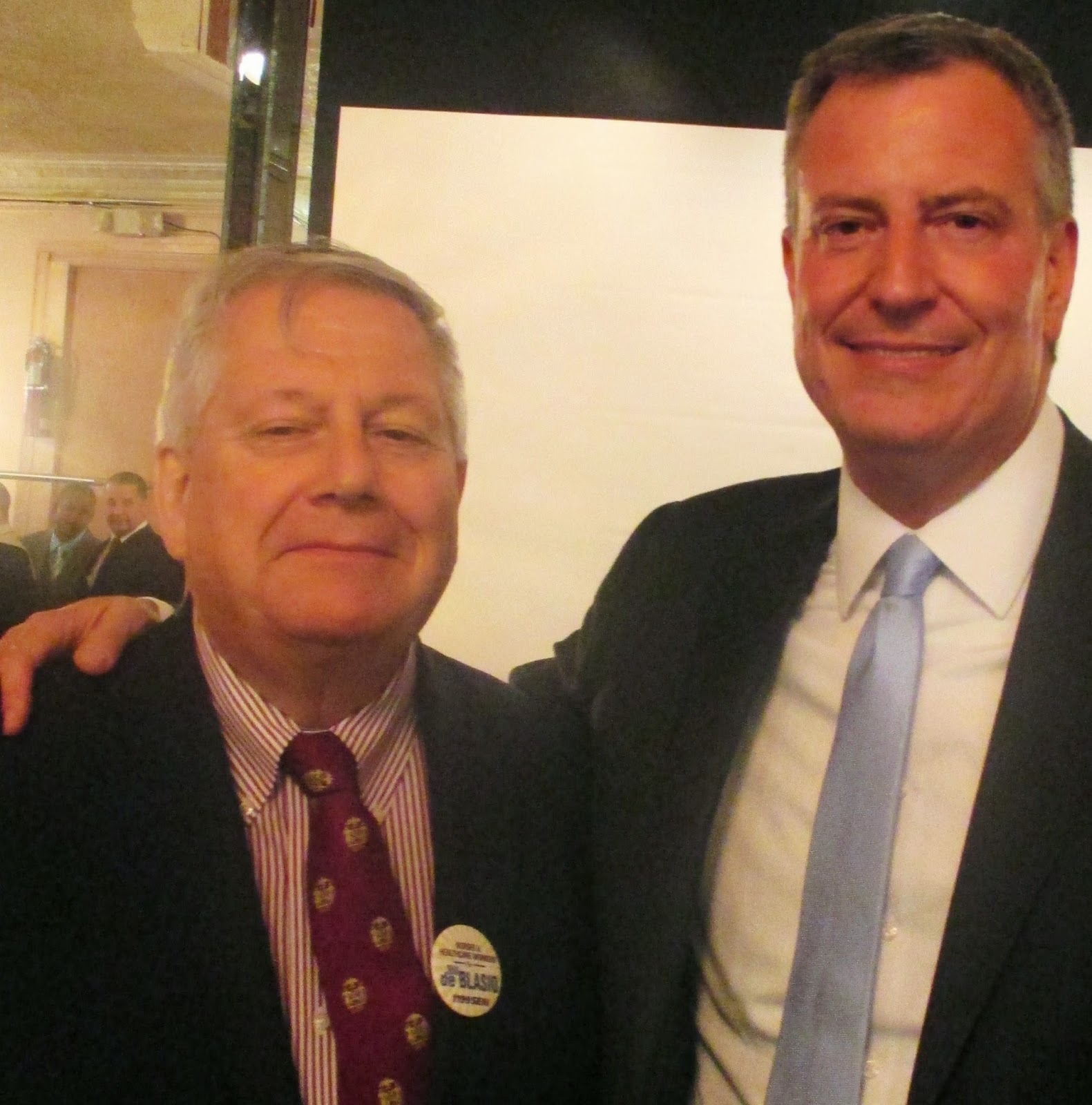
NYC | Candidate Bill de Blasio in His Neighborhood

John Tepper Marlin (L) and the 
Democratic Nominee for Mayor, 
Bill de Blasio, yesterday, in
Brooklyn.
Yesterday evening I ventured to 5th Avenue and 21st Street in Brooklyn and participated in what was a neighborhood party for Bill de Blasio, who has just won the Democratic Nomination for Mayor.

He described the area as "his neighborhood". It was an opportunity for de Blasio to thank 100 of his neighbors who helped push him to a strong (no-runoff) victory in the Democratic Primary. He urged them not to let up for the next six weeks to the general election.

He apologized first for being two hours late. He said he had a really good excuse–he was meeting with the Commander in Chief, Barack Obama. The President was introduced to Dante de Blasio, and was described as walking around Dante staring at his Afro, commenting on its size and contrasting it with his own lopsided Afro of many years ago.

De Blasio then turned to people who had been waiting for him and thanked each of them for their role in getting out the vote in his neighborhood.  He said to applause:
Here is someone who doesn't wait for other people to do things for him. When he sees a problem, he gets up and does something about it. That is leadership.
He mentioned that the first two polls matching himself against Lhota have given him a three-to-one majority, but he urged those present "not to rest on our laurels".

He picked up on income and wealth inequality with the "tale of two cities" theme and was eloquent on the struggles that working people have to "make ends meet" in an economy where real earnings have been declining. He portrayed Mayor Bloomberg as not being able to empathize with the working poor and the middle class families living at the margin because their life is so far removed from his own.