Showing posts with label income inequality. Show all posts

Thursday, April 24, 2014

SINGLE PAYER NY? | Inequality and Health Costs

NYS Assemblyman Richard
Gottfried (D-NYC, Chelsea)
In yesterday morning's edition of The NY Times, David Leonhardt and Kevin Quealy launch a new feature, "The Upshot", by providing new data on rising inequality of U.S. incomes in the United States.

The charts show that incomes have been falling for the lowest 5th percentile in the United States, and while rising in the other percentiles have been rising more slowly than other industrialized countries in the 10th, 20th, 30th and 40th percentiles. U.S. median income is likely to be exceeded now by Canada's.

The implications that the authors draw from the data are reasonable. Their focus on the subject is justified. Their report pushes policy in the right direction...

More Complex Than It Seems

But the chart and its meaning are more complicated than might seem at first look.
  • The intervals in the table are not even. They are 5 percentage points at the top and bottom and then switch to 10 percentage points. 
  • The intervals by years are foreshortened at the recent end from four to two years. 
  • The key to understanding the relationship between the United States and other countries is the slope of the lines for each point in time for each percentile. This requires sophisticated thinking - it's cross-sectional trend analysis. There are pitfalls here because exchange rates are changing for independent reasons.
  • The United States appears to be losing ground only for the 5th percentile. If the chart only showed the 10th percentile, none of the trend lines would point downward. 
  • For the percentiles the United States is increasing but other countries are getting better faster, at least up to the median (50th percentile).
  • The reporters base some of their their conclusions on data not in the chart. In a followup table published online later in the day, the reporters provide a simplified table showing clearly that Canada's median income in 2010 for the first time appears just about to equal the U.S. median income. But the evidence for the idea that Canada has bypassed the United States since 2010 comes from "other data".
These  complications don't negate the results or the headline, but they provide food for further thought. Focusing on disposable income does not provide a final answer to the question: "What goods and services can people at each level of income buy or get access to?" This may help the case for Sweden's poor, but it raises questions about a U.S. average, since states vary in what they provide. Since 1980, for example, has health care become more accessible for more Americans? Leaving Obamacare aside, drug benefits were added to Medicare.

The many online commentators on the Leonhardt-Quealy story point out the following causes of an apparent growth in U.S. income inequality relative to other countries:
  • U.S. education is not maintaining its leadership in building literacy and skills.
  • Government policies encourage more inequality, with a minimum wage that hasn't been raised for years, soaring increases in executive compensation, and The U.S.  
One Cause of Greater Inequality: Growing Health Care Costs

Rapid growth of U.S. health care costs over the 1980-2010 period is another reason for the decline in disposable income for the poorest Americans. Health care costs on average are a higher proportion of the incomes of people below the 50th percentile than above it, and they have been rising steadily for decades.

This reduces discretionary income, especially for the poorest people. Norway, Sweden and Canada have had a national health care system in place. This has to be a significant factor in why their poor are doing better.

An Idea from Richard Gottfried

To reduce health care costs in NY State, Assemblyman Richard N. Gottfried, Chair of the NY State Assembly Health Committee, is trying to emulate the health care systems of Europe and Canada by introducing a Single Payer Health Plan for New York. It recognizes that the national Affordable Care Act (“Obamacare”) is making health care more accessible and efficient, but still leaves a costly layer of administration that should eventually be unnecessary.

His “New York Health” bill (A.5389-A/S.2078-A, sponsored in the Senate by Bill Perkins) will make sure that in NY State, everyone is covered. It will also save billions through a publicly sponsored, single-payer health coverage, like Medicare or Child Health Plus for everyone.

A majority of doctors, nurses, and patients prefer a single payer system, as do many small businesses and unions. The proposed New York Health program would:
  • Provide comprehensive, universal health coverage for every New Yorker and would replace private insurance company coverage.
  • Cover all New Yorkers for medically necessary services, including: primary, preventive, specialists, hospital; mental health; reproductive health care; dental; vision; prescription drug; and medical supply costs - more comprehensive than most commercial health plans.
  • Be funded through a graduated tax on payroll and non-payroll taxable income, based on ability to pay. Today, the same premium is paid by a CEO and a receptionist, and a successful company or a small, new business. For most people, it will be a substantial reduction in what they now spend and most people’s discretionary income will go up.

Wednesday, September 25, 2013

NYC | Candidate Bill de Blasio in His Neighborhood

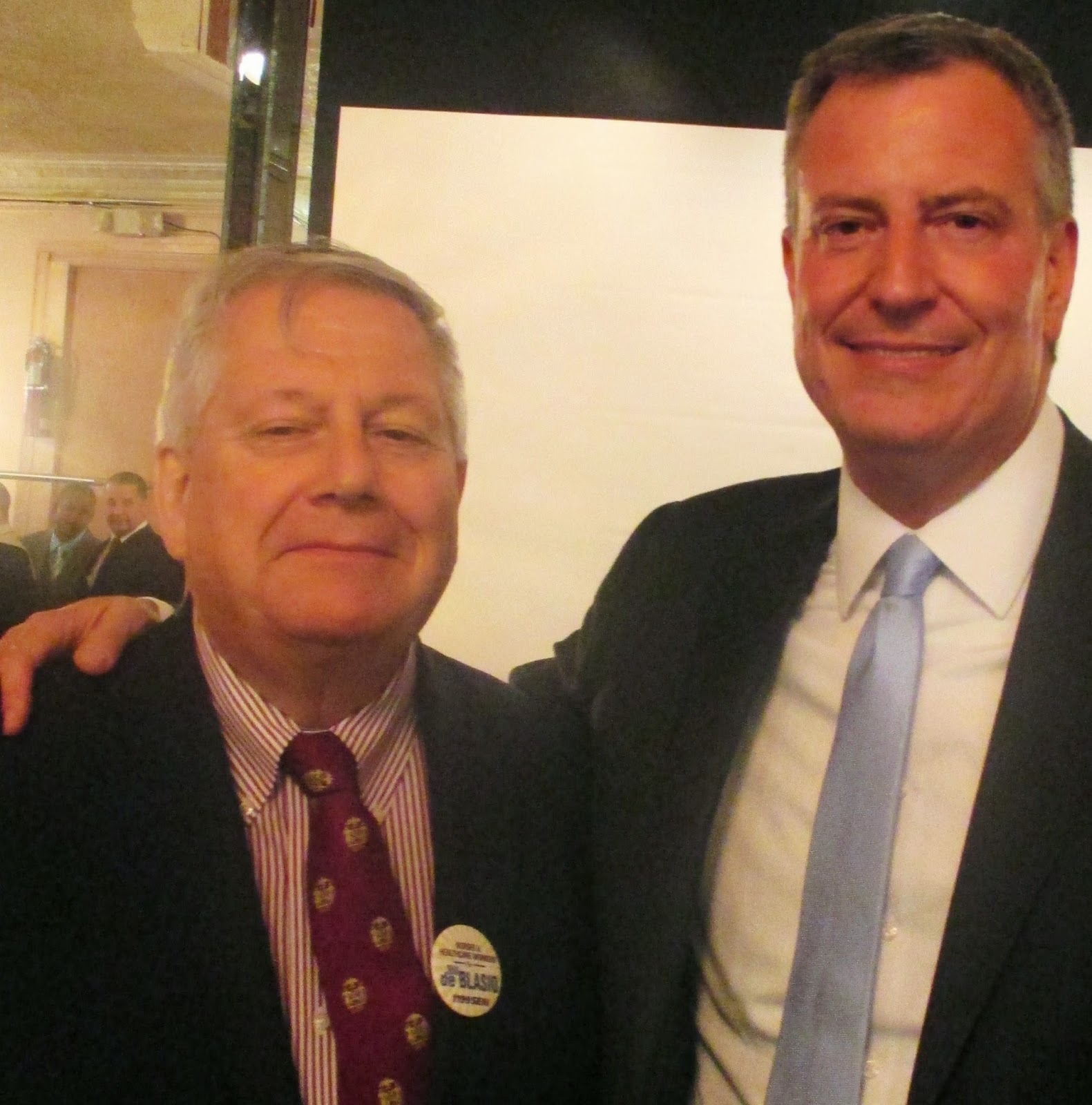
John Tepper Marlin (L) and the 
Democratic Nominee for Mayor, 
Bill de Blasio, yesterday, in
Brooklyn.
Yesterday evening I ventured to 5th Avenue and 21st Street in Brooklyn and participated in what was a neighborhood party for Bill de Blasio, who has just won the Democratic Nomination for Mayor.

He described the area as "his neighborhood". It was an opportunity for de Blasio to thank 100 of his neighbors who helped push him to a strong (no-runoff) victory in the Democratic Primary. He urged them not to let up for the next six weeks to the general election.

He apologized first for being two hours late. He said he had a really good excuse–he was meeting with the Commander in Chief, Barack Obama. The President was introduced to Dante de Blasio, and was described as walking around Dante staring at his Afro, commenting on its size and contrasting it with his own lopsided Afro of many years ago.

De Blasio then turned to people who had been waiting for him and thanked each of them for their role in getting out the vote in his neighborhood.  He said to applause:
Here is someone who doesn't wait for other people to do things for him. When he sees a problem, he gets up and does something about it. That is leadership.
He mentioned that the first two polls matching himself against Lhota have given him a three-to-one majority, but he urged those present "not to rest on our laurels".

He picked up on income and wealth inequality with the "tale of two cities" theme and was eloquent on the struggles that working people have to "make ends meet" in an economy where real earnings have been declining. He portrayed Mayor Bloomberg as not being able to empathize with the working poor and the middle class families living at the margin because their life is so far removed from his own.

Bill de Blasio, Joe Lhota, and the Future of NYC


Bill de Blasio with neighborhood friends from Brooklyn, 
November 24, 2013. Photo by JTMarlin.
New York City has been blessed with a succession of strong mayors, and now we have two strong candidates for mayor - the "second-toughest job in America," as the late Mayor Koch used to say.

Mayor Bloomberg will be a hard act to follow. Coming in right after 9-11, he was a godsend and must be considered one of the great mayors of the city. Having a mogul as Mayor was a signal that the city is likely to be safe for other moguls, and gave them confidence to stay, to visit and move in. The steady aggregation of wealth in Manhattan keeps the NYC brand strong, even if Wall Street's rep is in the gutter. NYC is still the safest big city.

Adolfo Carrion (L) and Joe Lhota (R) at AARP Mayoral
Forum. Photo by JTMarlin.
But, lucky as we are to have had him lead the City, Mayor Bloomberg is leaving behind some big problems for de Blasio or Lhota to deal with. For starters:
  • The NYPD's "stop and frisk" hunts for illegal weapons or other contraband have been deemed unconstitutional by a Federal judge because they have had insufficient cause. Race is not enough of a reason to stop someone. The judge says a cop has to have a reason for stopping someone. That doesn't mean crime rates are going to have to soar again.
  • The labor unions are chomping - no, foaming - at the bit for long-delayed collectively bargained contracts. The new agreements could be budget-busters. Depends on how the revenues come in and the U.S. economy is still recovering from 2008-09.
  • The people Mayor Bloomberg chose to turn the school system around, and the methods they are using (such as constant testing) have been strongly criticized. Needs some re-thinking. 
  • His economic development programs have been heavily real-estate-oriented and involve unprecedented levels of new property-tax abatements that will pinch the budget as more services are required for new areas of development.
  • The late-in-the-game tech initiative, a Cornell campus on Roosevelt Island, may disappoint for the very reason that was its impetus - the City's interest in making use of property on Roosevelt Island.
  • The Mayor's ability to fund his own election campaigns has meant that he is not forced like other politicians to hunt for contributions - which has kept him above interest-group pressure, great, but also has kept him detached from the hoi polloi.    
Both Bill de Blasio and Joe Lhota are capable of running  New York City. The major differences between them are ones of personality and policy.
  • Personally, de Blasio is warm, enthusiastic, and neighborly, whereas Joe Lhota is tense, combative, and remote (when he is under stress, his eyelids come together as if he seems to want to shut out all the rest of the world).
  • On the policy front, de Blasio wants to level the playing field for NYC's middle class and poor people, which means more services for them and probably higher taxes on the very well off. Lhota's biggest concern is to avoid raising taxes at the top rates and to keep NYC safe for wealthy apartment buyers. They both will be tempted to put these differences under the light of class warfare. Lhota may think he will win most this way, but I wouldn't bet on it. Not this year.
The unions may have been divided in the primary, but most of them seem to have no trouble scrambling from the Quinn and Thompson camps to de Blasio. The first two polls show de Blasio ahead by a three-to-one margin. (These numbers are virtually the same as those for Quinn vs. Lhota way back in 2012 when de Blasio was an unknown.) The first tests for the next mayor will be whether he can work out labor agreements that don't break the budget.

The good news for the next mayor, whether de Blasio or Lhota, is that New Yorkers are weary of their mogul. Twelve straight years of Bloomberg after eight years of Giuliani means that City Hall has gradually been cut off from the public, for reasons of security and of philosophy, in ways that were inconceivable in the Koch and Dinkins days.

To bridge the gap between income and wealth inequality described as "the two cities", de Blasio has made a specific proposal to get a little more money from the rich (raising the top tax rate slightly, by a fraction of a percentage point, on those earning more than $500,000 a year) to provide expanded access to early-childhood education for everyone. Offering earlier schooling means the working parent or parents can go back to work earlier, while the children are socialized earlier and are likely collectively to perform better in higher grades. NYC businesses will reap the benefit of a more skilled workforce. Lhota has accepted half the idea, the universal pre-school part, rejecting the idea that higher taxes would be needed.

In the less than six weeks between now and the election, the two campaigns and the many "independent" voices will be painting the choices in various colors of class warfare. Lhota has already said that de Blasio is using a "Marxist Playbook". The realistic range of policy options in New York City does not take us into the terra incognita of "There be Dragons" Marxism. But the City does face real choices.

Wednesday, September 4, 2013

DE BLASIO | The Income Inequality Issue

Bill de Blasio with wife Chirlane and their son Dante.
September 4, 2013–It wasn't supposed to happen this way.

A year ago, the accepted wisdom was that Christine Quinn would at this point be leading the pack, followed by Bill Thompson. In the runoff, Thompson would attract most of the male and underpolled minority voters, and he would probably win.

It is hard to believe today that the Thompson-winning-the-runoff scenario will in fact pan out–now that Public Advocate Bill de Blasio has pierced the crucial 40 percent line in a Quinnipiac poll one week before the primary election. Thompson had a better chance in 2009, when he finished close behind Bloomberg, who arranged a  change in NYC law to allow himself to run for a third term.

If de Blasio does win more than 40 percent of the primary vote, he would walk to the November election without a runoff. Thompson is running second and Quinn third. The difference between second and third place in the poll is not significant. But the difference between first place (43 percent) and the average of #2 and #3 (19 percent) is highly significant. There is still the unknown of the underpolling of black voters, but a majority of those polled say they prefer de Blasio to Thompson.

Gail Robinson
Gail Robinson,
reporter for City 
Limits
What should we credit for de Blasio's surge in the polls?
  • Seriously, one factor is Dante de Blasio's Afro and his warm words about his father in a television ad. He and his mother have pulled votes from Thompson. 
  • But the New Republic thinks that de Blasio has picked out a perfect theme for NYC Democratic primary voters, i.e., the issue of inequality.
A brave reporter for City Limits, Gail Robinson, has attempted to dig into the issue and she contacted me for my thoughts. Certainly, incomes in NYC are unequal. I told Gail that my reading of economic history is that attempts to make incomes equal have worked best in a negative direction, by lowering the incomes of the top earners:
  • The idealists who led the Decembrist revolt in Russia in 1825 wanted to raise the status and income of the serfs. They failed. 
  • The Bolsheviks had a more manageable plan–force the rich farmers into collective farms. Stalin slaughtered the ones who protested. Worked perfectly. The farmers who survived became equally poor.
Ironically the case for income inequality in NYC that de Blasio is hammering at was best developed last year by the candidate who is at the bottom of the polls, John Liu. The staff of the NYC Comptroller's Office reported to him that:

  • The top 1 percent of earners in NYC accounted for more than one-third of the income reported by NYC residents in 2009–twice the national share.
  • These 34,500 households all earned at least $500,000. Together, they paid 43.2 percent of NYC's income taxes. Progressive taxation of income is alive and well in New York City.
  • At the other extreme, 53 percent of households, those earning less than $30,000, owed no state or city income tax, although anyone working has to pay the Federal payroll tax. 
It is hard to make the case that the 1 percent in NYC are not paying their "fair share" of NYC income taxes.
Digression: The figures would look distinctly different from the Federal perspective, including payroll taxes. The 12.4 percent regressive FICA payroll tax on labor stops being collected at $113,700, though the smaller Medicare tax of 2.9 percent stays and a surtax of 0.9 percent kicks in at $200,000 or $250,000. The basic taxes are paid half by employer and half by employee. Payroll amounts to 85 percent of the income of the bottom 99 percent, vs. 40 percent of the top 1 percent, whose other incomes are on average less rigorously taxed than payroll is (the key point being that there is that $113,700 ceiling on incomes subject to the payroll tax).
When I was working at the NYC Comptroller's Office, a political aide to one of the Comptrollers asked me if I could write a report to be used for a speech in which the Comptroller would argue that rich people didn't pay their "fair share" of City taxes. I provided the data showing numbers like the ones above and the project was abandoned. It was picked up again by Liu.

The problem is not that a surtax on the rich would make them all leave New York. Only a few of the 34,500 households that make up the top 1 percent would leave. But they would not go gently into that good burb. Once officials in Connecticut, New Jersey or Florida (or Westchester) get wind of such moves, they would actively recruit movers. The departure of 500 households could seem like a mass exodus.

Restoring New York City's middle class remains an admirable goal. Taxes are too high on the working poor. But solutions must be sought in an intergovernmental context. When President Clinton imposed a surtax on people earning more than $200,000 a year, there was no moving or squawking about moving because no one could escape the tax except by leaving the United States.

If he wins the Democratic primary, Bill de Blasio will need to recalibrate his political antennae to the more conservative electorate of the General Election. Significantly higher taxes on the 1 percent will prompt some people to avoid the higher tax by moving out of NYC–i.e., by selling or giving up their home or office or both. If a lot of people decide to start doing this all at once, it will be bad for NYC real estate and business generally.

Wednesday, September 14, 2011

The Jobs Impact of a High Top Tax Rate

President Obama wants to cut payroll taxes and pay for it in part by raising the top Federal income tax rate.

Cutting payroll taxes is long overdue. You get less of what you tax. If you tax jobs - and that's what a payroll tax is - you get fewer jobs. Also, a middle-class worker is more likely to spend the money from a tax cut than someone earning $500,000 a year.

What would the effect be of a higher top Federal income tax rate? Tony Phillips in his blog on Salon.com compares top marginal tax rates and job growth during the period 1925-2010.

The top tax rate was below 40 percent in 31 of these years (1925-31 and 1987-2010). The average top tax rate was 33.3 percent. Job growth averaged 0.94 percent. (GDP growth averaged 3.6 percent.)

The top tax rate was 70-94 percent during the other 45 years! The 94 percent rate was in the two peak wartime years of 1944-45. The average top rate was 81.5 percent. The average rate of job growth was 2.6 percent, 2.8 times the average growth for the low-rate years. (GDP growth during the high-top-tax-rate years averaged 8.6 percent, 2.4 times the average GDP growth rate during the low-rate years.)

Meanwhile, in the low-top-tax-rate years, inequality of income has increased. This has hurt consumer demand, which is the bulk of GDP. The payroll tax has become a huge share of Treasury income, but it tops out. Without a higher top rate, our income tax structure is highly regressive, as Warren Buffett has famously complained.

The latest year when a higher top tax rate, 70 percent, was in effect was the last year of the Carter Administration. Phillips says:
[In 1980, when] America's top marginal income tax rate was 70%, that rate applied to earners with incomes of $215,400 or more. In 2011 dollars, that equals $590,000. Under a 1980 scheme, only a tiny fraction of Americans would pay the top marginal tax rate.
So Obama's proposed tax reforms look good from both sides. Cutting payroll taxes will boost demand and create jobs. Raising the top income tax rate to pay for the cut reduces the severely regressive tax sttucture and seems historically to be associated with more job creation than occurs under the present low-top-rate system introduced during the Reagan administration.