Showing posts with label de Blasio. Show all posts

Sunday, June 22, 2014

NYC | de Blasio's Cities of Opportunity Task Force

I wrote this in 1988.
June 22, 2008–At the 82nd annual U.S. Conference of Mayors meeting yesterday, Sacramento Mayor Kevin Johnson–who heads up the USCM–announced a new Task Force.

It will be called the "Cities of Opportunity" Task Force and it will be chaired by New York City Mayor Bill de Blasio.

The Task Force will address issues of inequality, through a higher minimum wage, expansion of affordable housing and ensuring every child has access to pre-K.

Mayor de Blasio said: 
Mayors are starting to respond to this crisis, and this task force is going to organize and focus the progressive ideas coming out of cities across the U.S., and put city issues back on the national agenda. Cities are the problem solvers and the centers of innovation. As Mayors, we are on the front lines. It is our responsibility to create more opportunities for our citizens and more equitable cities.
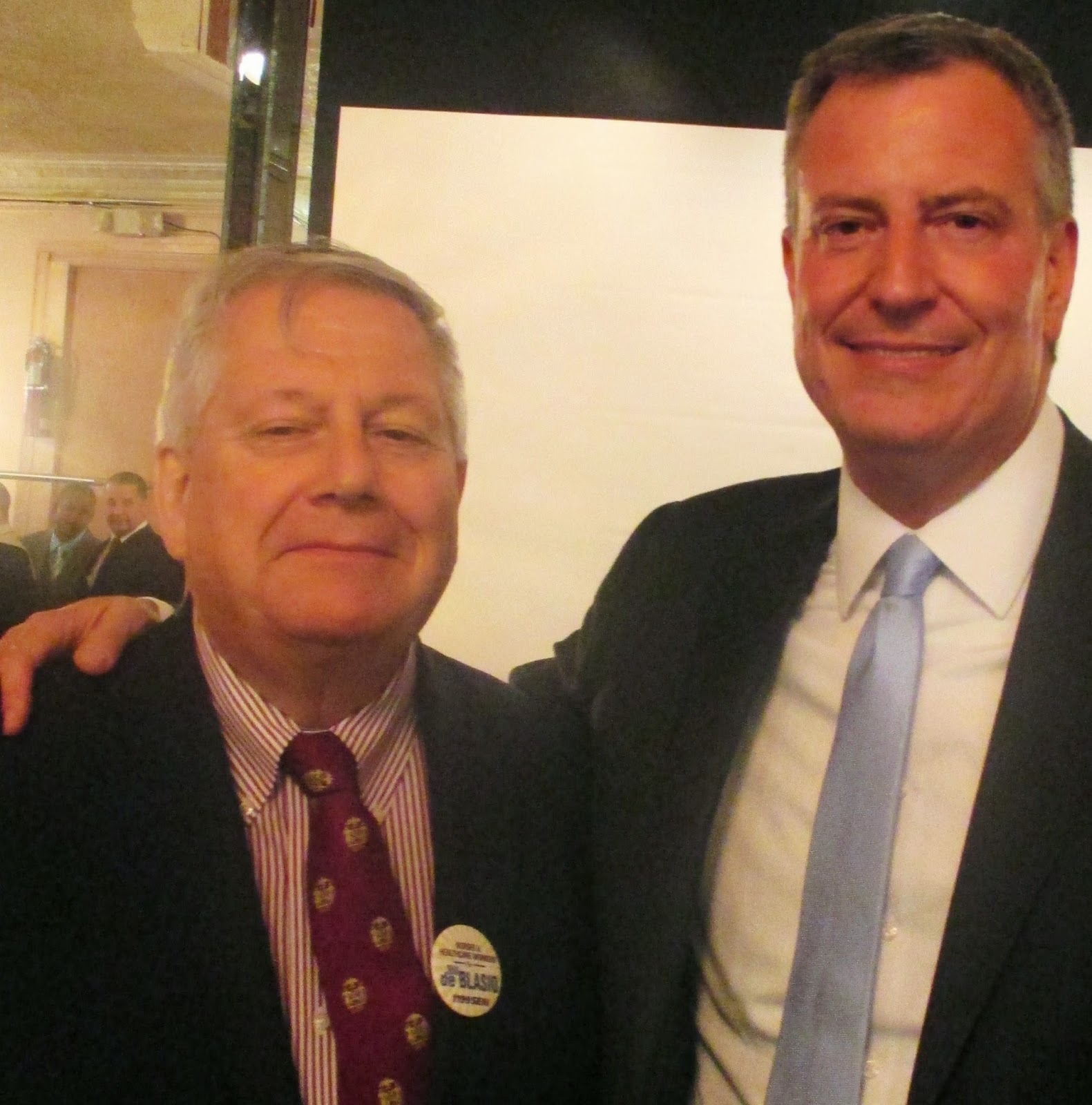
John Tepper Marlin (L) with new
Chair of "Cities of Opportunity"
Task Force.
The task force's Vice Chair will be Boston Mayor Martin J. Walsh. New York City and Boston are two cities with very high (among top 13 cities) Gini Coefficients, i.e., very high inequality of income.

Mayor Walsh:
This is a national problem, but we feel the impact of income inequality particularly in Boston's neighborhoods. Some areas have seen a development boom, significant drops in crime statistics, strong advances in our education system; and yet, we struggle with concentrations of real poverty and unemployment in other neighborhoods. This inequality makes it difficult to sustain the strong workforce, active consumer base, and vibrant civic life that every city needs for lasting growth. We need solutions to bridge this growing divide, and I applaud Mayors Johnson and de Blasio for their work. I'm proud to participate in this Task Force.
The task force will spend a year developing and sharing governing methodologies to empower cities to make equity a central governing principle.

The task force will develop an action plan for cities to take action in developing aggressive equity agendas and implement real change. This plan will include practical tools and best practices – both previously executed and newly developed by the task force – which cities can use to make the most equitable decisions that they can, with the powers that they have, to create more equitable cities.

The Cities of Opportunities Task Force will conduct its kickoff meeting in New York City on August 10-11, 2014 where mayors will develop the groundwork for the scope and direction of the task force's work.

Philadelphia Mayor Michael Nutter
I am pleased to join Mayors de Blasio and Johnson and a host of other mayors from across the country to tackle inequality in America's cities. Cities are incubators of change and innovation, and mayors are at the forefront of it all – we get things done. Providing equitable opportunity directly correlates to the success of our cities, our regions and our country...
Los Angeles Mayor Eric Garcetti
I look forward to partnering with Mayors Emmanuel and de Blasio on this transformative task force that will look to develop policies aimed at addressing the needs of our historically underserved and disenfranchised communities.
Dallas Mayor Mike Rawlings
We as a nation will only succeed when our cities succeed together. The gap between those of means and those that are not as fortunate will only be closed with new, long-term, non-partisan and pragmatic solutions.
Houston Mayor Annise Parker
Even in cities with robust economies like Houston, too many are locked outside looking in on opportunity. We are pleased that the Conference of Mayors is focused on this issue to ensure that all residents of every city can have equal opportunities to thrive. This is our call to action.

Thursday, June 19, 2014

NYC - Manhattan Tops 2.5 Million Jobs in 4Q13

Manhattan Jobs Passed 2.5 Million in 4Q13
Manhattan jobs grew 2.4 percent between the fourth quarter of 2012 and the fourth quarter of 2013, the Bureau of Labor Statistics announced this morning.

The base of 2.5 million jobs will be a marker for Mayor Bill de Blasio.

The Manhattan (aka New York County) growth rate was among the 100 best of the 335 largest counties in the United States.

The best-performing borough in New York City was Brooklyn, with 4.5 percent growth, followed by Staten Island with 4.4 percent and the Bronx with 2.9 percent. Queens trailed with 1.5 percent growth.

The average weekly wage in Manhattan fell 3.3 percent over the year, to $2,041, trailing San Mateo, Calif., which was $2,724 in 4Q13.  San Mateo's income fell even more than Manhattan's, as did that of Washington, DC and Tulsa, Okla.

Saturday, January 25, 2014

What Mayor de Blasio Could Do About Snowstorms

First, shovel a path from your door.
January 25, 2014—Mayor Bill de Blasio and John Doherty, who is in charge of the snow plows, have been unfairly castigated for their handling of the snowstorm.

I don’t claim inside information about what happened on the Upper East Side of NY, but consider this:
• When the temperature remains well below freezing, plain salt doesn’t work. New York has suffered an unusually long spell of sub-freezing weather, with temperatures commonly below the level where salt on the street would melt the ice.
• When traffic is at a standstill, snow plows can’t get through.
The good news is that it is still nearly four years until the next mayoral election. The bad news is that Superbowl week is upon us.

Implement a Snowstorm Traffic Flow Plan. The Mayor needs a plan from the NYPD, as well as the Department of Sanitation, for keeping traffic moving so that snow plows can do their work at all times. If it is freezing weather, traffic police are more, not less, necessary. Gridlock is disaster in a snowstorm, because it prevents remedies.

Involve the Public. If NYPD Commissioner Bill Bratton doesn’t want to tie up his force on traffic control, one idea is to reach out to the public and ask them to avoid certain parts of New York City - and announce plans to back up this request. Boston, which is no stranger to snow, has a map of all the fire hydrants and catch basins and urges the public to “adopt” them on a neighborhood basis and keep them clear in a storm.

Implement a New York City Storm Severity Index. The City has had an emergency rating that ranges from Phase 1 to Phase 3. The rarely used Phase 3 was invoked for the Blizzard of January 7-8, 1996. This blizzard, and the one that occurred in March 1993, are also rated by the National Weather Service as the only two storms that reached the top category 5 on the NESIS scale, which was developed in 2004 – and also on the more recent RSI scale. But the scales are not useful as guides for action in a storm – the NESIS and RSI scales only consider snowfall and population affected. In 1996, the NYC Comptroller’s Office recommended that the City develop its own Storm Severity Index. Here’s an example of how such an Index would work:
NYC Storm Severity Index = (S - 2)n*d
where S = expected number of inches of snow or water-equivalent ice in the first 24 hours
n = expected number of days of continuously freezing (below 32 F) weather
d = expected average number of degrees below freezing over the n days
If projected snowfall is eight inches, and five days of continuously freezing weather are expected, and temperatures are expected to average 17 degrees, the Index becomes 6*5*15=450. Now the Mayor has an idea of how badly the storm will slam the City.

From a Jobs POV, Keep Manhattan Open.  Brooklyn has been insulted often since it was consolidated with New York City in 1897-98. It doesn't have a baseball team any more, but it has a million more residents than Manhattan. It would rank fourth after NYC (4 boros), LA and Chicago, if it were still independent. But Manhattan accounts for at least 70 percent of the New York City economy, and commuters from the other boroughs need those jobs.

Close the Schools on the Severest Storm Days. School buses clog traffic and stop snow plows going through. It’s a problem for parents who work, but if school buses are blocking traffic, the parents won’t get to work anyway. Only half of teachers showed up at the schools on the first full day of the storm. Offices are more likely to close when schools are closed.

Consider Alternatives to Plain Salt, Which Doesn’t Work Well Below 15 F. U.S. airports watch snowstorms like hawks. They use de-icers and anti-icers that work down to -20 F. Glycol and urea are bad for the environment but the EPA has approved potassium acetate based (KAC) liquid E36. It takes just 10 minutes to go to work. There is also an additive to salt that lowers the temperature at which salt water melts.

Wednesday, January 1, 2014

DE BLASIO | NYC v. Snowstorm

Blizzard of February 2013.
My "Notify NYC" messages from the City of New York are still coming from "Michael Bloomberg". I guess that will be changed tomorrow when City workers are back at their computers.

The word from Notify NYC is that 6-8 inches of snow will fall starting 6 pm tomorrow, January 2, through 1 am Friday. The snow will be accompanied by "low temperatures" which means that the snow will accumulate and some will turn to ice.

Expect salt spreaders. Last year on February 7-9, the first big blizzard of the winter hit New York City and then-Mayor Bloomberg reported he had on hand 250,000 tons to spread on the streets of New York.

A snowstorm happening at the end of a week, on Friday or Saturday, is relatively benign for offices because only one day of work is lost. By Monday the commute is likely to be back to normal. Saturday is a less crucial day for most businesses, obviously excluding retailers and entertainments. During my stint as chief economist for three NYC Comptrollers in 1992-2006, we considered a Saturday economy as three-fourths of a Monday-Friday weekday economy and Sunday was one-fourth of a weekday, so it added up to a six-weekday week.

We estimated the relationship between certain storm variables and economic impact based on historical records. The crucial variables in a snowstorm for determining economic impact are the timing, the precipitation and the temperature. The impact is reduced if the snow is on a weekend, if the precipitation is low (two inches is where trouble can start) and if the temperature is above freezing, 32 F (32 degrees Fahrenheit).

Putting down salt allows the City of New York to reduce the impact of freezing temperature on the ability of commuters to get to work, or shoppers to get to stores. One of the worst scenarios is a slushy snowfall and then a deep freeze, causing icy roads. A snowstorm becomes a blizzard if the snow is driven by the wind.

In the laboratory, adding salt (sodium chloride) to water can bring down the freezing-melting point – depending on which way one is going - from 32 degrees Fahrenheit to 20 F (in the case of a 10 percent concentration of salt) or 2 F (for a 20 percent concentration). In practice, the lower number depends on how much salt one puts down on the roads (the more salt that is added, the higher the salinity percentage and the lower the freezing point of the water). In a lab, the freezing point can be brought down lower than in storm conditions. One source suggests that below 15 F, salt will have little effect.

So salt is only useful to add when the temperature is between 15 F and 32 F. Below 15 F, the salt won’t melt the ice. Above 32 F, ice won't form and the salinized water will just run off into the city sewers.

The preferred remedy for ice in places like Montreal, where I spent much of my childhood, is sand, which helps provide traction to pedestrians and motorists regardless of the temperature. My beloved grandmother Olga van Stockum nonetheless died of hip injuries after falling on Montreal ice in 1949.

Salt has some negative effects on the environment. It corrodes cars and other vehicles and the roads themselves. It is bad for shoes. The runoff is terrible for plants and marine life. Pets that walk outside get the salt on their paws and suffer from the abrasion.

But a big city needs to keep working. So we accept the negative impact of salt. The test is whether the mayor can keep the roads open on Friday morning.

Monday, October 28, 2013

Voting - Last-minute donors are buying "stock at 52-week high"

De Blasio and Early Supporters, Brooklyn. Photo by JT Marlin.
Crains Insider has an inform-ative story by Andrew Hawkins about real estate developers resignedly writing checks, for the max allowable, to mayoral candidate Bill de Blasio -- even though it is late, one week before the election and de Blasio is a shoo-in with a 45-percentage-point spread between him and Joe Lhota.

What impressed me most about the article was a campaign contributor's acknowledging that late giving to a candidate was not buying much, that it was like "buying a stock at its 52-week high", as opposed to important early volunteering and money that paid for de Blasio's advertising campaign. The EMILY in "Emily's List" stands for "Early Money Is Like Yeast."

Both labor unions and real estate contributors mostly put their early bets on Christine Quinn or Bill Thompson. Polls as of February showed Quinn ahead three to one, with de Blasio just one percentage point behind Thompson, and I noted that de Blasio had the advantage of incumbency. But then Anthony Weiner shot into first place, showing that enthusiasm for front-runners Quinn and Thompson was weak. So when Weiner's campaign faded, de Blasio's ad featuring Dante Blasio and his Afro provided the boost for de Blasio to take Weiner's place in the lead. After de Blasio won the Democratic primary outright, it became clear that Joe Lhota was battling against a huge spread in the polls. Lhota's attack ad on crime got nothing for him, as de Blasio added five percentage points to his lead. So the campaign cash is now flooding in to de Blasio's campaign.

The final debate between de Blasio and Lhota is on Wednesday evening (sandwiched between the anniversary of Sandy on Tuesday and Halloween on Thursday) from 7 to 8 pm on NBC-TV.

Friday, October 18, 2013

JOE LHOTA | Why Is NYC Deaf to Tough-on-Crime Tune?

Giuliani Endorses Lhota
Rudy Giuliani in 1993 and 1997 campaigned brilliantly on the issue of public safety, picking up on a theme that Richard Nixon hammered at, mashing up student protests with a rise in crime to argue that lawlessness was undermining New York City.

I was the Chief Economist for the New York City Comptroller's Office for the entire eight years of Giuliani's mayoralty. I remember leaning forward with anticipation when a reporter struggled to get Giuliani to move on from"law 'n order" to his economic-development strategy.

Rudy replied something like this: "As long as corporations are moving out of New York City because of crime, as long as property values are threatened by crime in the streets, my economic-development strategy is to reduce crime." So there.

This tough-on-crime electoral strategy worked from the 1960s through the 1990s. It worked for Nixon, for Ronald Reagan, for George H. W. Bush, and for hundreds of candidates in state and local elections. Even a supposedly liberal Republican like Nelson Rockefeller signed onto a draconian drug law.

The conservative mantra was:
  • Liberal police chiefs would not let the cops do their jobs.
  • Liberal judges would let criminals back onto the street.
  • Liberal parole boards would grant parole too easily.  
Joe Lhota saw how this worked for Giuliani. He is piping the same tune. But this time, no one is dancing, or joining in, or even listening. De Blasio continues to ride high in the polls despite Lhota's soft-on-crime ads.

Why isn't the music working any more? Lhota has a new attack ad suggesting that de Blasio would bring New York City back to the high-crime days of the 1960s and 1970s. De Blasio spokesman Dan Levitan said:
Lhota is right that we can’t go back. We shouldn’t return to the days when Republicans like Giuliani used fear tactics to divide New Yorkers against each other.
Well, here are pieces of a counter-mantra that might explain New York City's deafness to the issue:
  • Crime is down in New York City and everywhere in the United States. There are lots of explanations. Here's one I like: The civil rights movement of the 1960s has calmed down groups in the cities that were hostile to the police.Having a black president surely helps establish that the country offers opportunities for black citizens.
  • Police work has gotten better in NYC and all over the country. Cops are being managed more efficiently. Crimes are tracked minute by minute and are analyzed. Task forces are sent to hot spots. 
  • Tough on crime means more people in prison, which is costly.  Three percent of the American population is behind bars or on parole and probation – U.S. prisons hold 20 percent of all the people incarcerated in the world. Conservatives and libertarians are increasingly about the cost of this. Legislators are showing rare unanimity on this topic. In 1994, Newt Gingrich's Contract with America promised to put more people in prison. But now he is concerned about the huge costs of the large prison population, "in dollars and lost human potential".  
  • Some rehabilitation programs work. There are some successful programs to prepare ex-offenders for return to the workforce. The 2012 Republican platform called for prisons to "attempt to rehabilitate and institute proven prisoner reentry systems to reduce recidivism and future victimization."

Saturday, October 5, 2013

NYC | Money > 2:1 for de Blasio

Bill de Blasio with an early campaigner. Photo
 by JT Marlin.
Once it was clear that Bill de Blasio had come from way behind to be the favorite in the NYC mayoral primary, the conventional wisdom was that de Blasio for Mayor would be a hard sell to the NYC establishment and that business money would flow to his opponent, Joe Lhota.

That seemed to be the pattern for the first two weeks after the primary on September 10. Lhota raised more money than de Blasio during that period. It wasn't clear where the Thompson and Quinn votes would go. A report came out saying that one-quarter or more of the Quinn votes would go to Lhota.

But two things happened next:

(1) By September 24, polls were out from the NY Times/Siena College and Quinnipiac pollsters that both gave de Blasio a three-to-one advantage. If Quinn votes were going to Lhota, they were thin on the ground.

(2) During the next two weeks, de Blasio has been raising more than twice as much as Lhota, as the table below shows.

de Blasio    Lhota
Dem, GOP primaries, 9/10 $6,800K $3,800K
First 2 weeks after primary $153K $156K
Since polls showed 3-1 deB $635K $280K
Source: NYC Campaign Finance Board filings

The latest poll in October shows deBlasio's advantage has climbed to 3.5 to one. Lhota has become a long shot. De Blasio's campaign team and consultants, having pulled off an upset, are not likely to be caught napping in the short campaign before the general election.

The wild card will be the independent messages from donors to Citizens United-type campaign funds trying to influence the election without having to reveal their identity. While these messages are a potential menace to any candidate, they are less targeted because they are prohibited from engaging in "express advocacy" for a client against another candidate -- and they are therefore likely to be less effective than direct campaign messages.

Wednesday, October 2, 2013

NYC | $ per Vote–de Blasio Lowest, $24

Bill de Blasio is the most efficient campaign spender so far this year, based on figures provided by Sam Roberts on p. A20 of today's New York Times, supplemented by my own historical investigation.

De Blasio spent $24 per vote (the same amount that Peter Minuit paid the Lenape or Canarsee Indians in goods for all of Manhattan, Battery not included) to campaign for the Democratic nomination for Mayor from the office of Public Advocate.

Thompson, two-time former City Comptroller, spent $36 per vote. Quinn spent $60 per vote. The Democrats were all more efficient in their spending than the Republicans, except for Anthony Weiner.

Party
$ Million
$ per Vote
Votes
de Blasio
D
6.8
24
283,333
Thompson
D
6.6
36
183,333
Quinn
D
6.6
60
110,000
Liu
D
3.2
68
  47,059
Lhota
R
3.8
119
  31,933
Bloomberg, 2009
R
102.0
174
586,207
Weiner
D
6.6
190
  34,737
Lauder, 1989
R
13.0
352
  36,908
Catsimatidis
R
10.4
419
   24,821

John Catsimatidis now outranks Ronald Lauder on spending per vote. Catsimatidis may be the biggest NYC mayoral campaign spender in history based on results, $419 per vote.

Ronald Lauder's 1989 primary campaign, costing $352 per vote, was at the time described as the most expensive campaign per vote in U.S. history.

The high cost of Mayor Bloomberg's 2009 campaign is also clear from this table - $174 per vote, $102 million total - 15 times the total amount that Bill de Blasio spent becoming the Democratic nominee for Mayor this year.

But Linda McMahon spent $454 per vote in the 2010 Connecticut GOP primary for U.S. Senate. She won it but then lost the general election with spending of $95 per vote - the most spent in any state or local general election in 2010.

In New York State, the most costly primary was the $3.1 million battle between Chris Cox and Randy Altschuler in NY District 1. Altschuler won, spending $191 per vote (Cox spent $195 per vote), but went on to lose to incumbent Tim Bishop, spending another $2 million for a $23-per-vote cost in the general election.

The success of the de Blasio primary campaign, if followed up by similar success in the faceoff with Lhota next month, will boost the already-strong credentials of de Blasio's campaign consultants -
  • John de Cecato of AKPD Message and Media, founded by David Axelrod (de Cecato prepared the famous ad featuring Dante and his Afro). 
  • Anna Greenberg of Greenberg Quinlan Rosner Research, which did the polling for the de Blasio campaign. 
  • Joe Rospars of Blue State Digital, the people who were brought together for the Howard Dean campaign in 2004, got behind Barack Obama in 2008 and signed up 13 million supporters for him online, raising $500 million via Quick Donate.
Of course, the campaign consultants should not get all the credit for the success of the candidate. Some of that should go to Mr. de Blasio himself, his Wellesley College wife Chirlane McCray, and their two impressive children.

NYC | Lhota v de Blasio on the Economy

Joe Lhota (L) and Bill de Blasio (R).
In preparation for the Primary, City Limits magazine collected the views of mayoral candidates on economic development.

Given that the two main candidates are now facing off in the General Election in less than five weeks, these views are worth consulting again, this time more attentively.

Joe Lhota (Republican nominee for Mayor of New York City)

• "Diversify our economy and provide an environment conducive to job creation and the elevation of the standard of living in all five boroughs."

• "Create a climate that will encourage and sustain job growth, including reducing burdensome regulations and taxes that stifle private sector growth."

Bill de Blasio (Democratic nominee for Mayor of New York City)

• Reform or eliminate corporate tax breaks to save the city $250 million and devote it to CUNY

•  Form cohesive system from currently disjointed job training and placement programs, especially for less-skilled workers

• Expand CTE high schools

• Use better zoning enforcement and infrastructure investment to promote manufacturing

• Strengthen “neglected" sectors by building economic development hubs in each neighborhood and launching loan and investment funds to provide capital to local start-ups

• Reduce fines on small businesses and increase their chances of landing city contracts

• Expand sick day coverage, push for higher wages through city contracts and provide better work-rights enforcement

Wednesday, September 25, 2013

NYC | Candidate Bill de Blasio in His Neighborhood

John Tepper Marlin (L) and the 
Democratic Nominee for Mayor, 
Bill de Blasio, yesterday, in
Brooklyn.
Yesterday evening I ventured to 5th Avenue and 21st Street in Brooklyn and participated in what was a neighborhood party for Bill de Blasio, who has just won the Democratic Nomination for Mayor.

He described the area as "his neighborhood". It was an opportunity for de Blasio to thank 100 of his neighbors who helped push him to a strong (no-runoff) victory in the Democratic Primary. He urged them not to let up for the next six weeks to the general election.

He apologized first for being two hours late. He said he had a really good excuse–he was meeting with the Commander in Chief, Barack Obama. The President was introduced to Dante de Blasio, and was described as walking around Dante staring at his Afro, commenting on its size and contrasting it with his own lopsided Afro of many years ago.

De Blasio then turned to people who had been waiting for him and thanked each of them for their role in getting out the vote in his neighborhood.  He said to applause:
Here is someone who doesn't wait for other people to do things for him. When he sees a problem, he gets up and does something about it. That is leadership.
He mentioned that the first two polls matching himself against Lhota have given him a three-to-one majority, but he urged those present "not to rest on our laurels".

He picked up on income and wealth inequality with the "tale of two cities" theme and was eloquent on the struggles that working people have to "make ends meet" in an economy where real earnings have been declining. He portrayed Mayor Bloomberg as not being able to empathize with the working poor and the middle class families living at the margin because their life is so far removed from his own.

Bill de Blasio, Joe Lhota, and the Future of NYC


Bill de Blasio with neighborhood friends from Brooklyn, 
November 24, 2013. Photo by JTMarlin.
New York City has been blessed with a succession of strong mayors, and now we have two strong candidates for mayor - the "second-toughest job in America," as the late Mayor Koch used to say.

Mayor Bloomberg will be a hard act to follow. Coming in right after 9-11, he was a godsend and must be considered one of the great mayors of the city. Having a mogul as Mayor was a signal that the city is likely to be safe for other moguls, and gave them confidence to stay, to visit and move in. The steady aggregation of wealth in Manhattan keeps the NYC brand strong, even if Wall Street's rep is in the gutter. NYC is still the safest big city.

Adolfo Carrion (L) and Joe Lhota (R) at AARP Mayoral
Forum. Photo by JTMarlin.
But, lucky as we are to have had him lead the City, Mayor Bloomberg is leaving behind some big problems for de Blasio or Lhota to deal with. For starters:
  • The NYPD's "stop and frisk" hunts for illegal weapons or other contraband have been deemed unconstitutional by a Federal judge because they have had insufficient cause. Race is not enough of a reason to stop someone. The judge says a cop has to have a reason for stopping someone. That doesn't mean crime rates are going to have to soar again.
  • The labor unions are chomping - no, foaming - at the bit for long-delayed collectively bargained contracts. The new agreements could be budget-busters. Depends on how the revenues come in and the U.S. economy is still recovering from 2008-09.
  • The people Mayor Bloomberg chose to turn the school system around, and the methods they are using (such as constant testing) have been strongly criticized. Needs some re-thinking. 
  • His economic development programs have been heavily real-estate-oriented and involve unprecedented levels of new property-tax abatements that will pinch the budget as more services are required for new areas of development.
  • The late-in-the-game tech initiative, a Cornell campus on Roosevelt Island, may disappoint for the very reason that was its impetus - the City's interest in making use of property on Roosevelt Island.
  • The Mayor's ability to fund his own election campaigns has meant that he is not forced like other politicians to hunt for contributions - which has kept him above interest-group pressure, great, but also has kept him detached from the hoi polloi.    
Both Bill de Blasio and Joe Lhota are capable of running  New York City. The major differences between them are ones of personality and policy.
  • Personally, de Blasio is warm, enthusiastic, and neighborly, whereas Joe Lhota is tense, combative, and remote (when he is under stress, his eyelids come together as if he seems to want to shut out all the rest of the world).
  • On the policy front, de Blasio wants to level the playing field for NYC's middle class and poor people, which means more services for them and probably higher taxes on the very well off. Lhota's biggest concern is to avoid raising taxes at the top rates and to keep NYC safe for wealthy apartment buyers. They both will be tempted to put these differences under the light of class warfare. Lhota may think he will win most this way, but I wouldn't bet on it. Not this year.
The unions may have been divided in the primary, but most of them seem to have no trouble scrambling from the Quinn and Thompson camps to de Blasio. The first two polls show de Blasio ahead by a three-to-one margin. (These numbers are virtually the same as those for Quinn vs. Lhota way back in 2012 when de Blasio was an unknown.) The first tests for the next mayor will be whether he can work out labor agreements that don't break the budget.

The good news for the next mayor, whether de Blasio or Lhota, is that New Yorkers are weary of their mogul. Twelve straight years of Bloomberg after eight years of Giuliani means that City Hall has gradually been cut off from the public, for reasons of security and of philosophy, in ways that were inconceivable in the Koch and Dinkins days.

To bridge the gap between income and wealth inequality described as "the two cities", de Blasio has made a specific proposal to get a little more money from the rich (raising the top tax rate slightly, by a fraction of a percentage point, on those earning more than $500,000 a year) to provide expanded access to early-childhood education for everyone. Offering earlier schooling means the working parent or parents can go back to work earlier, while the children are socialized earlier and are likely collectively to perform better in higher grades. NYC businesses will reap the benefit of a more skilled workforce. Lhota has accepted half the idea, the universal pre-school part, rejecting the idea that higher taxes would be needed.

In the less than six weeks between now and the election, the two campaigns and the many "independent" voices will be painting the choices in various colors of class warfare. Lhota has already said that de Blasio is using a "Marxist Playbook". The realistic range of policy options in New York City does not take us into the terra incognita of "There be Dragons" Marxism. But the City does face real choices.

Tuesday, September 3, 2013

DE BLASIO | #1, Passes 43%, Quinn #3

Sept. 3, 2013–At 43 percent and rising, de Blasio may win the Democratic nomination outright, with no runoff.

Thompson and Quinn are competing for the runoff spot–if there is a runoff. Thompson is flat at 20 percent; he did not pick up any votes from the falling stars. The memory is still fresh of his close finish behind Bloomberg in Bloomberg's third election to the mayoralty. That is the closest Thompson has come to being Mayor.

Quinn fell below Thompson for the first time since the polling started in July.

Wiener and Liu are competing for the bottom spot, with 7 and 4 percent. Wiener's role in the election may have been to start off tall he surprises by coming in first at the beginning.

Bill de Blasio and his son (under
the Afro) Dante.
The Quinnipiac Poll cites a campaign ad featuring de Blasio's charming son Dante with a big Afro as helping pump up de Blasio's popularity. De Blasio not only leads Speaker Christine Quinn among women, he also leads former Comptroller Bill Thompson among black voters.

In a runoff, the projected vote as of the date of the poll would be
De Blasio over Quinn, 66-25 percent;
De Blasio over Thompson, 56-36 percent;
Thompson over Quinn, 59-33 percent.

With seven days left, only 24 percent of likely Democratic primary voters now say there is a good chance they will change their mind. The Thompson voters (61 percent, i.e., 12 percent of all those polled) and de Blasio voters (59 percent) are more loyal than Quinn supporters (56 percent).

De Blasio oriented his campaign for the Democratic nomination around the theme of income inequality–a good issue for the likely Democratic voters in New York, who tend to favor strongly progressive positions.

Friday, August 30, 2013

NYC MAYOR | Can Catsimatidis Get GOP Nod?

John Catsimatidis campaigning for the GOP nomination for Mayor
of New York City. Unexpected developments in the Democratic primary
are making people take a second look at GOP candidates. Photo: Cats site.
I was invited to breakfast meeting last week to hear from a candidate for the GOP nomination for mayor of NYC, John Catsimatidis.

There was no charge for the event. He doesn't need to raise funds. He ranks 132nd on the Forbes 400 and 458th on a global list of billionaires, with a net worth of $2 billion.

That may make him look like a piker by Bloomberg standards, but Cats doesn't need to take six-to-one matching funds from the City of New York. All NYC taxpayers should be grateful for that.

The thrust of Cats's pitch to the group of 75 people who came to hear him was that he was a self-made man who worked his way in a few years from being a grocery store clerk on 137th Street in Harlem, to running ten stores with a yearly volume of $25 million, generating income to him of $1 million. This has become the Gristedes grocery chain.

He has also made investments of approximately $1 billion in real estate, and owns interests in aviation and a Hellenic newspaper among other businesses. He has been a major player in getting the Greek Orthodox churches to work together. Anyone who knows about political fundraising in the United States respects the commitment of Greek-Americans to their candidates.

Cats describes himself as a GOP liberal–pro-business but interested in helping others, young and old. Sounds like Bloomberg. He is pro-safety and would reappoint Ray Kelly as Police Commissioner. He likes trade schools where graduates can go straight into jobs–electrical, carpentry, nursing, other health care services. He would bring in a Deputy Mayor who would recruit high-tech companies to come to New York City.

How would Cats differentiate himself from the other main GOP contender, Joe Lhota? He has the backing of former Mayor Giuliani and is more widely known as a government executive than John Catsimatidis.

Cats's response:
  • Joe Lhota has a bad temper.
  • He called Mayor Bloomberg "an idiot".
  • He called the Port Authority police "mall cops".
  • Lhota can't raise enough money to win. Cats would put his own money into the race. (Both Lhota and de Blasio will abide by spending limits to qualify for matching funds.)


L to R: Nick Sakellariadis, Harry Wilson and John Catsimatidis.

A mid-August Quinnipiac poll of likely GOP voters showed Lhota - former deputy to Mayor Giuliani and former MTA chairman - with 43 percent of likely primary voters, versus 37 percent for John Catsimatidis. The margin of error for this poll is 9.4 percentage points, which means that Lhota and Catsimatidis are in a statistical dead heat. Compared with the month before, Lhota lost 6 percentage points while John Catsimatidis increased his support by 2 percentage points. George McDonald is in third place with 9 percent.

My prediction is that Cats's potential as a candidate will be directly dependent on whether or not he does what he says he will do, i.e., hire people who are "better than me". He needs to rein in his impulses.

As an example, Cats promises to dig up all the concrete barriers (or, from a pedestrian point of view, islands). Citing the situation on 7th Avenue, he sees the battle as one between motorists and bicyclists. Sure, the Citibikes would have to be evicted from a lot of the areas where they are now protected by concrete islands. But pedestrians, especially seniors and children (for whom Cats has special concern), and parents of young children, and dog-walkers, have also become enamored of the greater ease of crossing the wide avenues with an island as a refuge on the way. The avenues are scary places to cross, especially for older people and people with disabilities. Those islands are lifesavers. Wholesale destruction of the islands would be a huge setback for NYC.

John Catsamitidis at this event and at others I have attended came across as hugely likeable. However, he needs someone to buy him a bigger-sized jacket and shirts with vertical stripes to disguise his Santa Claus figure. He should assemble a team of people with experience in different aspects of New York City government. He should announce who they are. Then he should listen hard to them before he announces with a wave of his hand what he is going to do. He had me eating out of his hand and then, like the 13th cuckoo of the cuckoo clock, he loses my confidence with a grand statement that appears to reflect his personal self-interest as CEO of a large grocery chain.

His chances of becoming mayor when Christine Quinn was the front-runner were remote. But NYC's business establishment is not going to be enthusiastic about a Bill de Blasio mayoralty and they will be looking for a Republican to support. When Cats first started campaigning, he did not convey seriousness about his candidacy - too ready with the wisecrack. He has taken a few steps towards being taken seriously, picking up a few allies. In the volatile atmosphere of the 2013 elections he just might be able to win the GOP nomination. In this crazy year, voters for the first time have to choose a successor to a 12-year mayor who looks better to many than the people who want to replace him. As the negatives of each of the candidates are ferreted out, Cats's prospects of winning in September and November have risen.

To find out more about candidates you hadn't paid any attention before, go to the Campaign Finance Board, which has an on-line Primary Election Voter Guide now available here or here.

DeBlasio's Leap to #1

De Blasio's hugely successful ad 
features his appealing son Dante.
De Blasio's spurt to a decided lead in the race for the Democratic nomination has huge implications. He is ahead in two independent polls - leading by 32% vs. 18% for Thompson in the NYTimes-Siena College poll (with Quinn #3) and by 36% in the Quinnipiac poll, which despite its name put Quinn in second place with 21%. The possibility that de Blasio could win 40% of the vote and avoid a runoff now presents itself.

De Blasio's appeal to the Democratic primary electorate has been twofold -

1. His "al Dante" (my term) campaign appeals to the minority vote (taking away from Thompson) by featuring his charming afro-topped son Dante giving him an unmistakably sincere endorsement as a father. De Blasio is now being attacked for using his son in this way. That may work - or it may be seen as a desperate move by his opponents and may backfire.

2. His fix-the-tax-mix approach appeals to the soul of the Democratic primary electorate by noting the high degree of income inequality in New York City and the fact that it has been increasing. Valid concerns, but hard to do much about at the local level. The biggest problem is that the Federal payroll tax is regressive, taxing the first dollar of payroll and cutting out at $113,700. NYC has hungry competitors to the north, west, east and south who have numerous Tax Foundation charts (both fair and unfair) to point to if NYC tries to fix income inequality on its own.

De Blasio leads the other candidates in every main category - among both men and women, both young and old, and both the optimists and pessimists about NYC. Of likely Democratic voters, the NYTimes-Siena College poll indicates that 45 percent view Quinn unfavorably (the de Blasio and Thompson figures are 17 and 16 percent), perhaps thanks to the well-financed anti-Quinn campaign.

I'm a Registered Democrat.  However, I try to be objective when I am asked by friends to comment on the implications of the new NYC polls for possible political outcomes. Quinn and Thompson have been keeping the tone of the campaign fairly somber. The new polls suggest this isn't working, and with ten days to go till the election, it's hard to change the strategy. Attacking de Blasio's son for supporting his father, or vice versa (#GoWiththeFro), doesn't sound to me a good way to turn the tide. If the battleground is who can do the most for young people and black youth in particular, it seems to me de Blasio wins.

What it means for November in my view  is that if the de Blasio lead in the polls continues to hold up, the GOP candidate (Catsimatidis and Lhota are the two most likely to be nominated) has a better chance now than any of them had any right to expect hitherto.

To find out more about candidates you hadn't paid any attention to  heretofore, go to the Campaign Finance Board, which has an on-line Primary Election Voter Guide now available here or here.