Showing posts with label Washington. Show all posts

Sunday, November 15, 2020

ECONOMIST JOB OPENING | In Washington, D.C.

November 15, 2020—Job opportunity for self-starting candidates with strong communications and critical thinking skills, with a premium on experience covering economic policy on the Hill. 

This position is one of a team of four economic policy analysts in an economic policy research and advocacy firm.  The team works with legislators, Hill staffers, academics, public interest groups, and progressive organizations on domestic economic policy legislative and political projects with a focus on fiscal and financial policy.

Target Start Date:   December 7, 2020

Job Description:  http://eepurl.com/hh3ccr

Sunday, April 5, 2020

COVID-19 STATUS | U.S. Summary in One Table

April 5, 2020—The largest number of Americans have been suffering from the COVID-19 virus in eight states and the District of Columbia. As of April 4, the states were, in order of death rates: New York, New Jersey, Louisiana, Michigan, Connecticut, Washington, Vermont, Massachusetts. Their death rates all exceed the national average death rate to date of 2.6 per 100,000 population. The list of the worst-hit states underscores the role of social interaction in spreading the disease. New York City was the first big U.S. city to suffer from the pandemic, and its hospitals have quickly been overwhelmed by its spread. Governor Andrew Cuomo provides a daily briefing on his handling of the public health crisis.

Confirmed Cases and Deaths

Two main measures are being used to gauge the progress of the disease: confirmed cases and deaths. Both measures have built-in problems.

Confirmed cases provide an earlier estimate of the extent of the spread of the disease than deaths. It can take a week or more for symptoms to appear, and then it may take another week or more for recovery. Patients can be hospitalized for weeks before recovering or succumbing to the disease.

However, confirmed cases depend on the availability of testing equipment and personnel, and in the early days of the pandemic in the United States tests were in short supply.  

For this reason, a low rate of cases to population may simply mean that fewer people are being tested in a state rather than that the disease is not spreading in a state. For the same reason, the case fatality rate is a less reliable number than deaths relative to population.

Deaths by cause would seem to be a simple enough number to keep track of. In a democracy it is hard to hide a dead body for long. Deaths are closely observed and recorded and whistleblowers historically have not been, as in dictatorships, punished for speaking outA cause of death must be listed. The course of the COVID-19 disease is easy enough to spot. There are in fact some problems with the data, but let's look first at the reported numbers.

New York State tops the ranked list of deaths per 100,000 population, with 
18.3 recorded as of today. Within New York State, the most densely populated counties are suffering the most.

New Jersey and Louisiana both have half the severity of New York State, about 9 per 100,000. Michigan and Connecticut are 5 per 100,000. These numbers are rising daily.

As a comparison, the average number of deaths in the United States from traffic fatalities in a year is 12.4 per 100,000. (Note that the traffic fatalities number is the sum of events happening over a year's time, whereas we have only three months of pandemic data.) 

The overall U.S. death rate to date from the coronavirus is 2.6 per 100,000 population.

Issues with Cause of Death Data

Two kinds of issues with the data on death rates are emerging: 
  • Underreporting of COVID-19 deaths. Some jurisdictions require that a test for the presence of the virus have been conducted in order to list it as a cause of death. So the absence of testing kits both lowers the number of cases and the number of deaths.
  • Lack of data about victims. Even when the deaths are properly recorded, the hospitals or doctors signing the death certificates may be so pressed for time or staff that they are not recording demographic data about the victims. Ibram X. Kendi, in “Why Don’t We Know Who the Coronavirus Victims Are?The Atlantic, April 1, 2020, suggests that African Americans are disproportionately the victims, but in many states we don't know. He asks why other states don't report this information—the problems including multiple illnesses and the lack of a test to prove that the victim had the virus; the coroner may be insisting on such proof (here is the Suffolk County, NY procedure for reporting a death). 
Who Are the Victims?

The evidence so far is that more blacks are victims than their proportion of the population, and men are much more likely to be victims than women.

Kendi cites data showing that African Americans are 14.6 percentof the Illinois population, but are 28 percent of confirmed cases of the coronavirus (Latinos, however, are a smaller percentage of deaths than in the population). An even more striking disparity has occurred in Milwaukee, where blacks account for 26 percent of the population but are half of the reported cases and 81 percent of deaths. In Michigan, blacks are 14 percent of the population but 41 percent of the victims.


Support for Masks, Shutdown

Support has been growing for closing meeting places like restaurants and wearing face masks in public. The support for these actions has bubbled up from the states rather than having been led from Washington. The White House at first did not give credence to the pandemic's arrival in the United States and then expressed concern about interfering with economic activity to slow the progress of the disease.

Among the top nine victims of the virus, blue states predominate. Some of the governors of these states have clashed with the President on getting support in the form of supplies, equipment or a national shutdown or mask-wearing policy. 

Democratic New York City and State, with more than 18 deaths per 100,000 population in the state, have supported closing public meeting places. Four other states and D.C. have Democratic leadership. These leaders of these states were early in supporting closing public places until the apex of the disease has passed and in calling for an immediate end to tariffs on medical supplies from China.

The other three states (Louisiana, Vermont and Massachusetts) are purple. Two have Republican governors and one has a Republican senator. Among the next nine states, ranked by death rates, three are red states and two are purple (Colorado and Pennsylvania).

In states with Republican or mixed party leadership, leaders have often appeared to wait for direction from the White House. This has sometimes led to disagreement between Republican Governors and Democratic Mayors over delays in locking down or advice on social distancing.

Note on Data: Confirmed cases and deaths by state are as of April 4, 2020 from the Johns Hopkins University Coronavirus website. A convenient tabular form of the JHU data was posted by The Guardian later on the same day. Total number of U.S. cases and deaths added by JT Marlin. Population data are from the U.S.Census Bureau, Population Division, Table 1. Annual Estimates of the Resident Population for the United States, Regions, States, and Puerto Rico: April 1, 2010 to July 1, 2019 (NST-EST2019-01), December 2019. The Census Bureau documents its estimation methods. Calculations of cases/population, deaths per 100,000 population and case fatality rates by JT Marlin.

Wednesday, March 18, 2020

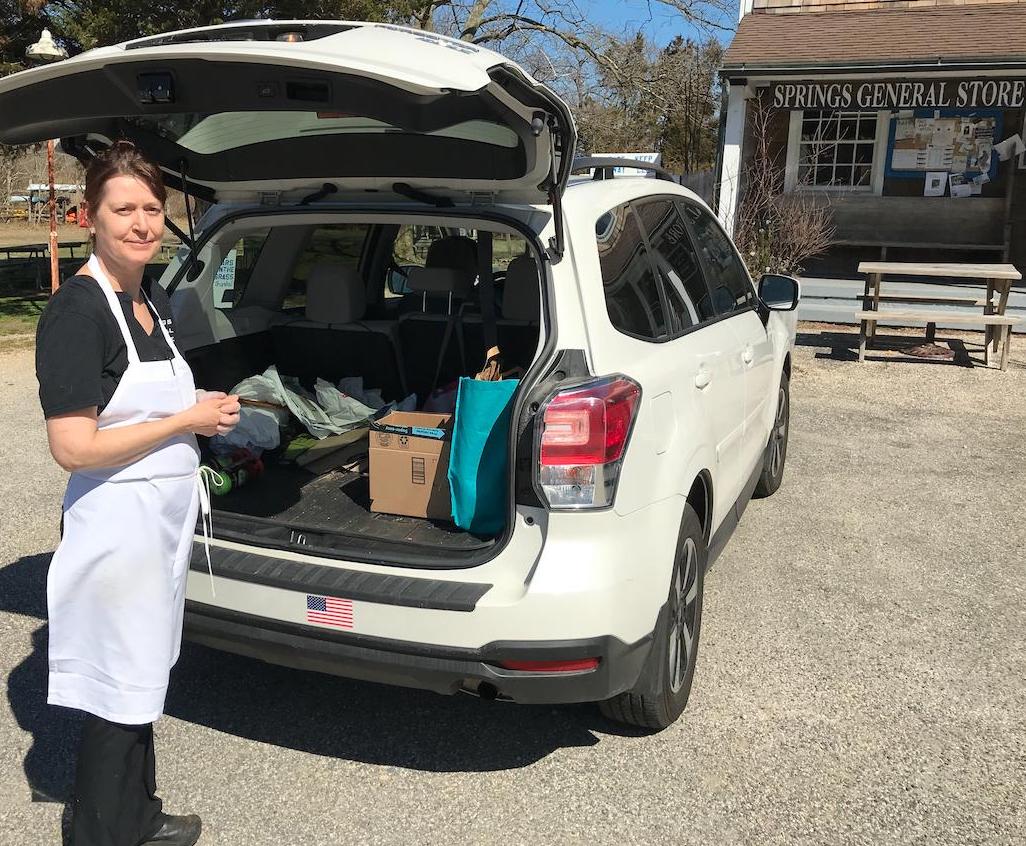
PANDEMIC | The Economic Impact of the Virus


Kristi Hood loads up groceries for a self-quarantining
family. This is a new service of  the Springs
General Store. Photo by John Tepper Marlin.


PS. Here are some followup stories in the East Hampton Star. As a public service, the newspaper has a free alert on the coronavirus as it affects the Town of East Hampton and Suffolk County generally:

Suffolk Hospitals Face "Herculean" Task as Virus Numbers Grow (March 24, 2020).

Friday, April 6, 2018

OPENING IN DC | Economic Policy Assistant

Vacancy: Economic Policy Assistant Position in Washington, DC

The position supports the work of an economic policy research and advocacy firm participating in the national economic policy making process, working with legislators, academics, public interest groups, and progressive organizations via engagement in economic policy legislative and political projects with a principal focus on fiscal and financial policy. 

The position involves working with a team of writers/researchers on policy products and projects relating to a range of domestic economic policy issues.  It includes various administrative responsibilities.  The work is a mix of legislative and political projects and offers hands-on experience collaborating with colleagues and partners and preparing deliverables for clients.  
Compensation:  Competitive, commensurate with experience and performance, $15-20/hr, plus expenses 
Schedule:   Flexible; 20-40 hrs/week
Tasks/Responsibilities:
  • Research and writing on a range of domestic economic policy issues
  • Administrative tasks such as planning meetings, taking detailed notes, tracking timelines for projects and specific to-do lists
  • Assist in distribution of a regular newsletter
  • Occasional event planning and tech support (iPhone, printer, wireless networks) 
Requirements/Qualifications:
  • Proven experience as a policy researcher 
  • Knowledge of office management systems and procedures and office equipment
  • Proficiency in MS Office/Google Drive, and MailChimp programs
  • Excellent time management skills, the ability to prioritize work, pay attention to detail, and troubleshoot problems
  • Excellent written and verbal communication and organizational skills
  • Bachelor’s degree
Location:   Dupont Circle, Washington, D.C.

Application Due Date: Friday, April 27, 2018
Target Start Date: Mid- to late-May, 2018

--------------------------------------
To apply, send a copy of your resume and a cover letter to: 


Dana Chasin
202-697-3992 

Wednesday, January 10, 2018

ADMINISTRATIVE ASSISTANT | Washington, DC

U.S. Capitol
The following is a good opportunity for a recent college graduate seeking to gain experience in office management and economic policy research in Washington, D.C. 

The year 2018 will be interesting.

The position supports the work of an economic policy research and advocacy firm participating in the national economic policy making process.

The Administrative Assistant  will be interfacing with legislators, academics, public interest groups, and progressive organizations via engagement in economic policy legislative and political projects with a focus on fiscal and financial policy. 

OPENING FOR ADMINISTRATIVE ASSISTANT
Economic Policy Advocacy Firm

The position supports the work of an economic policy research and advocacy firm participating in the national economic policy making process, working with legislators, academics, public interest groups, and progressive organizations via engagement in economic policy legislative and political projects with a focus on fiscal and financial policy. 

Target Start Date: February 5, 2018
Location: Dupont Circle, Washington, D.C.
Compensation: Competitive, commensurate with experience and performance, roughly $15-20/hr, plus expenses 

Schedule: Flexible; 20-40 hrs/week

Responsibilities:
Organize and schedule appointments
Coordinate and facilitate conference calls
Plan meetings and take detailed notes
Assist in distribution of a regular newsletter 
Assist in tracking timelines for projects and tracking specific to-do lists
Book travel arrangements
Occasional event planning and tech support (iPhone, printer, wireless networks)

Requirements/Qualifications:
Proven experience as an administrative assistant, or office admin assistant
Knowledge of office management systems and procedures and office equipment
Proficiency in MS Office/Google Drive, and MailChimp programs
Excellent time management skills, the ability to prioritize work, pay attention to detail, and troubleshoot problems
Excellent written and verbal communication and organizational skills
General familiarity with fiscal, financial, and economic policy issues
Bachelor’s degree
--------------------------------------
To apply, send a copy of your resume and a cover letter to:

Thursday, November 10, 2016

TRUMP | Mr. T Goes to Washington (Updated Feb. 12, 2017)

Trump and Obama Discuss Transition Today.
Nov. 10, 2016 –Doubtless  with today's visit of President-elect Trump to Washington, many people will be revisiting Frank Capra's 1939 movie, Mr. Smith Goes to Washington.

(Update 2-12-2017: This might be the high concept of the Trump campaign.)

Young Jefferson Smith played by Jimmy Stewart is elected President with the mission of cleaning up corruption in Washington, what Trump has called "draining the swamp".

While Mr. Trump's theme harmonizes with Mr. Smith's, the reality is starting off a little differently from the movie.

At his meeting today with President Barack Obama, the President-elect called him a "very good man" during their meeting in the Oval Office to discuss the transition. Obama told Trump: 
Mr. Smith (1939) Struck 
Chords Similar to Mr. Trump's.
If you succeed, the country succeeds.
Trump thanked Obama for the extending the meeting, which was scheduled for 10-15 minutes but ran an hour and a half:
Mr. President, it was a great honor being with you, and I look forward to being with you many, many more times.
Obama said they talked about both domestic and foreign policy  and that he was encouraged by Trump's interest in working together during the transition:
My No. 1 priority in the next two months is to try to facilitate a transition that ensures our President-elect is successful.
The President-elect said he would seek counsel from Obama.

Related LinksWhy is the President-elect being so nice to the Democrats who were his opponents? . Why did he run as a Republican? . The Wisdom of Mark Cuban

Saturday, October 8, 2016

INNOVATION | Top Five States for Entrepreneurs

The Channel Company's CRN arm has ranked the U.S. states for their suitability as a the home of young entrepreneurs seeking to establish a solution-providing startup.

The states were ranked on a variety of criteria including the Kauffman Foundation's ranking of the rate of entrepreneurship formation.

The ranking is described as a comparison of U.S. states according to their contribution to innovation and growth, with a focus on assisting innovators in providing solutions to current problems.

The top five were:
  • California
  • Florida
  • Washington
  • New York
  • Tennessee

Thursday, June 19, 2014

NYC - Manhattan Tops 2.5 Million Jobs in 4Q13

Manhattan Jobs Passed 2.5 Million in 4Q13
Manhattan jobs grew 2.4 percent between the fourth quarter of 2012 and the fourth quarter of 2013, the Bureau of Labor Statistics announced this morning.

The base of 2.5 million jobs will be a marker for Mayor Bill de Blasio.

The Manhattan (aka New York County) growth rate was among the 100 best of the 335 largest counties in the United States.

The best-performing borough in New York City was Brooklyn, with 4.5 percent growth, followed by Staten Island with 4.4 percent and the Bronx with 2.9 percent. Queens trailed with 1.5 percent growth.

The average weekly wage in Manhattan fell 3.3 percent over the year, to $2,041, trailing San Mateo, Calif., which was $2,724 in 4Q13.  San Mateo's income fell even more than Manhattan's, as did that of Washington, DC and Tulsa, Okla.

Friday, December 7, 2007

TECH | NYS Underperforms

How should one monitor the progress of a state's competitiveness in the stakes for future tech jobs?

One way is to look at the data for federal grants for Small Business Innovation Research (SBIR), which is a way to bring research dollars to a state at the same time as one is building a stable of ponies for future venture-capital bets.

New York City’s Silicon Alley (in conjunction with its more hardware-oriented cousin techspots up the Hudson Valley from Poughkeepsie to Albany and elsewhere in the state) likes to think of itself as #3 after Silicon Valley and Route 128, and a recent ITAC report seeks to make something out of the fact that in the total number of tech jobs, the NYC metro area ranks ahead even of Silicon Valley and Greater Boston. The sheer size of the NYC metro area is what seems to put NYC ahead on the ITAC count. It is certainly true that having a lot of tech jobs in the NYC area is important in creating critical mass for future innovation. But density of tech jobs is surely more important for creating an environment conducive to serendipity, and the other important ingredient is effective leadership from the governor's office.

These factors go a long way to explain why NY State performs so poorly on the number of SBIR awards in FY 2006. New York was in eighth place in FY 2005 as well, so the rank is not an accident of the year 2006. As expected by the conventional wisdom, California ranks #1 with 725 grants and Massachusetts is #2 with 466 grants. But between these two front-runners and NY State (with only 163 grants) are five interlopers: Virginia (221), Texas (176), Colorado (173), Maryland (169) and Ohio (167). The strength of Virginia and Maryland on this list could reflect the proximity of their Beltway components both to agency grant-makers and to the Army and Navy research labs. Texas may also have benefited from its having a former governor in the White House for nearly six years.

But Colorado and Ohio ranking higher than the Empire State? I was mystified and am grateful to my friend David Hochman for helping me understand why they are doing better than NY State. Colorado doesn't have aggressive tech programs at the state level but it has several large Commerce Department (NIST and NOAA) and DOE labs, and in addition, for a range of historic reasons a really vibrant (high-density) tech community around Boulder and Longmont. Ohio has not only the Air Force labs and a significant NASA Center but also an unusual state program called the "Third Frontier" Project, a.k.a. the Ohio Research Commercialization Grant Program (felicitously acronymed ORCGP). This program, which has no direct parallel in NY State, provides aggressive support for institutions attempting to obtain federal grants.

Between 2005 and 2006, Michigan (with Detroit in a near-depression status because of the decline of the U.S. auto industry) dropped off the top ten list and was replaced by Washington (home of Microsoft, 91 grants). In ninth place is Pennsylvania with 133 grants.

Since Governor Eliot Spitzer was not in charge in FY2006, these numbers do not reflect on his current administration. We can hope that New York moves up in the rankings in future.