Showing posts with label Suffolk County. Show all posts

Saturday, June 20, 2020

PERRY GERSHON—For the Suffolk Economy (NY-1)

The following statement is an endorsement by two economists of Perry Gershon as the best candidate to represent Suffolk County (NY-1) residents in the U.S. Congress. Dr. Frank P. Braconi served as Executive Director of the Citizens Housing and Planning Council of New York before serving as the chief economist for three New York City Comptrollers in 2006-2015. Dr. John Tepper Marlin was the chief economist for three New York City Comptrollers in 1992-2006. Before that he worked as an economist for three federal agencies and was subsequently senior economist for nearly four years at the Joint Economic Committee of the Congress.

We are have lived for decades in Suffolk County and got to know Perry Gershon during the past few years as he has been running for the Democratic nomination to represent NY-1 in the Congress.

Why do we economists support Perry to win back NY-1? Because Perry understands why Trump’s promises to make the economy work better have failed. Perry understands that Trump rammed through a tax cut that helped big corporations and their shareholders more than small businesses, and the cuts were paid for in part by capping the deductibility of state and local taxes. This hurt middle-class taxpayers in suburban areas like Suffolk County, which was suffering economically even before the pandemic hit.

Perry understands the disaster of Trump’s closing down the White House pandemic preparedness unit, a mistake for which Suffolk County paid a steep price. An unready Trump first postponed actions recommended by his advisers and then came up with some wildly improbable ideas about possible treatments for the disease. Perry understands that a major reason for unemployment levels not seen since the Great Depression is terrible leadership from the White House.

The foundations of economic prosperity are health, education and personal security. Trump has undermined all three, and Lee Zeldin has helped do this for Suffolk County: 
  • On the health front, he used economic arguments for many of his anti-environmental votes.  His voting record in his last full term was rated by environmental organizations as one of the three worst of Members of Congress from New York State. Zeldin and Trump have sought to undermine Obamacare. The number of uninsured Americans is rising during the Trump administration. Covid-19 has shown just how important it is that healthcare coverage extends to everyone. 
  • On education,Trump’s cap on the state and local tax deduction hurts the ability of local governments and school boards all across Suffolk County to seek improvements in educational funding. Twice in 2019 Zeldin has voted against repeal of this law.
  • On personal safety, Zeldin has also supported the right of those who would deny the right of women to make decisions about their own bodies. Perry is also staunchly in favor of gun safety, while Zeldin is not. Perry has acted on his outrage at the murder of George Floyd by joining several local protests. Zeldin is missing from them.
In return for his slavish following of the President’s bidding, what has Zeldin gotten for Suffolk County? In December 2019, Suffolk County lost jobs from a year earlier. Its job growth was in the lowest one-eighth of large U.S. counties.

Other counties that lost jobs, like Westchester, at least saw higher incomes than most other counties. Suffolk's income growth was just as bad as its poor job growth. 

As we come out of our lockdowns, we will need to rebuild our economy while maintaining our public health standards. Perry knows how that should be done. He has built four small businesses, one of which was a sports bar at age 23. The other three businesses were in commercial real estate lending. Perry combines the independence he gets from having succeeded in the private sector with a cooperative approach that means he can work with the many disparate groups that make up NY-1.

We support Perry because we think Suffolk County has tremendous economic potential that is not being tapped. The nation is hurting, but Suffolk County taxpayers are hurting more than most. Perry can make the best case to expose the failures of our Tea Party Congressman and go on to make a difference in Washington, D.C. by representing small businesses and middle-class taxpayers in Suffolk County.

Friday, June 5, 2020

UNEMPLOYMENT | Local Rates Higher

June 5, 2020—New Yorkers have a feel for these things and they are surprised at a reported U.S. unemployment rate of 13.3 percent. Economic analysts surveyed by Dow Jones expected nonfarm payrolls to decrease by 8.3 million while their average estimate of the May unemployment rate was 20.5 percent.

The BLS actually reported this morning a 2.5 million increase in payrolls, the largest increase on record.

One explanation is that in New York City the unemployment rate might be much higher. Using a simple forecasting model based on April and prior months, the New York City unemployment rate for May would be above 20 percent, i.e., 21.6 percent.

Here are the May numbers for New York City and neighboring counties, as projected from prior months. All of these actual BLS numbers for May will not appear until close to the date when the national unemployment rate for June is released.

Unemployment Rates - U.S. and Local, May 2020

U.S. Rate, %
Projected Local Rate, %
New York City
13.7
21.6
Nassau Co.
13.7
15.1
Suffolk Co.
13.7
15.7
Westchester Co.
13.7
14.1
Source: May unemployment rate from BLS. Projected
May local rates by CityEconomist.

For the future, New York City may outperform the rest of the country because it has been through the coronavirus mill earlier. It has just had its first day since March 12 without a confirmed coronavirus death.

(Hat tip to Dr. Jurgen Brauer, Geoffrey Hilton and Dr. Farid Heydarpour for assistance with the interpretation of the data.)

Sunday, May 24, 2020

PERRY GERSHON | Primary, June 23

Perry Gershon, Candidate for
the Democratic nomination,
NY-1, June 23 Primary.
I got to know Perry Gershon during his campaign for the Democratic nomination to run in CD-1 against Lee Zeldin two years ago. He won the nomination. At the time, a former Republican, Michael Koegler, endorsed Perry against Zeldin and Perry's four former opponents in the Democratic primary did as well.

In the general election, Perry came within four percentage points of winning. In other words, if two percent of the voters switched from Zeldin to him, Perry would have won.


Perry is running again for the Democratic nomination. Does he have a better chance this year to defeat Zeldin? I think so. He has better name recognition, having been actively campaigning for three years. 

This year, the GOP coattails are not as long as they were two years ago. A major campaign issue in 2018 was the state of the U.S. economy. The Republican candidate had promised that his tax cut would make the U.S. economy soar. Clearly, it didn't happen. 

The 2017 Tax Act gave a huge break to corporations, reducing the tax rate on profits from 35 percent to 21 percent, more than they had asked for. They mostly used the money to buy back their stock. The Tax Act hurt suburban areas like Suffolk County because the cap on the SALT deduction hit middle-class homeowners in New York State, because their taxes are high and they did not benefit from the higher standard deduction or the lowered rates in the top personal income brackets.
Perry Gershon's field campaign staff and volunteers before the coronavirus hit.
That's Perry with the Shiba Inu dog.

When the pandemic hit, the White House was unprepared, postponed action and then came up with unscientific responses. The national economy is now a disaster and a major reason is the poor response of the White House. 

Meanwhile, Zeldin has gained little for Suffolk County in return for his unquestioning  loyalty to the President.  Even before the pandemic hit, in December 2019, Suffolk County lost jobs from a year earlier. Its job growth was in the lowest one-eighth of large U.S. counties.

Even compared with other counties that lost jobs, like Westchester, there was a crucial difference. Incomes in Westchester rose faster than most other counties, whereas Suffolk's income growth was just as bad as its poor job growth. 

So Zeldin's partisan anti-environmental stance did nothing for Suffolk County. His voting record in his last full term was one of the three worst of Members of Congress from New York State; the other two members are no longer serving.

This year we have three good Democratic candidates in the primary on June 23. The question many are asking is which one is most likely to defeat Lee Zeldin. In 2018, as the Democratic nominee, Perry gave Zeldin the closest race of his political career and established himself throughout NY-1 in the process. In the two years since that election, Perry has continued to spend time in the community, building alliances and relationships, particularly in the western part of the district. 

The coronavirus makes it impossible now to replicate the intensive mixing-in that Perry did last summer. He spent the summer of 2019 walking outdoor street fairs and fire department BBQs, meeting constituents, listening to their concerns, and talking about how to improve healthcare, protect the environment and make Long Island more affordable. Beginning in September, Perry started hosting monthly town hall meetings throughout the district, something Congressman Zeldin has refused to do. Perry will have held 11 town halls by the June 23 primary.

Perry is focused on reversing the attacks on healthcare by the Trump Administration. He is appalled that the number of uninsured Americans is rising during the administration of President Trump. COVID-19 has shown just how important it is for everyone that healthcare coverage extends to everyone else. Perry is also staunchly in favor of gun safety and the rights of women in the workplace and over their bodies.

As we come out of our lockdown, we will need to rebuild our economy to be more resistant to infections. Perry knows how that should be done. He has built four small businesses. He started his own sports bar at age 23. Then he went on to a 25-year career in commercial real estate lending, starting up three different real estate lending operations.

Suffolk County is struggling to come out of the current severe recession.  Perry’s experience in starting businesses and creating new jobs means he can play a critical role in the post-COVID-19 recovery.

Perry combines the independence he gets from having succeeded in the private sector with a cooperative approach that means he can work with the many disparate groups that make up NY-1.

Because all three of the Democratic candidates have fine qualities, I have been reluctant to make a pitch for any one of them. One of Perry's opponents is a scientist and we need more of them in the Congress. The other is an elected local official from the East End, and therefore knows this terrain. They have all pledged, as they did in 2018, to support with enthusiasm whichever of the three wins the primary. 


I support Perry because I think he has the greatest ability to defeat Lee Zeldin and make a difference in Washington, D.C.

Thursday, April 23, 2020

PANDEMIC | Global to Local Data

Global

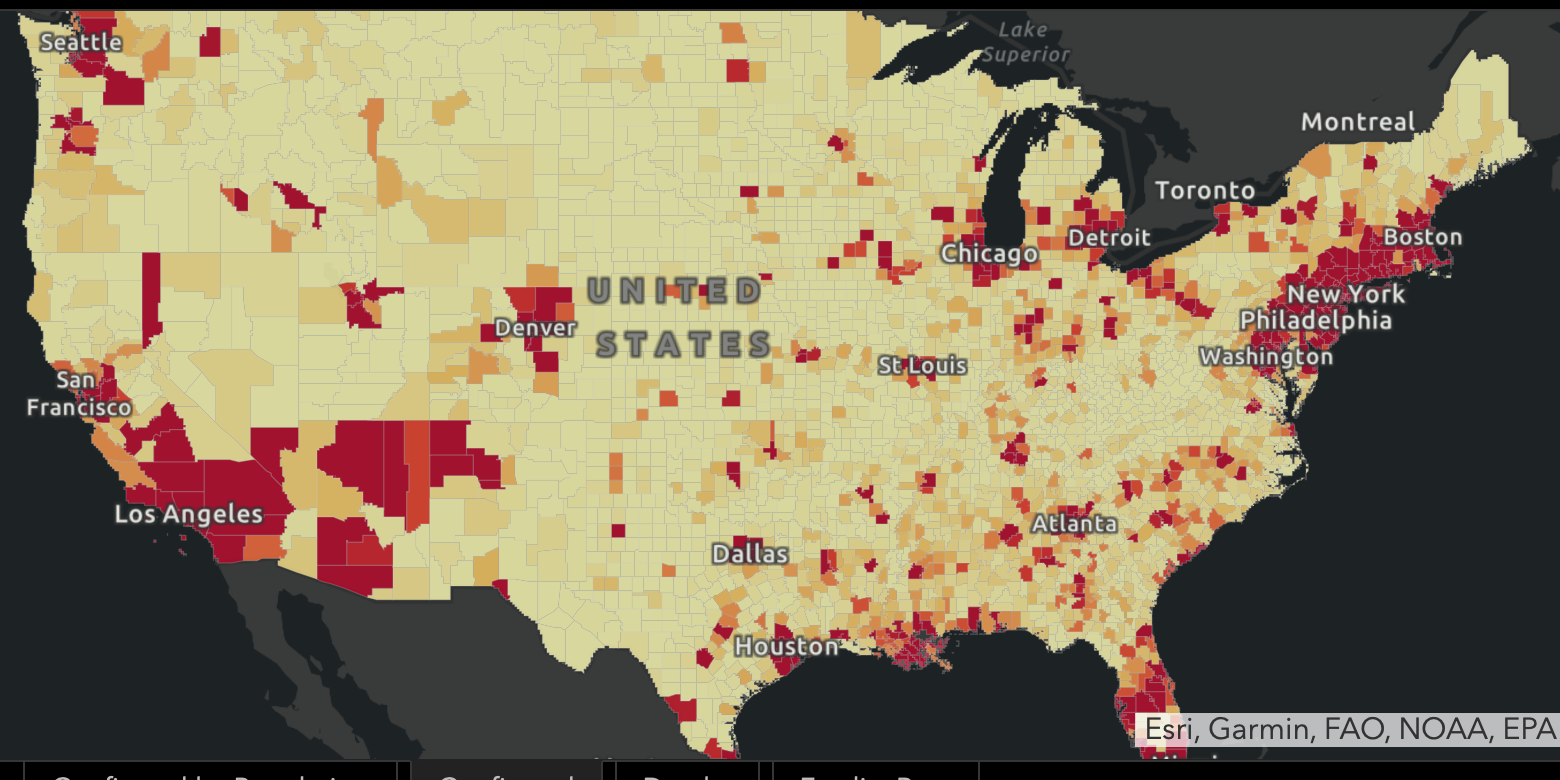
The map and table below show that the United States is by far the most affected based on confirmed/reported cases of Covid-19.  The first is from the New York Times, April 24.
The second is from Johns Hopkins University's website.
Worldwide, Confirmed and Reported Cases, Johns Hopkins University Map, April 24, 2020.
Total cases confirmed worldwide as of Friday morning, April 24: 2.7 million. The most confirmed/reported cases now are in these five countries:
1. 869,170 United States
2. 213,024 Spain
3. 189,973 Italy
4. 159,460 France
5. 153,129 Germany
6. 139,246 United Kingdom

United States

The map and table below show that New York State and New Jersey have been taking the brunt of the impact of the virus, with nearly 21,000 deaths in New York.


USA Confirmed Cases, Johns Hopkins University Map, April 24, 2020.
Top ten states by confirmed cases (from the The Guardian, April 24, 2020)

New York State


This map and table shows that within New York State, the incidence of cases by county is highest in New York City and surrounding counties, where the density is highest. Nassau and Suffolk both have about 30,000 reported cases of the coronavirus, both about 2,000 cases per 100,000 population (2 percent), but Nassau has many more deaths relative to the number of cases.


New York City and Top Five Counties by Reported Cases and Deaths (New York Times)


Suffolk County (NYS Department of Health), Towns


The map and table below show that the high concentration of Covid-19 cases are on the western end of the county, where the density is higher. The Town of Islip has the highest count of cases.


Source: Bonac TRS, April 23, 2020

East Hampton Town

This table shows that East Hampton Town has been spared so far any deaths but the Village has a high number of cases relative to the residential population. This reflects the fact that the Village is a commercial center with continuig interaction.

East Hampton Town, Census Places (Hamlets and Villages)
Compared with Global, U.S., NYS, NYC, Nassau County and Suffolk County
Source: Data from previously cited sources. Computations by CityEconomist.

Wednesday, March 18, 2020

PANDEMIC | The Economic Impact of the Virus


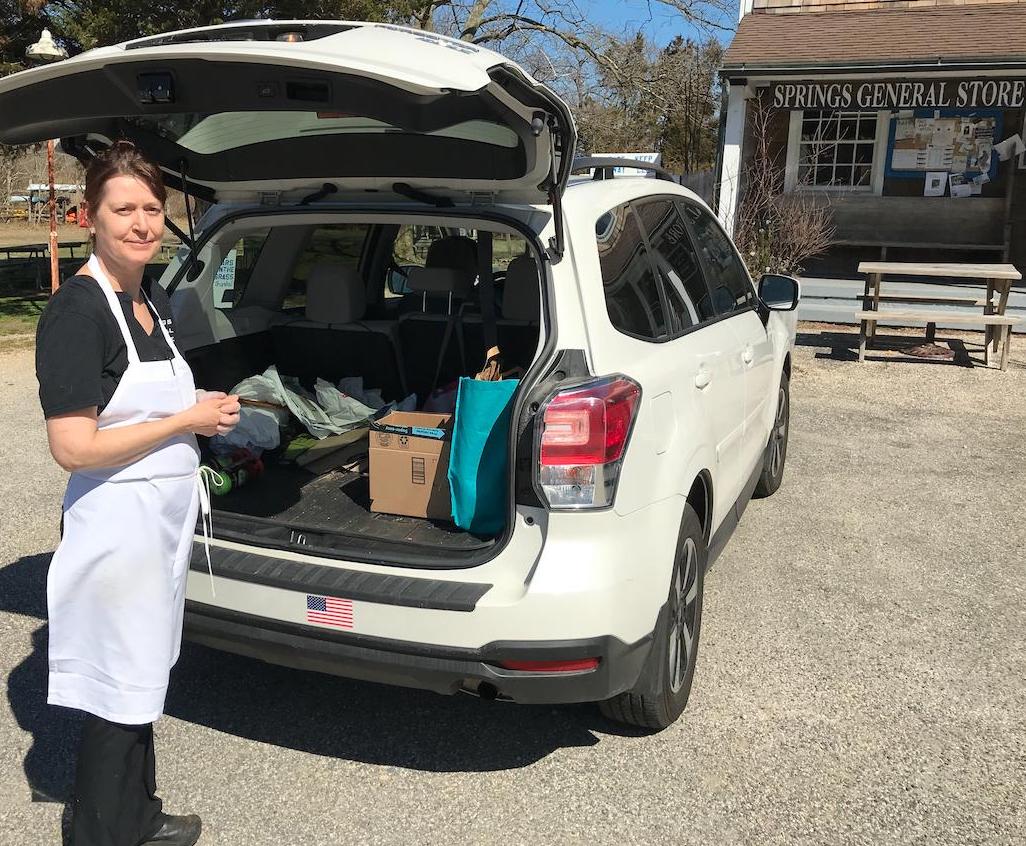
Kristi Hood loads up groceries for a self-quarantining
family. This is a new service of  the Springs
General Store. Photo by John Tepper Marlin.


PS. Here are some followup stories in the East Hampton Star. As a public service, the newspaper has a free alert on the coronavirus as it affects the Town of East Hampton and Suffolk County generally:

Suffolk Hospitals Face "Herculean" Task as Virus Numbers Grow (March 24, 2020).

Friday, February 1, 2019

DID YOUR 2018 TAX FALL? (Beware the Ides of April)

On Long Island, NY for middle-income folk, tax refunds are not matching expectations. The cap on state and local taxes (SALT), including both property taxes and income taxes (or sales taxes in states with no state or local income tax) is taking away the benefits of tax cuts on incomes for many taxpayers. The most-affected states by the cap on SALT deductibility are New York, Connecticut, New Jersey and California, in that order. Beware the Ides of April, i.e., April 15.

Comparing federal taxes paid on 2018 income with taxes paid on 2017 income, here are some early numbers. Please send any figures you have, or find online, to john@cityeconomist.com and I will add them. If you can't remember your prior-year tax bills, you can get them here from the IRS: https://bit.ly/2WMgpuG.


Wednesday, May 23, 2018

SUFFOLK, NY | Job Growth – A Zero for Zeldin

Source: Bureau of Labor Statistics, data released May 23,
2018. www.bls.gov.
The Congressman from CD 1 in Suffolk County, New York, was first elected in 2014, and reelected in 2016. 

He has made creating jobs a central part of his program, one of the main issues highlighted on his own web site.

He said in 2016 he would go to Washington, work with the Tea Party to reduce environmental and other regulations, and "help grow our economy and create more good paying jobs".

So how's it going with that, Mr. Zeldin?

Numbers just came out today for the fourth quarter of 2017. They show that Suffolk County ranked 309th out of the 347 largest counties for growth during 2017, comparing fourth quarter 2017 with the fourth quarter of the previous year.

The growth rate was Point One Percent. That's one-tenth of one percent. That is statistically equivalent to Zero.

Compare that with Brooklyn (King's County), which grew 41 times as fast, 4.1 percent, and ranked 14th out of the 347 largest counties.

Zeldin has had two terms to prove he can make a difference in job growth. I would say he flunks his own test. He has not helped grow the economy. He has not "created more good-paying jobs". Time's up!

Wednesday, September 6, 2017

SUFFOLK, NY | Disappointing 1Q17

Suffolk County, N.Y.
The first-quarter county data came out from the Bureau of Labor Statistics this morning (http://bit.ly/2wFDNPd), showing how Suffolk County is doing on jobs and wages.

Average employment in the county rose 0.6 percent, up slightly from the first quarter of the previous year, but not as much as most other counties. Suffolk ranked #259 out of 347 large U.S. counties, on the edge of the bottom quartile.

Manhattan jobs, by comparison, rose 1.3 percent, closer to the median county average. Brooklyn jobs rose 3.2 percent, which ranks #34, in the top tenth of the large counties.

Suffolk average wages rose 5.1 percent, ranking #260 out of the 347 counties, which puts it in the bottom quartile. In Manhattan, by contrast, wages rose 6.3 percent, again putting the county in the middle of the ranking.

Thursday, June 8, 2017

JOBS | Suffolk County, NY

How is Trump doing?
In 2010, Randy Altschuler attacked the incumbent congressman from Suffolk County, NY, Rep. Tim Bishop, for not doing enough for the Long Island economy.

He said that 30,000 jobs had left Long Island during Bishop's incumbency. I pointed out in an article on Huffington Post that the number was a lie. The correct figure was a gain of 36,000 jobs. Altschuler stopped using the number, but not until after he sent a glossy card to every voter with the lie plastered all over it.

Lee Zeldin was next to campaign against Bishop, in 2008. He lost badly in a Republican-leaning district. But in 2014 he adopted a straight Tea Party program, one of the first campaigners to do this. Here were his four main programs:
  1. Oppose raising the Federal minimum wage.
  2. Curtail Medicaid benefits. 
  3. Simplify the Federal tax code and cut taxes on the rich. 
  4. Cut Federal spending.
Zeldin was one of the first of the Tea Party electeds, in 2014. The GOP gained a majority in both the House and Senate in the 114th Congress, 2015-16. So how have Zeldin and the GOP Congress been helping Suffolk County? Let's ignore the first year, during which Zeldin was finding out where the bathrooms are in the maze of Capitol offices. Few Members of Congress make a dent in Washington in their first year (one reason for respecting seniority). Let's look at the second year of his term of office. How has the Suffolk County economy performed in 2016?

County-level numbers for jobs and wages are released quarterly and the numbers for the fourth quarter of 2016 were just released by the BLS on Wednesday. Here is the story for Suffolk:

Jobs. Suffolk's nonfarm payroll jobs rose to 661,400 in the fourth quarter of 2016, an increase of 900 jobs.

That's fewer than 1,000 jobs, compared with Bishop's presiding over growth of   36,000 jobs when he was attacked by the GOP for not doing enough for the economy.

The tiny growth rate during 2016 ranks 205th of 345 large counties for which the BLS computes this information, about 60 percent down the list. Within New York State, the growth rate is in the bottom half of the 18 large counties on the BLS list.

Wages. But maybe, has the quality of the jobs improved under Zeldin? What has happened to weekly wages? The news is much worse. Wages in Suffolk County declined by 3.5 percent, placing the county 289th out of 345 large U.S. counties, i.e., in the bottom fifth. Only two counties out of the 18 in New York State did worse.

This is not a good record. Since November 2016 the GOP has not only Congress but the White House, and a president who promised more jobs. We are waiting and watching.


Sunday, July 31, 2016

ED BIZ | Manager-Sharing, Long Island, N.Y.

Greenport Schools have a positive attitude.
One of the ways that school districts can organize to buy better management of their schools for less money is to share management positions. 

Two schools on the North Fork of Long Island, in Greenport and Southold, are sharing a school superintendent.

David Gamberg serves two schools.
That way they can afford to pay the person more, while the cost is shared among twice as many taxpayers. Here is a story in Newsday about this. It was sent to me by someone who is seeking to improve the management of the Springs School.

Newsday.com, July 24, 2016
By John Hildebrand  
john.hildebrand@newsday.com

Two communities on Long Island’s North Fork are taking joint management of their public schools to a new level in a rare initiative that supporters hold up as a model for localities across the state.

The partnership between Greenport and Southold schools got a boost two summers ago, when Superintendent David Gamberg started running both districts. It has expanded since, and the newest development came July 1, when Charles Scheid, assistant superintendent for business in Southold, took over the same administrative duties in neighboring Greenport.
The shared-management team includes Ryan Case, director of educational technology; Marcus DaSilva, assistant plants and facilities administrator; and Frank Mazzie, a business administrator and purchasing agent.

Last week, school administrators from both communities met at a diner on the Southold-Greenport border — “neutral ground,” as one participant put it — and heard a pep talk from Gamberg on the rewards and risks of double duty. The meeting was part of a daylong retreat to plan for the 2016-17 school year and beyond.

“None of this could work if each of you around the table was not able to be flexible,” said the superintendent, who had stressed the benefits of joint operations in an earlier interview. “The more we make these arrangements for sharing, the more opportunities there are for kids.”

Gamberg, 54, has spent many years in public education, including the past eight years as Southold’s school chief. An avid gardener, one of his pet projects is a “mini-farm” outside Southold Elementary School where students harvest hundreds of pounds of produce each year for sale and free distribution.

The superintendent, who technically is employed by Southold, has thrown himself into the cause of joint supervision. He divides his time equally between the two districts, and half his $243,280 annual salary is paid by Greenport under a cooperative arrangement known as an Inter-Municipal Agreement, or IMA.

Southold and Greenport are among a handful of the state’s 700-plus public school systems that share superintendents — and currently it is the only such arrangement on Long Island. In the past, several East End districts have shared school chiefs, including Greenport, where former Superintendent Michael Comanda also served several years as part-time head of the tiny New Suffolk district.

What makes the relationship between Greenport and Southold stand out, one Albany expert observed, is cooperation that goes far beyond the front office.

“This is the most extensive sharing of personnel that I’ve heard of, and it’s certainly more substantial than just sharing a superintendent,” said Robert Lowry, deputy director of the New York State Council of School Superintendents.

Others on Gamberg’s administrative team split their time under agreements with school boards in both districts. Scheid, for example, spends 60 percent of his time in Southold and 40 percent in Greenport, which has a smaller budget. Mazzie devotes 75 percent of his time to Greenport and 25 percent to Southold.

Participants acknowledged the plan’s complexities and said they would review school-management operations in six months to make sure the system is working to everyone’s satisfaction. Most said they are optimistic.

“I think people see it works with David as superintendent, so people can say, ‘Why wouldn’t the other positions work as well,’ ” said Paulette Ofrias, president of Southold’s school board.

Her counterpart on the Greenport board, Babette Cornine, noted that the two districts began talking about cooperative management in 2013, months before Gov. Andrew M. Cuomo announced a statewide drive for greater streamlining and efficiency in local governments.
“We were kind of ahead of the curve,” she said.

Gamberg estimated the two districts now are saving a combined $400,000 a year on administrative salaries and benefits. By the close of the 2016-17 school year, cumulative savings from the shared arrangement will exceed $1 million, he added.

“It does two things: It saves money, and it provides programs for students in both districts that they couldn’t do on their own,” said state Sen. Kenneth P. LaValle (R-Port Jefferson), whose constituency includes Greenport and Southold.

LaValle, who chairs the Senate’s Higher Education Committee, called the shared-management initiative a potential model for other districts. Pressures for financial savings have mounted since 2012, when the state imposed tax caps on schools and municipalities, he pointed out.

Some experts said school districts might find joint administration appealing, because it avoids complications that can accompany outright consolidation. When two districts merge, for instance, the wealthier of the two typically experiences a rise in taxes, while the other sees taxes reduced.

Measuring the financial impact of shared administration in Southold and Greenport is difficult, however, given their socioeconomic differences.

The 800-student Southold district is more affluent, with a higher median family income and fewer children on the subsidized lunch program. It traditionally has spent more money per student — about $36,300 to Greenport’s estimated $26,600, according to a calculation of budget divided by enrollment. Between 2014-15 and 2016-17, the district has maintained student programs and services while raising its budget less than 1 percent cumulatively — far below the Suffolk County average of 3.9 percent.

Greenport, on the other hand, recently added teachers and other staff in an effort to make up for cuts imposed during an earlier economic downturn. In addition, local residents in May approved a budget that exceeded the district’s tax cap. Spending in the system between 2014-15 and 2016-17 jumped more than 9 percent cumulatively as a result of staff additions and tax-cap overrides.

With the extra spending, though, Greenport’s offerings for its 675 students have improved. In 2014, for example, the district opened prekindergarten classes for 38 youngsters — a program that already was provided in Southold.

At the state level, fiscal experts said it was predictable that money saved through administrative streamlining would be used, in part, to restore or expand services.
In 2013, researchers at Cornell University’s Department of City and Regional Planning surveyed officials in 946 localities across the state and found that such funding shifts were common. One result, researchers said, was that efforts to achieve greater efficiencies failed to reduce spending 50 percent of the time.

“But this is not a bad thing,” said Mildred Warner, a professor in the planning department, who noted that plowing back fiscal savings into schools often improves student services.
Southold and Greenport both have a strong sense of local identity, tracing their origins as English settlements back to the 1600s. Even so, the two school districts, like many in the East End, have found over the years that cooperation allows them to offer programs that they otherwise could not manage because of their small size.

Since 1983, students from Greenport and Southold have played on the same varsity football team, along with students from the nearby Mattituck-Cutchogue district. The three systems also share a varsity lacrosse team and a U.S. Navy Junior ROTC program. Greenport and Southold share teams in softball and volleyball, as well as advanced high school courses and an annual play.

Still, school administrators remain sensitive to community distinctions. Gamberg, who makes the eight-minute drive between Southold and Greenport on a near-daily basis, honors the districts’ respective colors by wearing red neckties when in Southold and purple ties in Greenport.

“People notice that,” he said.

Saturday, November 1, 2014

JOBS | Rep. Tim Bishop and the Suffolk County

When Rep. Bishop was challenged two years ago for a second time by Randy Altschuler, Altschuler distributed tens of thousands of flyers accusing Bishop of having "forced more than 30,000 jobs to leave" Suffolk County.

That grossly erroneous number was based on an improper use of the household survey, which is based on a telephone interview of small sample of households to determine the unemployment rate.

Looking at the correct database, in September 2012, I showed that employment in Suffolk County had increased by 36,300 jobs, a difference of 66,300 jobs from that claimed by Altschuler.

Lee Zeldin, who has challenged Tim Bishop before in 2008, when Barack Obama swept into office, is back again in a different environment. When Zeldin first entered the 2014 race, he said his campaign would be based on economic issues.

In fact, Zeldin has avoided raising economic issues, and for a good reason. The national economy has been perking along to the point where recovery to an unemployment rate of less than 6 percent has finally occurred. Recovery is at a slower rate than anyone predicted, because the depth of the financial stress left in 2008 was greater than anyone knew at the time.

The economies of Suffolk County, Long Island, and Greater New York, have been doing fine, better than most of the rest of New York State and New Jersey.

To his credit, Zeldin has not attempted to argue that Suffolk County has lost jobs. His economic arguments, as outlined in this week's East Hampton Press (p. A5), have instead been drawn from the general ideology of the Tea Party, as follows:
  • He opposes raising the Federal minimum wage, on the basis that it would be a burden on some small businesses.
  • He argues that Medicaid is being abused and people should be denied the benefits.
  • He says the Federal tax code should be simplified to reduce exploration of deductions and exemptions. He favors a flatter tax.
  • He wants to cut Federal spending.
  • He says he has had 48 new laws passed in Albany during the past four years.
  • He voted for repeal of the MTA payroll tax and for a tax credit for New York State craft brewers.
Bishop answers that he is pragmatic and non-ideological, looking for solutions that benefit his constituents:
  • He favors a minimum wage of $10.10 by 2016 to keep pace with inflation and help the working poor make ends meet. (The minimum wage and overtime laws have many exemptions based on type of business and type of employee; they reduce the impact on small businesses most concerned about the impact on their costs.)
  • He has voted for tax cuts to help small businesses hire U.S. workers, has worked to eliminate tax loopholes to benefit companies outsourcing American jobs and favors tax cuts for the middle class.
  • Having opposed efforts to end existing Medicare programs, he supports a guarantee of Medicare and Social Security. 
  • He supports Federal spending on infrastructure spending, education and training - he led the fight for the Federal science and technology budget that was threatened and would have eliminated thousands of jobs at the Brookhaven National Lab.
  • He is working with the FAA to ensure that a replacement of the air traffic control facility at Westbury is kept on Long Island.
Regardless whether one is a Democrat or a Republican, Tim Bishop has one huge advantage over Lee Zeldin - he has been in Congress since 2003. He knows his way around Washington. Zeldin does not. Bishop has built relationships with other Members of Congress, and has seniority on the committees he is a member of. He can do more for businesses and workers and jobs on the East End of Long Island than his challenger, who will be starting over from scratch.


  • Saturday, August 18, 2012

    JOBS | Suffolk County (Postscript Feb. 3, 2016)

    August 18, 2012–Rep. Tim Bishop's challenger has sent out a glossy flyer repeating in bold face the canard that "Long Island has lost more than 30,000 jobs since Tim Bishop became the Congressman". This is weaker than saying he "chased away" the jobs. But it is still an error and unfair. It remains on Mr. Altschuler's website on August 18. (Postscript Feb. 3, 2016: It has since been removed.)

    On August 6 I sent a second letter to the East Hampton Star noting the continued error. The letter was published on August 16.

    Five Pinocchios

    Springs, August 6, 2012

    To The Star: On June 28, I wrote protesting the economic data coming from the Altschuler campaign, which said that Congressman Bishop has “chased away thousands of jobs” from Long Island. I noted that during the past year Long Island has in fact gained 12,000 payroll jobs. 
      
    So now I see a press release dated today from this campaign. It now takes a longer view. It says that “Long Island has lost more than 30,000 jobs since Tim Bishop became the Congressman.”
     
      
    There was a time at the end of the George W. Bush presidency, when the deregulated financial system was shedding jobs. But this is 2012. I checked the record. The latest number for payroll jobs on Long Island is June 2012, 1,275,000 jobs. This is from the New York Department of Labor. Subtract the base of 1,238,200 in June 2002, when Congressman Bishop was first elected.

    The difference is a 36,800-job gain, while Congressman Bishop’s opponent reports a 30,000-job loss. That’s a gap of 66,800 jobs. 

    As the late great Senator Daniel Patrick Moynihan said, “Everyone is entitled to his own opinion, but not his own facts.” Or, he might have added, his or her own arithmetic. 
      
    One can understand a rounding error or a seasonal adjustment mistake. But when the direction of the data is reversed for a number that has already been publicly questioned, it rises to a reckless disregard for facts. If the previous error deserves two Pinocchios, this one deserves five.
    JOHN TEPPER MARLIN

    The Altschuler campaign seems have gotten the message. The references to the 30,000 loss of jobs has been deleted in several places, as it should be–but not in every place. It's good that he has removed some of the erroneous statements. But what would an ethical person do to make restitution for the wrong facts in all the flyers that were sent out? How about a public admission that the statement was wrong?

    Meanwhile, a new claim is being made on the website (Postscript Feb. 3, 2016: This site has been taken down).
    Nearly 40,000 more people on Long Island are unemployed today than they were when Tim Bishop was sworn into Congress almost ten years ago.
    This is a very different statement. It's now about the number of unemployed people and not about the number of jobs. This shifts the focus from the comprehensive payroll jobs report that the BLS collects from 400,000 employers, to the Current Population Survey.  Mr. Altschuler might not have cited the number of unemployed in the way he did if he knew these five facts about the survey: 

    1. It's a small sample. A national sample of about one in every 1,250 households is conducted once a month to determine the number of employed persons and the number of unemployed and other characteristics of each household.  In the case of New York State, the monthly sample size is 3,730 households out of a population of 19.5 million. For Long Island, it implies a sample size of about 544 and for Suffolk County alone of 287.
    2. Unemployment is an active mode. An interviewer contacts the head of household and finds out which members of the household are working and how many are not working but are actively seeking work.People are classified as unemployed if they are available for work and have taken specific actions during the previous four weeks to look for work. So when the number of unemployed goes up it could mean something positive, i.e., a greater confidence in the future of the economy, leading those who are without work to take active steps to apply for a position.
    3. The BLS is properly nervous about how the data will be used. The original purpose of the Current Population Survey is to produce a national unemployment rate. The latest metro numbers (for June) are marked  preliminary. The user is warned that the numbers are "controlled to statewide totals" and inputs may be "revised" and "re-estimated". Because of the small sample at the county level, the data are not seasonally adjusted. 
    4. Employed people may have more than one job. That is one way that the job numbers and the civilian employment numbers can be reconciled.
    5. The number of unemployed needs to be related to county population and employment growth. Of the 100,000 growth in Long Island's population during the 11 years following the 2000 Census, approximately 10,000 were in Nassau County and 90,000 were in Suffolk. The First District of New York that Mr. Altschuler aspires to represent is in the eastern end of Suffolk County. 

    Stay tuned.