Showing posts with label Barack Obama. Show all posts

Sunday, November 26, 2017

GOP | Cleaning Up

National Review Continues to
Pillory the Imperial Trump Style.
New York City, November 26, 2017 – The current National Review cover shows a regal Donald Trump-like figure sitting on a on gilded hathi howdah (हाथी हौदा) atop a gilt-armored elephant.

I should explain that I have been receiving the National Review for the last few years courtesy of a subscriber who gets an extra subscription every December to send to someone who could use it. 

Proud indeed I am to be her Designated Democrat.

Back to the cover. Following behind the man on the golden hathi howdah are three men in black, carrying spades. Their faces bear the strong likenesses of three key non-family members of King Trump's inner circle.

This put me in mind of re-posting something I originally posted on November 9, 2008, after the election of Barack Obama.

Anyone reading this who is not a New Yorker or a circus follower should know that the elephants have reportedly made their last trip into New York City.

CLEANING UP GOP MESS 
HUFFINGTON POST


BY John Tepper Marlin

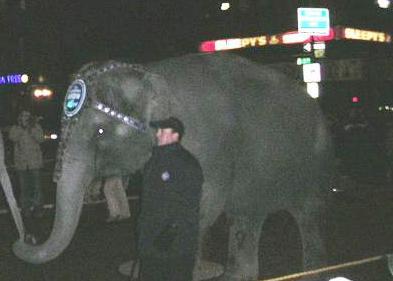
November 9, 2008 – In spring, the Ringling Brothers and Barnum & Bailey circus comes to New York City. A dozen-and-a-half elephants march through the Queens Midtown Tunnel in the early a.m. to report for circus duty at Madison Square Garden. 

Following them warily is a cadre of sanitation workers with shovels, a truck and water to clean up the mess the elephants leave behind.

2008-10-10-elephantwalk1.jpg
Elephants walk into New York City before dawn, followed
by men with shovels, and a truck with a flushing system.
And that’s what Ben Bernanke’s Fed is trying to do with the financial mess left by a series of GOP administrations that have 
- cut taxes on top earners while waging wars,
pumped up the national debt,
- increased U.S. fiscal dependence on foreign debt buyers.
dismantled bank regulations tracing back to 1913 and 1933,
- enabled dangerous financial transactions, while they have
- failed to regulate the shadow banking system.
So it’s fair that the percentage-point drops in the Dow translate to drops in voter support for GOP candidates on November 4, 2008. No wonder John McCain has made a lunge for the middle-class vote with his out-of-character and poorly conceived American Homeownership Resurgence Plan. 
The financial crisis of today has long been feared, Greg Ip noted in a Wall Street Journal blog 16 months ago
As an academic in the early 1980s, Mr. Bernanke pioneered the idea that the financial markets, rather than a neutral player in business cycles, could significantly amplify booms and busts. Widespread failures by banks could aggravate a downturn, as could a decline in creditworthiness by consumers or businesses, rendering them unable to borrow. Mr. Bernanke employed this “financial accelerator” theory to explain the extraordinary depth and duration of the Great Depression.
Even though bank weakness is less likely to hurt the economy today, given banks’ reduced importance as lenders, the financial accelerator is still relevant. That is because “nonbanks” — lenders, such as standalone mortgage companies, that don’t accept deposits — also “have to raise funds in order to lend, and the cost at which they raise those funds will depend on their financial condition — their net worth, their leverage, and their liquidity.”
Mr. Bernanke doesn’t say it, but the current crisis in the subprime mortgage market may be a perfect illustration of the financial accelerator at work today. Many subprime borrowers are facing bankruptcy because their net worth has collapsed and they can’t get new credit. Similarly, numerous subprime lenders have gone bankrupt because they could not get financing to continue operations from newly skeptical Wall Street lenders.
A prescient comment on this post pointed out that financial crises now have special potential for world-wide catastrophe because of the global reach of the U.S. financial system:
The serious mistakes of modern day economic analysis are to ignore the huge trade imbalance created by the globalization process. The huge trade deficit of US must flow back to US market and be lent to someone. As we know, lending generates more lending and who knows how many trillions this US trade deficit have ballooned to every year. It is this huge liquidity glut that is supporting US Government’s debt spending, US consumers' borrow and spend frenzy, huge borrowings of private equity firms and other M&A activities, enormous borrowings of hedge funds and so on. It is no wonder that the prolonged Fed tightening has lost its punch and takes so long to affect the home mortgage market. CK - June 16, 2007. 
Follow John Tepper Marlin on Twitter: 

Thursday, June 8, 2017

JOBS | Suffolk County, NY

How is Trump doing?
In 2010, Randy Altschuler attacked the incumbent congressman from Suffolk County, NY, Rep. Tim Bishop, for not doing enough for the Long Island economy.

He said that 30,000 jobs had left Long Island during Bishop's incumbency. I pointed out in an article on Huffington Post that the number was a lie. The correct figure was a gain of 36,000 jobs. Altschuler stopped using the number, but not until after he sent a glossy card to every voter with the lie plastered all over it.

Lee Zeldin was next to campaign against Bishop, in 2008. He lost badly in a Republican-leaning district. But in 2014 he adopted a straight Tea Party program, one of the first campaigners to do this. Here were his four main programs:
  1. Oppose raising the Federal minimum wage.
  2. Curtail Medicaid benefits. 
  3. Simplify the Federal tax code and cut taxes on the rich. 
  4. Cut Federal spending.
Zeldin was one of the first of the Tea Party electeds, in 2014. The GOP gained a majority in both the House and Senate in the 114th Congress, 2015-16. So how have Zeldin and the GOP Congress been helping Suffolk County? Let's ignore the first year, during which Zeldin was finding out where the bathrooms are in the maze of Capitol offices. Few Members of Congress make a dent in Washington in their first year (one reason for respecting seniority). Let's look at the second year of his term of office. How has the Suffolk County economy performed in 2016?

County-level numbers for jobs and wages are released quarterly and the numbers for the fourth quarter of 2016 were just released by the BLS on Wednesday. Here is the story for Suffolk:

Jobs. Suffolk's nonfarm payroll jobs rose to 661,400 in the fourth quarter of 2016, an increase of 900 jobs.

That's fewer than 1,000 jobs, compared with Bishop's presiding over growth of   36,000 jobs when he was attacked by the GOP for not doing enough for the economy.

The tiny growth rate during 2016 ranks 205th of 345 large counties for which the BLS computes this information, about 60 percent down the list. Within New York State, the growth rate is in the bottom half of the 18 large counties on the BLS list.

Wages. But maybe, has the quality of the jobs improved under Zeldin? What has happened to weekly wages? The news is much worse. Wages in Suffolk County declined by 3.5 percent, placing the county 289th out of 345 large U.S. counties, i.e., in the bottom fifth. Only two counties out of the 18 in New York State did worse.

This is not a good record. Since November 2016 the GOP has not only Congress but the White House, and a president who promised more jobs. We are waiting and watching.


Sunday, January 29, 2017

TRUMP | Has He Revoked Pardons for Obama's Turkeys?

President Obama pardoning a turkey.
Reports are circulating on social media that President Trump has issued an Executive Order to revoke all turkey pardons granted by former President Obama and immediately execute the turkeys.

It is, of course, too late for Trump to execute the earlier turkeys (there were reportedly 16 in all over Obama's eight years) who have gone on by now to Turkey Heaven.

The average life of a turkey is only about three years; the maximum recorded longevity for a turkey is reportedly 12 years.

The reports of the Pardon Revocations are satirical, says Snopes.

Monday, January 23, 2017

BLS | "Phony Numbers" on Their Way?

"Phony Numbers" Yesterday? Tomorrow? 
Jan. 23, 2017–The Trump Team attacked the BLS in 2016 for issuing misleadingly favorable numbers on unemployment. Trump called them "phony numbers".

In the second-last paragraph of his Op-Ed today, Paul Krugman wonders whether the Trump White House will be leaning on the BLS to do exactly what they were accused of under Obama.

The payroll job numbers are fairly hard to manipulate. They are based on filings by employers for unemployment insurance. If states with Republican governors wanted to influence the numbers they might be able to do this for a single month–for example by changing deadlines or filing procedures. But it is hard to see how they could do this easily over several months or years.

Meanwhile, blue-state governors–and some red-state governors–would be on the lookout for misuse of their data. Economists and statisticians are often alert when numbers that don't make sense and in the tradition of whistle-blowers they sometimes they speak up regardless of the consequences.

The household employment numbers are based on a sample of households surveyed by the Census Bureau, which reports to the Secretary of Commerce. When I was actively working with the numbers the Census work was paid for by a contract with the Commissioner of Labor Statistics, who reports to the Secretary of Labor; I have not heard of any change in this procedure.

One has to have faith that any secret changes in collecting these numbers, which have long been subject to scrutiny, would be difficult because someone would soon speak out in private or public.

Wednesday, December 14, 2016

JOBS | Two Job Numbers for Trump to Beat (Updated Jan. 6, 2017)

Trump visits Obama at the White House. 
It is understood among the cognoscenti that the Democrats managed the economy better for most Americans than the Republicans in the new millennium.

The problem for the Democrats in the 2016 election was voters who switched parties between 2012 and 2016. They were predominantly non-college-educated, from the least-well-educated states.

They picked up on the plain-language appeals and promises of candidate Donald Trump. The Democratic arguments were pitched to their college-educated base.

Perhaps the Democratic appeal to voters should have been based on a smaller number of performance indicators. President-elect Trump has promised to increase jobs. Two broad indicators–as opposed to anecdotal evidence from individual companies–might suffice to measure the success of his administration.

We can even use the BLS November job numbers [Jan. 6, 2017: see below for update, which changes little] for clear and independent benchmarks against which the economic performance of our presidents can properly be measured. The final report on the Obama Administration will be issued on January 6, subject to revision, but the December numbers, based on November reporting (and prior months for their seasonal adjustment), are not likely to change much from November.

Two Key Indicators

Here are the two key long-term numbers against which Obama's economy can be compared with the Bush economy of eight years ago and the Trump economy of two and four years hence:

1. Unemployment =  a rate of 4.6 percent in November

This is arrived at by dividing the number of unemployed, 7.4 million in November, of whom 1.9 million have been unemployed for 27 or more weeks, by the labor force (employed + unemployed), 159.5 million.

This compares with 7.3 percent in December 2004, the last month of the George W. Bush administration. (The numbers are easily found by punching into Google the two words  Unemployment and FRED. This will take you to the super-user-friendly St. Louis Fed database, God bless them.) That is a reduction of 2.7 percentage points. This compares with an increase of 3.4 percentage points during the Bush 43 administration and a decrease of 3.5 percent during the Clinton administration:
  • Clinton vs. Bush 43: Better by 3.5 - (-3.4) = 6.9 percentage points.
  • Obama vs. Bush 43: Better by 2.7 - (-3.4) = 6.1 percentage points.
2. Employment-population ratio = a rate of 59.7 percent in November.

This number is arrived at by dividing the number of civilian noninstitutional employed, 152.1 million, by the civilian noninstitutional population, 254.5 million.

This number is solid for long-term comparisons because it is not affected by answers to the unemployment survey. The labor force participation rate is dependent on the unemployment rate in the definition of the labor force. The employment-population ratio is not affected by any long-term change in the definitions of the unemployed or in the conduct of the monthly surveys of the labor force.

In December 1992 when President Clinton came to office, the employment-population rate had been falling and was at 61.4 percent. It rose during his administration to 64.3 percent, an increase of 2.9 percentage points. Under G. W. Bush, the rate fell by 3.3 percentage points to 61.0 percent. Under Obama the rate fell further to 59.7 percent, a drop of 1.3 percentage points. So here is the record of this measure:
  • Clinton vs. Bush 43: Better by [2.9 - (-3.3)] = 6.2 percentage points.
  • Obama vs. Bush 43: Better by [3.3 - 1.3] = 2.0 percentage points.
On both measures, the last two Democratic administrations outperformed the Bush 43 administration, by a lot.

Update, Jan. 6, 2017

Here are the final numbers for November, which arguably should still be the baseline, seasonally adjusted, if the incoming President wants to take credit for changed expectations in December (or his opponents do). Here also are the December seasonally adjusted numbers. Either way, from here on, it is President Donald Trump's baby–TrumpCare, TrumpEconomy and all.

Thursday, November 10, 2016

TRUMP | Mr. T Goes to Washington (Updated Feb. 12, 2017)

Trump and Obama Discuss Transition Today.
Nov. 10, 2016 –Doubtless  with today's visit of President-elect Trump to Washington, many people will be revisiting Frank Capra's 1939 movie, Mr. Smith Goes to Washington.

(Update 2-12-2017: This might be the high concept of the Trump campaign.)

Young Jefferson Smith played by Jimmy Stewart is elected President with the mission of cleaning up corruption in Washington, what Trump has called "draining the swamp".

While Mr. Trump's theme harmonizes with Mr. Smith's, the reality is starting off a little differently from the movie.

At his meeting today with President Barack Obama, the President-elect called him a "very good man" during their meeting in the Oval Office to discuss the transition. Obama told Trump: 
Mr. Smith (1939) Struck 
Chords Similar to Mr. Trump's.
If you succeed, the country succeeds.
Trump thanked Obama for the extending the meeting, which was scheduled for 10-15 minutes but ran an hour and a half:
Mr. President, it was a great honor being with you, and I look forward to being with you many, many more times.
Obama said they talked about both domestic and foreign policy  and that he was encouraged by Trump's interest in working together during the transition:
My No. 1 priority in the next two months is to try to facilitate a transition that ensures our President-elect is successful.
The President-elect said he would seek counsel from Obama.

Related LinksWhy is the President-elect being so nice to the Democrats who were his opponents? . Why did he run as a Republican? . The Wisdom of Mark Cuban

Tuesday, October 7, 2014

OBAMA | Visit to Chelsea Area, One-Time Alinsky Battleground

The Presidential Car carrying President Obama is first in line here, with a flag flying on each side of the front hood.
All photos by John Tepper Marlin (for permission to use, email teppermarlin at aol.com).
President Obama has arrived, a few minutes late, to visit the 400 block of West 22nd Street.

I have a bird's-eye view. He is expected to be here for an hour. It's a $25,000-per-guest fundraiser.

The neighborhood is of some importance in the history of community organizing. Saul Alinsky was here to organize the neighborhood, but it did not go so well (see below).

Not a good day to be illegally parked when "No Parking
Tuesday" signs abounded.
During the past few days, there seem to have been 1,000 federal, state and local police and sanitation workers in the area, checking and cleaning and barricading.

For local residents, it has been hard to miss that a VIP is visiting:
  • Deliveries to this block were cancelled for today.
  • All the Citibikes were removed from the racks in the block (see photo). 
  • Two days ago barriers were brought in barricading the entire block and Ninth Avenue to the north and south (see photo).
  • All public trash baskets and other "street furniture" (newspaper delivery boxes) have been removed.
  • "No Parking Tuesday" signs went up over the weekend.
  • This morning the NYPD tow trucks were out to enforce the parking ban. Three of them were just now getting ready to tow cars away across the road (see photo).
  • Oct. 7 morning - Cleaning the 400 block of West 22nd St.
     Obama is hours away from visiting the white house
    the street-cleaning truck is in front of. Note Citibikes
     are removed, and the barriers extend all down the block.
  • Sanitation trucks - cleaning trucks and two big trucks full of sand to barricade the block - arrived this morning (see photo).
  • Police officers are heavily concentrated in the area, including on top of a couple of buildings (see photo).
The intrusion on the neighborhood of security measures did not go unnoticed and was slated for discussion at the next block association meeting.

So where did the President go? To 460 West 22 Street, a renovated 16-foot-wide brownstone. Neighborhood gossip is the owners spent $10 million on the renovation. But the fact is the owners themselves say it was purchased for $4 million and the renovation cost $4 million.

It is advertised by Douglas Elliman (Eklund Gomes team) for sale with a lofty asking price of $16.25 million. The publicity from the fundraiser will clearly help see the building at some price. (See end of post for more on the house.)

The Alinsky Connection

The neighborhood has a community organizing history, which Barack Obama is surely - as a former community organizer in Chicago - aware of. Obama studied at the Industrial Areas Foundation (IAF),  created by Saul Alinsky with the help of supporters like Marshall Field III, Sears heiress Adele Rosenwald Levy, Gardiner Howland Shaw (an FDR assistant secretary of state) and Eugene Meyer, an investment banker who chaired the Fed under Hoover in 1930-33.

With the help of graduates of the IAF training, Alinsky had an early success organizing the Back of the Yards area, the meat-packing district made infamous in Upton Sinclair's 1906 novel The Jungle. During the late 1930s and 1940s, Alinsky formed the Back of the Yards [Neighborhood] Council (BOYC), which brought together (1) Catholic priests looking to retain and expand their congregations with (2) organizers for the far-left Packinghouse Workers Organizing Committee, which was looking for troops to mobilize. The alliance worked well for long enough to establish Alinsky, in the words of William F. Buckley, Jr., as  "very close to being an organizational genius".

Eugene Meyer and his wife Agnes co-owned The Washington Post and in 1945 he wrote a six-part series praising Alinsky's Chicago work.  Assembled as a book called The Orderly Revolution, it put Alinsky on the map.

Awaiting the President - a view up 9th Avenue from 22nd St.
At left, London Terrace, first U.S. urban renewal project, built
in 1931. At right, Penn South, the ILGWU-sponsored co-op
 dedicated in 1962 by JFK and Eleanor Roosevelt.
Around that time, Alinsky wrote Reveille for Radicals (1946), although his Rules for Radicals (1971, the year before his death) is now better known. 

The Rules were circulating in draft in the 1960s; Alinsky said that in this book he was seeking to provide the kind of guidance to "Have-Nots" (the 99 percent) that centuries ago Niccolo Macchiavelli's The Prince provided for the "Haves" (what we call today the 1 percent).

Less known is that Alinsky was brought in to Chelsea in the late 1950s by Hudson Guild, which obtained for him a $300,000 grant to organize Chelsea. At that time, the area between 23rd Street and 28th Street that was soon to be razed to make way for ILGWU leader David Dubinsky's Penn [Station] South development was still mostly composed of aging tenements, which were largely occupied by the families of Irish Catholic longshoremen and their families.

There was much discussion of a need for urban renewal in the area, and in 1958 the ILGWU plan for developing the area was made public. Dan Carpenter heard of Alinsky's success in Chicago and thought he would be useful in mobilizing Chelsea to address its urban reutilization needs, perhaps with an alternative plan to the one that the ILGWU was working on,

Security officers on the roof opposite the house
Obama is visiting.
Dan Carpenter was originally "head worker" at Hudson Guild, the well-regarded settlement house. He was then named Executive Director. Around that time he married the daughter of the founder of Hudson Guild, John Lovejoy Elliott, who was active with the Ethical Culture Society ("deeds not creeds"). I am familiar with the Society because both of my children went to the Ethical Culture School in Manhattan.

Alinsky's first move, following his Back of the Yards playbook, was to form the Chelsea Community Council, with Hudson Guild as his main local partner. However, at its organizing meeting in 1958, this Council, according to someone who was there and told me about it, fell apart.

The entry tent to the house.
The problem seems to be that Alinsky was following the playbook he had developed in Chicago, where his success had depended on the active cooperation of several Cardinal Archbishops of Chicago - Stritch until 1958, then Meyer and Bernardin. So he recruited Father Robert Dunn of St. Columba's Church on 25th Street east of Eighth Avenue. But this greatly distressed Dan Carpenter and other members of the Liberal Party, because the Catholics in the area operated independently of, and were suspicious of, the local socialists and Communists who led some of the labor union locals.

The Catholic Church was focused on its flock - ministering to the Irish and Puerto Rican residents who constituted, by one report, two-thirds of the 60,000 area residents - and had little time or patience to work with Alinsky's other main partners. St. Columba's and the Guardian Angel Church on 10th Avenue between 21st and 22nd Street were struggling to care for their aging Irish dockworkers and families, at the same time as the influx of Puerto Rican immigrants was changing the character and needs of the congregations.

The house at 460 West 22 Street. Note
Cipriani catering truck and glass-enclosed
penthouse. 
Hudson Guild was seen as challenging Catholic doctrine when, for example, it distributed information in the neighborhood about birth control or the philosophy of the Ethical Culture Society.

So when at the organizing meeting of the Chelsea Community Council, Father Dunn arrived with a list of people he was going to appoint to get things done, the Liberal Party members were distressed. They were expecting a proper election.

Both sides were shocked at each other, and the possibility of a viable partnership among the competing groups was pretty much all over after that. Dan Carpenter - a courtly man with a gentle manner - told me before he died that he was personally glad to see Alinsky leave town.

Dan lived in the 400 block of 20th Street, opposite the Episcopal General Theological Seminary, part of the Chelsea Historic District. He told me the 400 West 22nd Street block was very important during the controversy.

The Clintons have a connection to the story - not just that they named their daughter after the neighborhood (and the song "Chelsea Morning") but also that Hillary wrote her senior thesis at Wellesley on Saul Alinsky.

Looking east from the 400 block of West 22 Street. 
She basically said, according to a report - the thesis was kept under wraps during the Clinton presidency - that Alinsky's methods were not always successful. She could have used Chelsea as a case in point. Saul Alinsky reportedly was impressed enough with her thesis to offer Hillary Clinton a job when she graduated from Wellesley. Instead, she went on to law school; but she kept in touch with Alinsky by mail during the next few years.

The House That Obama Visited
Clever For Sale signs at 412 W 22 St.

The house at 460 West 22 Street is approximately 5,000 sf, which would put the asking price at $3,250 per sf. The listing says it has a garden in back. It is featured on the "Driven by Design" tour of Architectural Digest. The listing goes on:
Not so effective a sign.
Originally constructed in 1840, this landmarked, Italianate single-family townhouse just underwent a multi-million dollar complete artisanal-renovation and full restoration by Fanuka, Inc. (of Million Dollar Contractor) and Suk Design. Located on Chelsea's most refined block, this house is directly adjacent to picturesque Clement Moore Park, and is within short distance to the High Line, the Hudson River, Avenues World School, and the Dia Museum / Chelsea Art District. At 64' deep, this home features triple exposures and over 6000 sf of indoor living & outdoor entertaining space, which has been pristinely cultivated into a 6-floor [including basement], 4 bedroom / 4 bathroom + 1 powder-room mansion with 4 gas fireplaces and elevator.
According to the New York Times and HuffPost (Blake Fleetwood), the fundraiser is at a building with landmark status and is owned by Bryan Eure and his husband Bill White, the former president of Intrepid Sea, Air and Space Museum and the chairman of business development firm Constellation Group.

Huge pumpkin outside 460
W 22 St. - trick or treaters,
here is the stop to make!
I fear this post might be viewed as "native advertising" - i.e., advertising that serves the purposes of Douglas Elliman while ostensibly just telling a story.

May I therefore draw your attention to two other houses on the same side of the street in the same block, also for sale, one with three For Sale signs and one with a hand-made sign that notes how much space you would get with this house.

Meanwhile, I recommend that trick-or-treaters stop by 460 West 22 Street at the end of October. Brownstoners on the block take Halloween seriously. They are also pretty organized and I wouldn't be surprised if some lawyers connected with or hired by property-owners in the neighborhood are right now looking for ways to limit the number of events that residents are allowed to have that shut down the block for a week at a time. New York City has a process for approving parades and street fairs, and some of these fairs are less disruptive than this fundraiser was. Stay tuned.

Sources include interviews with local residents and: John T.  McGreevy, Parish Borders: The Catholic Encounter with Race in the Twentieth Century Urban North, Historical Studies of Urban America, University of Chicago, 1996.

Friday, November 8, 2013

Chicago Prof Mahoney Praises Card Law by Maloney

Rep. Carolyn Maloney (D-NYC) gets her pen after Pres.
Obama signs the law she introduced, the CARD Act.
Man bites dog. The NY Times Business Section highlights a Chicago School economist who set out on a routine debunking of credit-card regulation and along the way decided the data show the opposite.

He meant to show the law did not benefit consumers... and found that it actually did benefit them. In fact the law was a $20.8 billion gift of lower fees to credit-card holders, not just in 2010 but every year.

Credit-card users are paying $20.8 billion less per year, just because of the law, concludes Prof. Neale Mahoney, along with his three NBER co-authors -- Sumit Agarwal, Souphala Chomsisengphet and Johannes Stroebel -- the last of whom is a professor at NYU Stern School.

But where did this law come from? The Credit Card Accountability Responsibility and Disclosure (CARD) Act resulted from a long struggle. Surprisingly for a newspaper published in New York City, Floyd Norris does not mention that the law was introduced by New York City's Congresswoman from the Silk Stocking District, Rep. Carolyn B. Maloney, and was supported by then-Senator Barack Obama on the Senate side.

Maloney first introduced the bill as the Credit Cardholders' Bill of Rights in the 110th Congress (H.R. 5244) when she chaired the House Financial Services Committee's Subcommittee on Financial Institutions and Consumer Credit. The bill passed 312-112 in the House. Although Sen. Obama supported the bill, it was not voted on in the Senate.

Maloney reintroduced the bill in the 111th Congress (H.R. 627), during which she chaired the Joint Economic Committee. On April 30, 2009, the House passed the bill 357-70, the Senate passed an amended version on May 19, 90-5, and the House passed the amended bill May 20, 279-147.

The bill was signed by President Obama on May 22 at a White House ceremony at which he acknowledged Maloney's key role in it by putting her right behind him when he signed the bill and bestowed on her a pen and a kiss. The law went into effect February 22, 2010.

Give credit where credit is due.

Friday, November 9, 2012

ESB to WS | "Mark to Market"

Empire State Building is red, white and blue–for Veterans'
Day. Photo by JT Marlin.
November 12, 2012–I was looking at the Empire State Building colors and was sure the message was: "Blue on top. Barack Obama won a second term. Get used to it."

To the Wall Street hedge fund and private equity guys who in vain spent bundles of money trying to defeat Obama for threatening to raise taxes on the very wealthy, the colors say: "Mark to Market."

In fact, of course, they need to go through denial (Wait for more ballots! Recount! Travesty!) and anger before they get to the Nirvana of acceptance. 

But the ESB management has kindly made it easy to find out what meaning ESB actually intended. You just have to go here to find out that the building is blue, white and red in honor of the Veterans' Day Holiday on Monday, not the election. They turned on the colors three days early.


Tuesday, November 6, 2012

EMPIRE STATE BLDG | Signals Vote Total

For the first time, the Empire State Building
shows Electoral College votes on a bar graph.
Photo by JT Marlin from his apartment.
Nov. 6, 2012–For the first time, the Empire State Building today has been signaling the results of the U.S. electoral college vote. (If a lot of Americans have their way, this will also be the last time that the signal will be used. for this purpose.)

Like the election of the Pope, one can see the outcome of the election by looking at the top of the building. But the signal is not polluting smoke but the color of the building itself. The lights at top show progress toward the magic of the 270-electoral-vote target.

The light show is being provided by CNN. The left side of the top of the building shows Romney Electoral College votes in red and on the right the Obama Electoral College votes in blue.

For much of the evening the lights under the bar graph section of the building were red, white and blue. When Obama reached 270 electoral votes, the rest of the lights went to all blue.

The bar graphs were made possible by new LED panels. This is the first use of the new lights. Many Americans would like to end the Electoral College and use the popular vote to decide the election. In that case the bar graph would take on a different meaning.

Saturday, June 23, 2012

JOBS | What Keynes Said, What Bush 43 Did

What did Keynes really say? He argued that governments able to run deficits, because they can print money, should run deficits in weak economic times - and run surpluses in good economic times.

What Bush 43 did was run deficits in good (low unemployment) economic times. By putting the winter woodpile in the stove in late summer, he stirred up the anti-deficit forces so that Obama had a hard time getting enough wood together for the stimulus he needed after the crisis of 2008.

This is the central message Paul Krugman has been hammering home in his New York Times column for months or years and in his excellent piece with his wife Robin Wells in the latest July 12 New York Review of Books. The NYRB article reviews the relative roles of Larry Summers, CEA Chair Christina Romer, Timothy Geithner et al. in the Bush 43 response to the financial crises of 2008 and then the Obama response to the spreading economic crisis of 2009.

The "starve the beast" thesis of the Reagan era (cut taxes and create a deficit crisis that will inhibit spending) turned the United States from the largest creditor nation in the world to the largest debtor nation. Under Bush 41 and 43, the Federal Government continued to run deficits even through unemployment was very low by historical standards. Only Bill Clinton, during the Democratic interregnum, ran surpluses. I commented on this in September 2008.

At precisely the point where all the anti-deficit armory was assembled, the financial crisis hit and its size and psychological impact had a huge economic impact on the U.S. and world economy. Just as the anti-deficit forces went to work, the need for stimulative spending suddenly became acute. As Krugman has argued at length, Obama's response fell short because of growing GOP opposition in the Congress. One reason is that state and local government revenues fell with the economic decline (they can't print money) and this offset the national stimulus. So states and localities have been faced with huge deficits in FY09-FY11 and more deficits face most of them in FY12 and FY 13, with no stimulus money left to help.

Now Steve Malanga of the Manhattan Institute castigates states and localities for spending too much in good times and not putting away money for bad times. He quotes Keynes. He tells us he asked then-Mayor Koch to put money into a rainy-day fund. Koch correctly responded that elected officials find this difficult to do. So far, rainy-day funds tend to be spent at the first hint of dewfall.

Here are my comments:
1. Keynes was focused on the national level.  Counter-cyclical fiscal and monetary policy is meant to be applied at the money-printing level. States and localities just don't have that power. When Greece and Spain gave up the drachma and peseta, they gave up their ability to pursue a counter-cyclical policy for very long - that power has gone to the European Union and the European Central Bank.
2. States and localities have to balance their budgets.  Balanced budgets are the law in many states and it's reality in the rest of them. When states and localities talk about deficits they are talking about gaps that must be faced. These gaps must be closed through borrowing or other gap-closing measures.
3. Some counter-cyclical mechanisms work well. Revenue-sharing with states and localities was a good idea. New York City's averaging of assessed values over five years is a hugely successful mechanism that evens out property-tax revenues over the business  cycle.    

Sunday, April 15, 2012

How Much Must You Give for a White House Invite?

The NY Times today ("White House Welcomes Donors...", Sunday, April 15) had a page 1 story by Mike McIntire and Michael Luo about President Obama's invitations to the White House. Fascinating stuff.
Biggest surprise for me was the degree of White House transparency. The Federal Election Commission (FEC) keeps track of campaign donations (see www.data.gov) and the Executive Office of the President keeps a public log of visits to the White House that is posted on www.data.gov. Inevitably, someone was going to tie these together.

The donation totals are cumulative over three election cycles, i.e., from 2008 through 2012 (first quarter). Surprise (not) - there is a pretty close relationship between how much money you give and the probability of a White House invitation - for this purpose a visit equates to an invitation. The Times story doesn't provide a formula, but here is what I got inputting the numbers from the Times chart - see my chart immediately below.
PROBABILITY OF AN INVITATION y=26.3% + 40.2%x$GIFT (in thousands of dollars).
So if you give $100,000 over a 5.5-year period, your probability of an invitation is 26%+40%x100, which is (26+40)% = 66%.
What this means is that two out of three donors at the $100,000 level visit the White House. 
But a few caveats are needed, and a couple of questions must be asked.

First off, the FEC disclosure reports include gifts of only $200 and above. That excludes many small gifts via the Internet. So there will some invitations to dinner to the Internet givers that wouldn't show up on the FEC reports. The probability at the "zero" gift level is the probability that someone gets a White House invitation after giving only (at least) $200. The probability applies to givers of $200 or more.

Second, the White House visitors' list is hard to navigate for purposes of reconciling the numbers. What rules were followed in deciding who is included from the list of invitees? For example, many overseas visitors show up on the site and they are not permitted to give. Many of visits are labeled as events ("Holiday Party"). Some of the locations to which visitors are invited are strictly public rooms. How was the list narrowed down?

Finally, to draw conclusions that would characterize the Obama White House in any way, would we not need some data from other presidencies? How does the Obama era differ from Bush 43, for example?   

Wednesday, September 7, 2011

Mayor Koch Makes a Couple of Good Points

Former Mayor Ed Koch doesn't blog, but he does send out from an email list maintained by his law office an occasional letter with his opinion of movies he has seen recently and sometimes he provides some comments on local or national political issues. He has taken positions on individuals in the news, such as candidates for public office.

Today, on the eve of President Obama's much-awaited speech with new proposals for job creation, the Mayor proposes that the President include the proposal that "the bankruptcy laws be amended immediately to empower bankruptcy judges to reduce principal as well as interest."

This would help clear the sticky foreclosure process. Houses lose value when banks push forward their claims slowly. Some banks do not want to reveal too quickly how many mortgages they signed on to are substandard and are being foreclosed on.

The usual argument against allowing bankruptcy courts to write down the principal owed is “moral hazard”. (This is an insurance term referring to the hazard that insurance can remove the incentive for insured owners to look after their property. Over-insurance, for example, creates a moral hazard because the insured gets more from the property when it is destroyed than the property is worth. Someone who is not moral might torch their own property.)

The argument against allowing bankruptcy courts to write down principal is that it would, in the Mayor's words, "encourage future borrowers to borrow more than they could repay."

Then the Mayor delivers his zinger, addressed to the President:

If “moral hazard” were the standard, why were the banks, which made decisions that were financially devastating to this country, bailed out to the tune of billions of dollars by laws enacted by Congress and signed by you, as well as actions taken by the Federal Reserve?  Remember, Mr. President, that banks were given those billions to provide liquidity to businesses, but instead used the taxpayers’ monies to buy U.S. Treasury bonds to enhance their balance sheets with the interest received.
Something needs to be done to finish "marking to market" in the housing industry. Borrowers have received a lot less help from the government than the lenders. The Mayor's proposal would redress the balance for the remaining borrowers. This would be a good addition to the President's proposals.

Friday, July 15, 2011

DEBT CEILING | 8 Proposals

Michael D. Shear, online July 15, 2011 (in the Saturday, July 16 NY Times), provides a “cheat sheet” on the various proposals for meeting the August 2 deadline for raising the debt ceiling. Comment: Not mentioned is the fact that Both Moody’s and S&P have threatened to lower their triple-A ratings on long-term U.S. debt if the deadline is not met, with S&P going further and expressing hawkish views about the terms of any compromise. The threat of a downgrade at least partly offsets the argument that cuts in spending now might bring on a double-dip recession. Here is an abbreviated summary of eight overlapping and evolving proposals, with a few additional facts from a Washington newsletter (W&J Washington Update, July 15) and other sources, and my comments:

1. The Obama-Boehner $4 Trillion Grand Bargain.The “big deal” worked on between President Obama and House Speaker John Boehner (R-OH) would add up to more than $4 trillion in deficit reductions over ten years, with $1 trillion of it from new tax revenue. But the tax revenue portion of this bargain made it unpalatable to Republicans. Boehner backed off from this last weekend but the President still likes this idea. Comment: S&P also likes this approach, saying that there is a 50 percent chance it will downgrade U.S. debt within 90 days, and suggesting that anything less than a $4 trillion deficit-reduction plan over ten years could trigger a downgrade.

2. The Biden Half-Bargain. House Majority Leader Eric Cantor (R-VA) revealed some details of VP Joe Biden's plan to cut $2 trillion. Health care would lose about $340 billion. Reducing the debt would save $300 billlion. The Biden plan included several hundred billion dollars of new revenues from sources such as owners of private jets, hedge-fund managers and large oil companies. Cantor said the new tax revenues were a nonstarter. Comment: This would add up to about the $2.4 trillion of the debt-ceiling increase; it would not meet the S&P $4 trillion standard.

3. Cantor’s $2.4 Trillion Cuts.Cantor proposed $2.4 trillion worth of spending cuts without revenue increases. The President responded that these cuts are too deep, and would affect middle-class programs - student loans, Veterans’ benefits, Medicare and Medicaid – and that the cuts should be offset at least in part by higher taxes on wealthy individuals. Comment: Focusing only on the spending side does not meet the test of fairness.

4. White House: Proposed $1.5+ Trillion Cuts. President Obama has proposed cuts of $1.5-$1.7 trillion. Cantor says this would not be enough. Comment: Even if these cuts were matched by $700-$900 billion in new taxes to get to the $2.4 trillion of the debt increase, the total is below the S&P standard.

5. Cantor’s Stepwise Debt Increases. Rep. Cantor has suggested votes that would increase the debt ceiling in steps, with each step allowing Republicans to call again for more spending cuts. President Obama is opposed, saying that he wants to deal with the long-term deficit problem now. Comment: The President is operating on the sound principle that painful adjustments are best made as part of a package that shows fairness in the bearing of sacrifices.

6. The “Balanced Budget” Amendment.  In the background, House conservatives are seeking to tie an increase in the debt ceiling to the passage of a constitutional amendment requiring Congress to balance the budget. Another proposal is a cap on federal spending as a share of GDP. Comment: Would such an amendment be ratified by two-thirds of the states? Unlikely. It would make Keynesian counter-cyclical fiscal policies more difficult, limiting the ability of future fiscal policymakers to respond to a recession or depression. (But on the plus side it might end the practice of financing wars with new debt.)
7. The McConnell Three-Step Option. Senate Minority Leader Mitch McConnell (R-KY) proposes allowing President Obama to raise the debt ceiling in three steps ($700 billion, $900 billion and $900 billion) between now and the end of 2012. Even if the Senate joins the House in voting against the debt-ceiling hikes, the President could veto their opposing legislation and go ahead. Comment: This would put the onus on the President but would also get past the deadline – it’s a better alternative than defaulting on debt payments, but does not address the long-term deficit concerns of the rating agencies.
8. The Hybrid Obama-McConnell. President Obama would be given the authority to raise the debt ceiling in return for the President’s commitment to the level of cuts that he proposed as a starting point. Then a base-closing-type commission would come up with additional deficit-reduction plans by the end of 2011 for an up-or-down vote. Comment: A well-thought-through package like this might conceivably be enough for the rating agencies, at least for this year.

Saturday, January 31, 2009

MED BIZ | How the Clinton Plan Was Killed, 1993 (Updated Nov. 11, 2016)

Ira Magaziner
(This was posted on January 31, 2009 and the content has not been changed since then. It is one of the most frequently read posts on the CityEconomist blog. An update was added in 2011 and the formatting was adjusted on Nov. 11, 2016. During 2009-2011 this blogger was serving as Senior Economist for the Joint Economic Committee of the Congress.)

Yesterday Paul Krugman, whose column in the NY Times is the first one I look for every morning (in print or online), wrote:
Mr. Obama really, really doesn't want to repeat the mistakes of Bill Clinton, whose health care push failed politically partly because he moved too slowly.
It's ironic that the Clinton team should be blamed for moving too slowly, because Ira Magaziner expressed determination to move quickly as a speaker in December 1992 on a panel I attended. (Alice Tepper Marlin was also on the panel.)

Magaziner announced that the group drafting the health care legislation planned to get a bill through during the honeymoon period, "by June" [1993]. He paused, and then stopped, looking up toward the back of the room. Everyone's eyes turned toward a tall, lanky gentleman who rose slowly from his chair and said:
Ira, if you think y'all are going to get a health care bill through by June, y'all need to have your head examined. Y'all will be lucky to get your budget through by June.
Sen. Ernest "Fritz" Hollings (1922-)
Then he sat down. The speaker was Ernest Frederick ("Fritz") Hollings, Democratic Senator from South Carolina from 1966 to 2005, and he was, alas, right in his prediction. No health care bill by June, or ever during the Clinton years. No budget by June.

Krugman's charge of having "moved too slowly" is a way of saying that the bill was too complex, was prepared too secretively or made excessive concessions to the insurance industry. I haven't read, however, an explanation as cogent as the one presented by Ezra Klein in an article in The American Prospect that was posted yesterday on AlterNet.

The article is a primer on the realities of the budget process in Washington today, especially the powerful role of the Congressional Budget Office in coming up with "the Number" for a bill's likely budget impact. The article is "Comprehensive Health Care Reform Is the Key to Our Economic Future," January 30, 2009. It opens:
"The history of health reform," explains Sen. Ron Wyden of Oregon, "is congressmen sending health legislation off to the Congressional Budget Office to die." That's not the history you often hear. Budget analyses do not make for gripping headlines. Editors want heroes and villains, narrative arcs and telling anecdotes. They do not want numbers. They do not want bureaucracies. But numbers, and the bureaucrats who decide them, can be quietly decisive in whether major policy reform lives or dies.

In the coming years, no bureaucrat will be as decisive as Peter Orszag -- the former director of the Congressional Budget Office who is now the head of Barack Obama's Office of Management and Budget -- and few bureaucracies will be as important as the CBO and the OMB. For every major policy and legislative fight, those organizations will decide the Number: the official price tag of a government program. And you can't do anything without the Number.
Go read the rest yourself here.

Update (Baumol's Cost Disease), 2011

The above was written in January 2009. Peter Orszag presented his views on the cost of medical care  in a New York City speech on November 15, 2011 to the New York Association for Business Economics (after leaving OMB, he became Vice Chairman of Global Banking for Citigroup in New York City).

Orszag showed how medical care costs are almost entirely responsible for the worrisome federal budget deficit projections.

CBO Chart Showing How Health Care Costs
Drive the Deficit. 
CBO data from 2007 make clear that as a share of GDP, projected Federal spending on activities other than health care has not been growing much. (See chart at left.)

Projected higher federal spending and deficits come almost entirely from one major spending sector, health care.

Health care took 20 percent of GDP in 2007 but is projected to rise to one-third of GDP in 2082. The growth is all in the top layer of spending, i.e., Medicare and Medicaid.

NYU Professor William Baumol warned 20 years ago that the cost of education and health care have been growing unsustainably because of the "cost disease" of high-labor-input activities such as teaching and medical care. Technological innovation and overseas manufacturing have saved money, but many labor inputs in health care have been harder to reduce.

To bring down the cost of health care, governments have a number of options, including these:
  • Target excessive use or cost of individual health-care procedures. Newspaper stories about excessive Medicare charges for specific procedures help focus public attention on them.
  • Ration "elective" procedures. The British National Health Service has long had a queue for elective (for non-life-threatening illnesses) surgeries or other procedures.
  • Limit demand for health-care services. This means educating the public and doctors about the importance of making healthy life-style choices. 
  • Create incentives for healthier choices. Subsidize healthier choices by the public (consumers of health care services) or impose Pigou taxes on less-healthful choices.
Other MED BIZ posts: BBC Panorama .  Aetna's Opt-Out

Sunday, January 18, 2009

OBAMA | Please Fund Tech Innovation (SBIR, DARPA)

My friend Professor Henry Etzkowitz was very helpful when I was working on a study of the software industry in New York City in 1999. Our work can be found here. He is an expert on the history of science and serves as Chair of the Management of Innovation, Creativity and Enterprise Program at the Newcastle University Business School.

Henry and I met recently in New York City to talk about President-elect Obama's stimulus program. This will be a gigantic investment in America's future. Should the Obama Administration use a portion of this funding to spur technological innovation? Or is this "picking winners" and is that a bad thing?

Those who oppose the government's picking winners argue that this is not the job of government and government employees have no expertise in culling business ideas and plans. So government's role has mostly been to lend money through programs like the Small Business Investment Company program, and leave it to private SBIC managers to pick among the possible investments.

Henry sent back to me some followup thoughts. I am excerpting, with his permission, some highlights of his thesis that the U.S. government has actually played a big and successful role in picking technological winners and that this role should be expanded.

The SBIR Program. The Small Business Innovation Research (SBIR) program has been a success, Henry says, in supporting high-tech firms.
SBIR was begun by program officers at the National Science Foundation (NSF) in the early 1980's. SBIR extended NSF's research programs by setting aside a relatively small percentage of research budgets, to support projects that demonstrate potential commercial as well as scientific merit. Researchers apply for SBIR grants and use them as the first step toward firm-formation, moving research ideas forward to commercialization.

In effect SBIR has served as a form of public venture capital, filling some of the gap, the so-called "Valley of Death" that business angels and private venture capital firms are typically unwilling to enter until a firm has proven itself through demonstrated earnings. Government has provided the seed capital to take many nascent firms to the point of private sector take-up. But government is not doing this task by itself. It relies on experienced private sector technology experts to serve as peer reviewers to judge the commercial potential of the new technology even as it continues to rely on academics to certify its scientific and technological potential. SBIR was extended from NSF to all government agencies with research budgets of more than $100 million.
The ATP. The European Union created Framework Programs to support collaborative industrial research, led usually by large firms. The U.S. response to this was the Advanced Technology Program (ATP) initiated during the Bush 41 presidency.
Opposition to the ATP led to a scale-down of grants, from tens of millions to large-firm led consortia to the low millions for innovative start-ups. This unintended consequence of reduced appropriations turned ATP into a useful follow-on to the SBIR, helping start-ups with new technologies through the "Valley of Death," the gap between government R&D funding and venture capital take-up. ATP is currently in "deep freeze" in the National Institute of Science and Technology, its sponsoring agency, receiving no new funds in recent years.

The ATP could be revived and SBIR could usefully be scaled up further, but the individual projects it supports are a necessary but insufficient technology policy for the current crisis. Larger scale initiatives are necessary to take advantage of the opportunity crisis offers to renew existing industries and create new techno-economic paradigms as the basis for future industries.
DARPA. The SBIR-ATP approach is relatively laissez-faire, choosing among competing ideas that arrive in response to general requests or over-the-transom proposals. The more tightly focused and directed approach is taken by the Defense Advance Research Projects Agency (DARPA). Under its demilitarized name ARPA, DARPA created the ARPANET as a communications system without a center, the origin of the Internet. DARPA's primary strength is its program-officer networks.
The DARPA officer is a highly skilled broad-gauge technologist, often a visionary drawn from a university, like psychologist J.C.R. Licklider who envisioned a new format for computer communication that led to the Internet. Following the DARPA format, invented in response to the Sputnik shock of the late 1950's Licklider had the freedom and the resources to establish a consortium of firms and universities to realize his vision.

The DARPA program officer, a public entrepreneur, is the key to the DARPA model. He or she has the resources and capability to fashion a technology development team from across university, industry and government laboratories and the remit to carry it from "blue sky" research all the way to commercialization and use. More recently a DARPA data-mining initiative provided the research resources and objective that provided the framework for the invention of the Google algorithm. Although DARPA is limited to achieving military goals, many of its initiatives have had significant spillover into the civilian economy. There have been various proposals for a civilian DARPA over the years but the political will has been lacking. Only military objectives have been granted an exemption from the dictum of government's supposed inability to pick winners. The current downturn offers a pressing opportunity to utilize this successful response to Sputnik to achieve broader socio-economic objectives. These models of R&D success, with mixed university-industry government elements and joint leadership, provide exemplars to creating a sustainable path to renewal, without relying on reviving past bubbles or inventing new ones.

As the Obama Administration seeks to maximize the long-term benefit from its stimulus funding, it should consider stepping up support of SBIR-ATP-DARPA initiatives.