Showing posts with label Ben Bernanke. Show all posts

Sunday, November 26, 2017

GOP | Cleaning Up

National Review Continues to
Pillory the Imperial Trump Style.
New York City, November 26, 2017 – The current National Review cover shows a regal Donald Trump-like figure sitting on a on gilded hathi howdah (हाथी हौदा) atop a gilt-armored elephant.

I should explain that I have been receiving the National Review for the last few years courtesy of a subscriber who gets an extra subscription every December to send to someone who could use it. 

Proud indeed I am to be her Designated Democrat.

Back to the cover. Following behind the man on the golden hathi howdah are three men in black, carrying spades. Their faces bear the strong likenesses of three key non-family members of King Trump's inner circle.

This put me in mind of re-posting something I originally posted on November 9, 2008, after the election of Barack Obama.

Anyone reading this who is not a New Yorker or a circus follower should know that the elephants have reportedly made their last trip into New York City.

CLEANING UP GOP MESS 
HUFFINGTON POST


BY John Tepper Marlin

November 9, 2008 – In spring, the Ringling Brothers and Barnum & Bailey circus comes to New York City. A dozen-and-a-half elephants march through the Queens Midtown Tunnel in the early a.m. to report for circus duty at Madison Square Garden. 

Following them warily is a cadre of sanitation workers with shovels, a truck and water to clean up the mess the elephants leave behind.
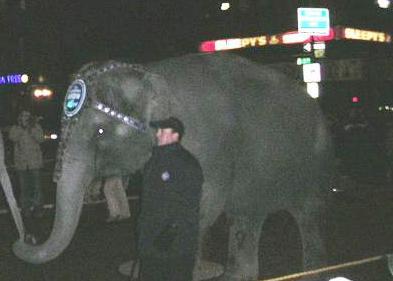
2008-10-10-elephantwalk1.jpg
Elephants walk into New York City before dawn, followed
by men with shovels, and a truck with a flushing system.
And that’s what Ben Bernanke’s Fed is trying to do with the financial mess left by a series of GOP administrations that have 
- cut taxes on top earners while waging wars,
pumped up the national debt,
- increased U.S. fiscal dependence on foreign debt buyers.
dismantled bank regulations tracing back to 1913 and 1933,
- enabled dangerous financial transactions, while they have
- failed to regulate the shadow banking system.
So it’s fair that the percentage-point drops in the Dow translate to drops in voter support for GOP candidates on November 4, 2008. No wonder John McCain has made a lunge for the middle-class vote with his out-of-character and poorly conceived American Homeownership Resurgence Plan. 
The financial crisis of today has long been feared, Greg Ip noted in a Wall Street Journal blog 16 months ago
As an academic in the early 1980s, Mr. Bernanke pioneered the idea that the financial markets, rather than a neutral player in business cycles, could significantly amplify booms and busts. Widespread failures by banks could aggravate a downturn, as could a decline in creditworthiness by consumers or businesses, rendering them unable to borrow. Mr. Bernanke employed this “financial accelerator” theory to explain the extraordinary depth and duration of the Great Depression.
Even though bank weakness is less likely to hurt the economy today, given banks’ reduced importance as lenders, the financial accelerator is still relevant. That is because “nonbanks” — lenders, such as standalone mortgage companies, that don’t accept deposits — also “have to raise funds in order to lend, and the cost at which they raise those funds will depend on their financial condition — their net worth, their leverage, and their liquidity.”
Mr. Bernanke doesn’t say it, but the current crisis in the subprime mortgage market may be a perfect illustration of the financial accelerator at work today. Many subprime borrowers are facing bankruptcy because their net worth has collapsed and they can’t get new credit. Similarly, numerous subprime lenders have gone bankrupt because they could not get financing to continue operations from newly skeptical Wall Street lenders.
A prescient comment on this post pointed out that financial crises now have special potential for world-wide catastrophe because of the global reach of the U.S. financial system:
The serious mistakes of modern day economic analysis are to ignore the huge trade imbalance created by the globalization process. The huge trade deficit of US must flow back to US market and be lent to someone. As we know, lending generates more lending and who knows how many trillions this US trade deficit have ballooned to every year. It is this huge liquidity glut that is supporting US Government’s debt spending, US consumers' borrow and spend frenzy, huge borrowings of private equity firms and other M&A activities, enormous borrowings of hedge funds and so on. It is no wonder that the prolonged Fed tightening has lost its punch and takes so long to affect the home mortgage market. CK - June 16, 2007. 
Follow John Tepper Marlin on Twitter: 

Friday, July 22, 2016

LEHMAN | Did It Have to Fail?

Paulson, Bernanke, Geithner.
James B. Stewart in The NY Times today reports on a new study of the dark days of Lehman Brothers in September 2008.

Could Lehman have been saved from bankruptcy? Should it have been? Would the world thereby have been saved from the Great Recession and its globally destabilizing consequences?

The study's author is Laurence M. Ball, Chairman of the Economics Department at Johns Hopkins University. He presented his 214-page paper, "The Fed and Lehman Brothers", which took him four years to write, to a conference of economists in Cambridge, Mass.

The study makes, as I read the story, two main points. Despite what Treasury and Fed officials (i.e., Henry M. "Hank" Paulson Jr., Treasury Secretary; Fed Chairman Ben S. Bernanke; and NY Fed President Timothy F. Geithner) have said,
  • Lehman Brothers could have been saved. Bernanke told the Financial Crisis Inquiry Commission in 2010 that Lehman's collateral was weak and saving it would have required breaking the law. Ball argues that is not true, and that Lehman's financial condition was never properly analyzed. The whole point of the creation of the Federal Reserve in 1913 was to "lean against the wind" and when panic hits, its job is to save the system. The officials of the time underestimated the consequences of not saving the system and we live with these consequences today. 
  • Paulson called the shots. Bernanke at the Fed followed the lead of Treasury Secretary Paulson, who took charge of the situation and was the prime mover in promoting the decision to let Lehman fail, because he didn't want to be known as "Mr. Bailout". Paulson says that the decision was that of the Fed to make.
Ball's paper was supported in its general conclusions by Prof. David Romer at Berkeley and another professor at M.I.T. Other academics interviewed by The NY Times withheld their judgment.

Wednesday, October 7, 2015

BANK SINS | Bernanke Says Too Few Execs Indicted

Former Fed Chairman Ben Bernanke
Should more bankers have gone to jail over the financial laxity that led to the meltdown of 2008?

Former Federal Reserve Board Chairman Ben Bernanke says yes.

The problem is, he says, that the Department of Justice has prosecuted Wall Street firms rather than individuals. In Bernanke's view, the firms are "legal fictions" and the malfeasance should have been pinned on the individuals who were profiting from it. But:
You can't put a financial firm in jail. There should have been more accountability at the individual level.
In an interview with USA Today's Washington Bureau Chief, Susan Page, related to his new book, Courage to Act, Bernanke says that the worst of the crisis was the so-called "Lehman Weekend" when Lehman Brothers became bankrupt.

He regrets he and his colleagues did not communicate better with the public when they were in the midst of the crisis in the fall of 2008. He repeats a theme of his book, that there was nothing the Fed could do to save Lehman, although at the time he did not say that.

Tuesday, October 6, 2015

2008 CRISIS | Fed Couldn't Save Lehman, Says Bernanke

Bernanke Says Now That Fed Was Helpless.
In DealBook today, in the New York Times (p. B1) Andrew Ross Sorkin says:
Mr. Bernanke, in perhaps the most candid explanation of Lehman’s 2008 collapse, writes that he and Henry M. Paulson, then the treasury secretary, purposely obfuscated when asked about Lehman’s demise early on, allowing a narrative to develop that the government had purposely let the firm fail.
 Sorkin quotes from Bernanke's new book:
In congressional testimony immediately after Lehman’s collapse, Paulson and I were deliberately quite vague when discussing whether we could have saved Lehman. But we had agreed in advance to be vague because we were intensely concerned that acknowledging our inability to save Lehman would hurt market confidence and increase pressure on other vulnerable firms.
Pam and Russ Martens conclude that Bernanke is trying to "rewrite the financial crisis".

Wednesday, August 31, 2011

FOMC | Krugman and the Liquidity Trap

On December 18, 2008, I reported on a speech by Laurence Meyer of Macroeconomic Advisors in which he said that after the December 16 Federal Open Market Committee statement, the FOMC could go on vacation for two years. In other words, by going to the zero (actually 0-0.25 percent) interest rate policy, the Fed was out of ammunition in the battle for recovery from the financial meltdown. In other words, the United States was in the Japanese liquidity trap.

Paul Krugman wrote an article in 1998 for Brookings with two other economists on the Japanese liquidity trap. In 1999 he posted his prescient thoughts about the possibility of a Japanese-style liquidity trap happening in the United States. He reviewed the assumptions of the traditional IS-LM model and concluded that at the zero-interest bound characteristic of the liquidity trap, the central bank has little power. In order to change expectations, he argues that inflation targeting is the solution - the central bank should plan on a certain degree of significant inflation. That will impose a negative interest rate on passive owners of liquid assets. It will force them to hunt for yield higher than the inflation rate and - assuming the banking system is working properly (which it was not doing in the first decade of this century) - that will prompt owners of liquid assets to invest. Krugman posted again on the liquidity trap in 2010 but with no mention of inflation targeting.

Interestingly, the 12th edition of Baumol and Blinder, Economics: Principles and Policy (South-Western, 2012, 2011) does not include anything specific about the IS-LM model. (Co-author Alan Blinder was formerly Vice Chairman of the Federal Reserve Board.)  The book does not include "zero-interest" or "zero bound" or "liquidity trap" in its index. But it does have  a box on inflation targeting (p. 695), noting that the current Fed Chairman, Ben Bernanke, was a "big advocate" of inflation when he was a Princeton professor. The British Chancellor of the Exchequer sets an inflation target (currently 2 percent) and the Bank of England is required to work towards meeting that target. Stanford Professor John Taylor showed during the Chairmanship of Alan Greenspan that the Fed's decisions could be replicated with a simple guideline, the "Taylor Rule": (1) When the inflation rate is above 2 percent, raise the real interest rate proportionately above 2 percent. (2) When there is a recessionary gap, reduce the real interest rate below 2 percent proportionate to the recession. Baumol and Blinder note that "No central bank uses the Taylor rule as a mechanical rule." But it is a useful guide to what is actually going on.

Saturday, December 27, 2008

FINANCIAL CRISIS | Missing Minsky

Dec. 27, 2008–Martin Wolf, at FT.com, wrote on December 24 that Keynes offers us the best way to think about the financial crisis:
We are all Keynesians now. When Barack Obama takes office he will propose a gigantic fiscal stimulus package. Such packages are being offered by many other governments. Even Germany is being dragged, kicking and screaming, into this race. The ghost of John Maynard Keynes, the father of macroeconomics, has returned [and] that of his most interesting disciple, Hyman Minsky.
Hyman Minsky
I first heard Hy Minsky talk in the 1960s. His main message was:

1. Financial systems have a built-in tendency to euphoria. The financial market does not tend toward stability. The opposite is true. Bankers and other financial actors borrow more and more heavily, making the system increasingly vulnerable to panic. Lenders start after a scare by being conservative, hedging their bets. But eventually confidence returns and speculation takes hold again. Then investors get to the Ponzi phase – manic use of credit, a euphoria or bubble.

2. The credit cycle tends to manic, but ends with panic. The Ponzi phase continues until some investors exit with their profits, or the central bank raises interest rates to reduce investor euphoria, and then a financial institution runs into difficulty. The failure causes a bankers' panic. Turning points in the five stages of the cycle are called “Minsky moments”.

3. The system tends to instability and must be regulated. Fashions in monetary theory have moved from a belief that Keynesian sophisticates could “fine-tune” the economy, to fear that the Fed had lost control of the ability to contain inflation, to a belief that markets work best with minimal interference. Hy rejected all these ideas, preaching consistently about the need for regulation and the importance of leaning against the excesses of what Keynes called the animal spirits of investors.

Born in Chicago, Hy taught at Brown, Berkeley and Washington University (St. Louis). He died 12 years ago in Rhinebeck, 77 years old, near Bard College’s Levy Institute, which has a special interest in business cycles and treated Hy as a star in his last six years. Hy didn’t live to see how closely this year’s meltdowns would follow his predicted scenario, with the Lehman failure being one of several clear Minsky moments.

Former Fed Governor Laurence Meyer, who spoke in New York City last week, has said of Minsky: “few have influenced my thinking about economics more than Hy.” If Hy had been listened to, we would have seen less permissiveness, fewer NINJA (No Income, No Job nor Assets) mortgage loans and more aggressive Federal Reserve and SEC oversight over highly leveraged instruments and institutions.

Fed Chairman Alan Greenspan and then-Governor Ben Bernanke were anxious not to “pop the bubble” because (citing the Milton Friedman-Anna Schwartz history) that’s the mistake the Fed made in 1928 - after the guy who knew what he was doing, FRBNY chief Benjamin Strong, died of TB. The Fed was concerned not to stifle financial innovation, arguing that it is ready with new weapons in the event of an asset-destroying credit freeze.

This last theory is now being tested. The stakes are high, beyond an academic debate. Whatever side one takes, any sensible person should be rooting for the outgoing and incoming Fed-Treasury teams to succeed in restoring confidence and the flow of credit.

Friday, March 28, 2008

McCain's Response to Meltdown Is “Dubious”

Senator McCain's approach to the credit crisis was today described by the LA Times as “dubious”. In Santa Ana, Orange County (home of Countrywide Financial and New Century Financial, failed leaders of the subprime fiasco), McCain called for minimal federal interference in financial markets and instead for (1) voluntary measures by banks to assist borrowers having trouble keeping up with payments and (2) a summit to discuss discouraging banks from writing down the value of distressed housing. The first proposal is already happening; the second is a shocker. Is McCain really serious about interfering with the markdown of bank real estate assets? The Japanese prolonged their recession by many years trying that trick.

Meanwhile, in Philadelphia and New York, Senators Clinton and Obama have advocated providing federal assistance to troubled mortgage holders and their communities, with Sen. Clinton's proposal the more aggressive. The two Democratic candidates question why federal aid has been used to preserve assets of wealthy investors in Bear Stearns while denying homeowners in foreclosure equivalent relief. Of the three main presidential candidates, Sen. Hillary Clinton is the most interventionist, both with regard to the Fed bailout of Bear Stearns (Sen. Obama has questions about it) and the desirability of further help to homeowners in default.

Congress is meanwhile not waiting for movement in or to the White House. It is going forward on two fronts:

1. Assembling Data on What Exactly Happened in the Bear Stearns Crisis and Bailout. As reported by Bloomberg yesterday, Senate Banking Committee Chairman Christopher Dodd has asked Fed Chairman Ben Bernanke, Bear Stearns CEO Alan Schwartz, JPMorgan CEO Jamie Dimon, SEC Chairman Christopher Cox and Treasury Secretary Hank Paulson to testify on the Bears Stearns bailout at hearings on April 3. In a separate action, the Senate Finance Committee has requested information about the Bear Stearns acquisition to JP Morgan Chase. Finance Committee Chairman Max Baucus , D-Mont., and ranking minority member Charles E. Grassley R-Iowa sent letters asking about federal assets involved and names of the negotiators, lawyers and accountants.

2. Preparing to Overhaul the Financial Regulatory System. Sen Chuck Schumer (D-NY) has outlined this imperative in an op-ed in today’s Wall Street Journal. Sen. Schumer is darn right – the overhaul is long overdue. The non-bank financial institutions have become a de facto part of the financial system that is being protected by the Federal Government. The scope of the orderly markets objective that led to the creation of the Federal Reserve in 1913 must be correspondingly expanded to include investment banks. We don't want a financial system in which institutions can take on risk with a “heads we win, tails you lose” option.

A unified federal oversight body with broad institutional coverage is needed to monitor market-wide leverage and risk. A market-oriented approach could charge players premiums for the extra risk they bring to the marketplace via higher leverage. A regulatory approach could control leverage via Basle II-type capital-adequacy requirements as are being planned for banks.

Tuesday, March 18, 2008

BANK CRISIS 2008 | After Bear Stearns Do We Need Brady Bonds?

March 18, 2008–The Fed's intervention in the Bear Stearns distress was presaged on November 8, 2007 when bank announcements of billion-dollar writeoffs were being announced with an air of finality while analysts like Bob Janjuah of the Royal Bank of Scotland were saying that the losses would soar to $250-$500 billion.

That November day, Chairman Bernanke told Congress to expect "temporary" slower growth and higher inflation.

How long is temporary? The overnight 97.5 percent cut in Bear Stearns's valuation (from $80/share book to $2/share sale price) may hasten whatever markdowns and recapitalizations are still needed in other financial institutions. Brady Bonds could help unfreeze the credit markets.

(More: John Tepper Marlin, Huffington Post, After Bear Stearns: Brady Bonds.)