Showing posts with label John Maynard Keynes. Show all posts

Monday, April 21, 2014

INEQUALITY | Piketty

Prof. Thomas Piketty, Paris School of
Economics, author of "Capitalism..."
Prof. Thomas Piketty (pronounced PEAK-et-tee) of the Paris School of Economics has been on a triumphal tour of the U.S. media to promote the new translation from French of his book Capital in the Twenty-First Century (Cambridge, Mass.: Belknap Press/Harvard University Press, 2014). What's the fuss?

The closest analogy seems to be the publication of John Maynard Keynes's General Theory, which in 1936 provided a way of thinking about monetary and fiscal policy that provided an economic rationale for the massive injection of monetary liquidity that was engineered by FDR and his first Treasury Secretary, Will Woodin, and the Federal budget deficits that followed.

Reportedly economists were awed then by the way Keynes solved several problems at once. Piketty has done the same thing for the discussion of income inequality.

But don't take my word for it. Paul Krugman has published several blogposts on Piketty's book, and his review appears in the May 8 issue of The New York Review of Books, entitled "Why We're in a New Gilded Age." Krugman sees several stages in the debate over inequality:

First, denial that rising inequality was happening on any major scale. Because of a stream of new data, sometime in the early 1990s
you could mostly say, “Oh, yeah? Guess what.” The evidence for a sharp rise in inequality [since 1975], a definitive break with the three postwar decades, was overwhelming.
Second, denial that those who were getting richer was a small group.  The whole top 20 percent, it was said, i.e., well-educated Americans, were getting richer.
But at a certain point — to a large extent thanks to Piketty and Emmanuel Saez [at Berkeley] — we got to say “Oh, yeah? Guess what.” Actually, rising inequality was in large part about the rise of a tiny elite, the one percent and within that the 0.1 percent.
Third, denial that the ones getting richest fastest were a tiny elite as in the Gilded Age.
The answer [from Piketty] was, “Oh, yeah? Guess what.” We don’t have Gilded Age* survey data, but we do have tax records back to the early 20th century, and top income shares are right back at late-Gilded-Age levels.
In his review of Piketty's book in the NY Review, Krugman gives credit to Piketty for the increased interest in income inequality and above all in the focus on the top 1 percent. He also credits Saez and Anthony Atkinson at Oxford.

Piketty's bottom-line message, says Krugman, is that the United States is on a path back to
"patrimonial capitalism" in which the commanding heights of the economy are controlled not by talented individuals but by family dynasties.
Krugman gives credit to Piketty for using tax records to go back before survey data on incomes were generated by the Census Bureau and other agencies. This takes the United States back to 1913 and Britain back to 1909. France has wealth-tax records going back to the French Revolution.

Piketty's essential theory is that if workers can be replaced easily by machines, the rate of return to capital (r) will exceed the rate of growth (g) and this will lead to greater concentration of wealth.

Krugman thinks this is a terrific theory. He and Piketty both have a nagging concern that maybe the higher inequality of income resulting from "supersalaries" could be a significant factor. But the onus for this goes back to the U.S. government for lowering the tax rate, thereby making the marginal increase in incomes worth the time of CEOs to pursue.

The drift toward oligarchy is not inevitable, but Piketty and Krugman think it is probable. This will be comforting for you, or afflicting, depending on your POV. But, Krugman says, with the publication of this book "we'll never talk about wealth and inequality the same way we used to."

* Some writers use "Gilded Age" as largely synonymous with "Belle Epoque". The advantage of using "Gilded Age" is multiple - it doesn't require a decision and word processing technology surrounding an acute accent over the E in Epoque, it doesn't require the reader to know anything about a complicated period of European history, and it refers to American robber barons that we all know about, like Andrew Carnegie. The main difference in the timing is that the Belle Epoque starts in the early 1870s and goes all the way to World War I, whereas the Gilded Age stops with the end of the 19th Century or maybe with the death of Queen Victoria in January 1901 (in those days, finance still revolved around London).

P.S. The CityEconomist Blogpost just clicked over 75,000 page views. Thank you for reading!!

Sunday, October 14, 2012

FRANCE | Say–Hero of the 99% AND the 1%??

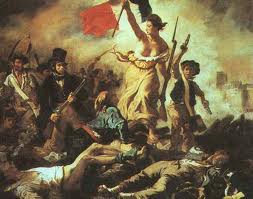
Marianne, Symbol of France, Brandishes the Tricolore,
Leading the  French People into Battle against the 1%.
Jean-Baptiste Say is the de facto Chief Economist of the French Revolution and therefore a champion of the 99%. He is also, via Say's Law, the man associated with the idea of small government and tax relief for the 1%.

How could that be? Which side is deluded?

Say was an active advocate for the Revolution and participated in its government. But his Say's Law was summarized dismissively by John Maynard Keynes as "supply creates its own demand".

Say's Law is the antecedent of the "supply-siders" who argue that the economy doesn't need Keynesian pump-priming by government to create demand. What an ailing economy needs in order to grow,  they say, is less government. In the short-hand of the 2012 election, this means continuing to cut taxes so as to "starve the beast" or shrink government so much that "we can drown it in a bathtub".

The idea of using tax-cutting as a way of forcing less government spending was initiated by David Stockman under President Reagan. What the country got was lower taxes and heavy borrowing to pay for a military buildup. During Reagan's presidency the United States switched from being the world's largest creditor country to being the world's largest debtor country. A long-chastened Stockman has recently called the proposed Ryan budget as a "fairy tale", meaning further tax cuts will end up being financed by further borrowing. He knows from experience.

How did it happen that a man who championed the 99% in revolutionary France is being cited by those who speak for the 1% in present-day USA? Say's Law is embraced by supply-siders to oppose Keynesian monetary and fiscal policy; it is rejected by Paul Krugman along with Keynes because it appears to be incompatible with fiscal deficits and monetary easiness in a recession.

So far as I can determine, this is how it happened. Say wanted to answer the idea promulgated by the aristocrats of the ancien regime that without the aristocracy there would be inadequate spending. This argument had two components:

(1) The aristocrats had the money to spend on luxuries and without spending on luxuries the economy would collapse. It was a kind of trickle-down spending idea promoted by those in power who did not have enough imagination to envision another system.

(2) Only the aristocrats had the skills to make the marketplace function.

Say said, to the contrary:

(1) The supply of goods would create its own demand because the marketplace sets prices so as to clear the supply. If someone supplies less valuable products than someone else, the price these products will fetch will be lower. At some price, everything will sell.

(2) The financial world of the aristocrats is not essential for the French economy to function. Their decapitation or flight will not destroy the markets. The supply of goods and services will continue to find intermediaries to determine the appropriate prices.

So the "starve the beast" folks are deluded on two counts:

(1) Say is no friend of theirs, because his entire theory was designed to show the lack of productivity of the 1%.

(2) In today's economy, there is also no evidence that cutting taxes on the 1% will necessarily ensure more lending and investment will occur. The 1% may just sit on their extra cash. It's the middle class that is more reliably likely to spend money that is created by tax relief.

In his later years, Say became a successful businessman. But his belief in the total  ineffectuality of the aristocrats was not borne out in the short term. A huge communication and confidence gap was left in French markets and institutions. After a period of confusion the Revolution gave way to what we might call today a junta under Emperor Napoleon.

The French Army under Napoleon trained its own officers. But the Navy was another matter. One theory explaining Napoleon's defeat at Trafalgar (see animation here courtesy of the late Colin White) by Admiral Lord Nelson is that all the officers in the pre-Revolution French Navy were "quatre quarts noblesse" meaning that all four grandparents had to be in the French nobility. Because the Revolution had killed or chased away all the Navy's officers, Napoleon's was left with underskilled naval leadership.

The French have not, however, looked back. "Liberte, Egalite, Fraternite" is written across the front of the Bourse. The attempt to replace the Tricolore under Napoleon III was one of the things that turned the French people back to a Republic.

Why did Keynes pick on Say? He needed to attack the idea that money markets and business cycles are self-regulating. You may not need the 1% to consume or manage the economy, but the governments must be able to address crises and stimulate the economy. Keynes argued that governments should run deficits in weak economic times, and run surpluses in good economic times.

What Bush 43 did was run deficits in good (low unemployment) economic times. By putting the winter woodpile in the stove in late summer, he stirred up the anti-deficit forces so that Obama had a hard time getting enough wood together for the stimulus he needed after the crisis of 2008.

This is a key message Paul Krugman has been hammering home in his New York Times column for months or years and in his excellent piece with his wife Robin Wells in the July 12 [2012] issue of The New York Review of Books. The NYRB article reviews the relative roles of Larry Summers, CEA Chair Christina Romer, Timothy Geithner et al. in the Bush 43 response to the financial crises of 2008 and then the Obama response to the spreading economic crisis of 2009.

Under Bush 41 and 43, the Federal Government continued to run deficits even through unemployment was very low by historical standards. Only Bill Clinton, during the Democratic interregnum, ran surpluses. I commented on this in September 2008.

At precisely the point where all the anti-deficit armory was assembled, the financial crisis hit and its size and psychological impact had a huge economic impact on the U.S. and world economy. Just as the anti-deficit forces went to work, the need for stimulative spending suddenly became acute. Obama's response fell short because of growing GOP opposition in the Congress. One reason is that state and local government revenues fell with the economic decline (they can't print money) and this offset the national stimulus. So states and localities have been faced with huge deficits in FY09-FY11 and more deficits face most of them in FY12 and FY 13, with no stimulus money left to help.

Steve Malanga of the Manhattan Institute has castigated states and localities for spending too much in good times and not putting away money for bad times. He quotes Keynes. He tells us he asked then-Mayor Koch to put money into a rainy-day fund. Koch correctly responded that elected officials find this difficult to do. So far, rainy-day funds tend to be spent at the first hint of dewfall.

Here are my comments:
1. Keynes was focused on the national level.  Counter-cyclical fiscal and monetary policy is meant to be applied at the money-printing level. States and localities just don't have that power. When Greece and Spain gave up the drachma and peseta, they gave up their ability to pursue a counter-cyclical policy for very long - that power has gone to the European Union and the European Central Bank.
2. States and localities have to balance their budgets.  Balanced budgets are the law in many states and it's reality in the rest of them. When states and localities talk about deficits they are talking about gaps that must be faced. These gaps must be closed through borrowing or other gap-closing measures.
3. Some counter-cyclical mechanisms work well. Revenue-sharing with states and localities was a good idea. New York City's averaging of assessed values over five years is a hugely successful mechanism that evens out property-tax revenues over the business  cycle.    

Saturday, June 23, 2012

JOBS | What Keynes Said, What Bush 43 Did

What did Keynes really say? He argued that governments able to run deficits, because they can print money, should run deficits in weak economic times - and run surpluses in good economic times.

What Bush 43 did was run deficits in good (low unemployment) economic times. By putting the winter woodpile in the stove in late summer, he stirred up the anti-deficit forces so that Obama had a hard time getting enough wood together for the stimulus he needed after the crisis of 2008.

This is the central message Paul Krugman has been hammering home in his New York Times column for months or years and in his excellent piece with his wife Robin Wells in the latest July 12 New York Review of Books. The NYRB article reviews the relative roles of Larry Summers, CEA Chair Christina Romer, Timothy Geithner et al. in the Bush 43 response to the financial crises of 2008 and then the Obama response to the spreading economic crisis of 2009.

The "starve the beast" thesis of the Reagan era (cut taxes and create a deficit crisis that will inhibit spending) turned the United States from the largest creditor nation in the world to the largest debtor nation. Under Bush 41 and 43, the Federal Government continued to run deficits even through unemployment was very low by historical standards. Only Bill Clinton, during the Democratic interregnum, ran surpluses. I commented on this in September 2008.

At precisely the point where all the anti-deficit armory was assembled, the financial crisis hit and its size and psychological impact had a huge economic impact on the U.S. and world economy. Just as the anti-deficit forces went to work, the need for stimulative spending suddenly became acute. As Krugman has argued at length, Obama's response fell short because of growing GOP opposition in the Congress. One reason is that state and local government revenues fell with the economic decline (they can't print money) and this offset the national stimulus. So states and localities have been faced with huge deficits in FY09-FY11 and more deficits face most of them in FY12 and FY 13, with no stimulus money left to help.

Now Steve Malanga of the Manhattan Institute castigates states and localities for spending too much in good times and not putting away money for bad times. He quotes Keynes. He tells us he asked then-Mayor Koch to put money into a rainy-day fund. Koch correctly responded that elected officials find this difficult to do. So far, rainy-day funds tend to be spent at the first hint of dewfall.

Here are my comments:
1. Keynes was focused on the national level.  Counter-cyclical fiscal and monetary policy is meant to be applied at the money-printing level. States and localities just don't have that power. When Greece and Spain gave up the drachma and peseta, they gave up their ability to pursue a counter-cyclical policy for very long - that power has gone to the European Union and the European Central Bank.
2. States and localities have to balance their budgets.  Balanced budgets are the law in many states and it's reality in the rest of them. When states and localities talk about deficits they are talking about gaps that must be faced. These gaps must be closed through borrowing or other gap-closing measures.
3. Some counter-cyclical mechanisms work well. Revenue-sharing with states and localities was a good idea. New York City's averaging of assessed values over five years is a hugely successful mechanism that evens out property-tax revenues over the business  cycle.    

Tuesday, January 17, 2012

Economic Indicator for the One Percent - Key West's 25th Annual Race Week

Putting up the divisional bulletin boards.
Here is an indicator of the prosperity of the One Percent - the density of yacht racers. The first big yacht regatta of 2012 is the Key West Race Week. According to the race staff I spoke with in Key West, recent attendance has been declining:
Peak year - 320 boats
2011 - 135 boats
2012 (expected) - 125 boats
2012 actual number of boats - 112.

I took some photos of the Key West headquarters, where the three divisional bulletin boards were being nailed up (see photo). They close off an entire street during Race Week. 

Interviews with Premiere Racing, the Key West race manager, explicitly mention the poor economy as the reason for the decline in boat entrants. For example, last May there was a question to the organizer, Peter Craig, about Race Week cutting back from five to four days after the 2011 dropoff, or even continuing at all. The question continues to be asked and a four-day race may emerge for some boats. The key to the event is in the sponsorships and Craig was confident in mid-2011 that he would assemble a good sponsor list for the 25th annual Race Week, his 19th. He has done this! Nautica was the title sponsor in 2010. Quantum Sail Design Group is in 2012. Kelly's Bar and Brewery (the "southernmost" brewery not counting Hawaii) is the headquarters venue.


The headquarters venue, Kelly's

The number of boat entrants depends on many factors, such as the number of new boat designs, the number of designs not competing any longer, and the number of boats entering in each of the main boat classes. But overall the number of boats is related to the economy and the willingness of boat owners to spend the money and time to get down to Key West for a week. An economic recovery in 2012 can’t come too soon for event organizers anywhere. I don't know Premiere Racing's burn rate, and he may be able to carry on indefinitely, but Craig told an interviewer that he has to recreate his sponsorship and financing every year. To paraphrase a comment attributed to the great economist Lord Keynes:
An event organizer can go broke while the One Percent are postponing a traditional activity for just a few years.
If you want to follow this colorful event, go to Quantum's blogspot page and sign on for one of the various real time reports of the race.

Saturday, December 27, 2008

FINANCIAL CRISIS | Missing Minsky

Dec. 27, 2008–Martin Wolf, at FT.com, wrote on December 24 that Keynes offers us the best way to think about the financial crisis:
We are all Keynesians now. When Barack Obama takes office he will propose a gigantic fiscal stimulus package. Such packages are being offered by many other governments. Even Germany is being dragged, kicking and screaming, into this race. The ghost of John Maynard Keynes, the father of macroeconomics, has returned [and] that of his most interesting disciple, Hyman Minsky.
Hyman Minsky
I first heard Hy Minsky talk in the 1960s. His main message was:

1. Financial systems have a built-in tendency to euphoria. The financial market does not tend toward stability. The opposite is true. Bankers and other financial actors borrow more and more heavily, making the system increasingly vulnerable to panic. Lenders start after a scare by being conservative, hedging their bets. But eventually confidence returns and speculation takes hold again. Then investors get to the Ponzi phase – manic use of credit, a euphoria or bubble.

2. The credit cycle tends to manic, but ends with panic. The Ponzi phase continues until some investors exit with their profits, or the central bank raises interest rates to reduce investor euphoria, and then a financial institution runs into difficulty. The failure causes a bankers' panic. Turning points in the five stages of the cycle are called “Minsky moments”.

3. The system tends to instability and must be regulated. Fashions in monetary theory have moved from a belief that Keynesian sophisticates could “fine-tune” the economy, to fear that the Fed had lost control of the ability to contain inflation, to a belief that markets work best with minimal interference. Hy rejected all these ideas, preaching consistently about the need for regulation and the importance of leaning against the excesses of what Keynes called the animal spirits of investors.

Born in Chicago, Hy taught at Brown, Berkeley and Washington University (St. Louis). He died 12 years ago in Rhinebeck, 77 years old, near Bard College’s Levy Institute, which has a special interest in business cycles and treated Hy as a star in his last six years. Hy didn’t live to see how closely this year’s meltdowns would follow his predicted scenario, with the Lehman failure being one of several clear Minsky moments.

Former Fed Governor Laurence Meyer, who spoke in New York City last week, has said of Minsky: “few have influenced my thinking about economics more than Hy.” If Hy had been listened to, we would have seen less permissiveness, fewer NINJA (No Income, No Job nor Assets) mortgage loans and more aggressive Federal Reserve and SEC oversight over highly leveraged instruments and institutions.

Fed Chairman Alan Greenspan and then-Governor Ben Bernanke were anxious not to “pop the bubble” because (citing the Milton Friedman-Anna Schwartz history) that’s the mistake the Fed made in 1928 - after the guy who knew what he was doing, FRBNY chief Benjamin Strong, died of TB. The Fed was concerned not to stifle financial innovation, arguing that it is ready with new weapons in the event of an asset-destroying credit freeze.

This last theory is now being tested. The stakes are high, beyond an academic debate. Whatever side one takes, any sensible person should be rooting for the outgoing and incoming Fed-Treasury teams to succeed in restoring confidence and the flow of credit.