
 The ten most-read posts in December 2015 were: |
| TECH GROWTH | NYC Firms Top Inc. 5000 List Sep 1, 2014 |
| OBIT | John E. Zuccotti (1937-2015) Nov 28, 2015 |
| OBIT | Adele Wick, Economist (1950-2015) Dec 10, 2015 |
| FOMC | Job Numbers Mean EZ Decision Dec 4, 2015 |
| GLASS-STEAGALL | Why Moyers Likes Stockman Dec 9, 2015 |
| WINE BIZ | NY State Planning to Do a Bad Thing Nov 23, 2015 |
| LOSS | Terror Attacks – Paris vs. 9/11 (Postscript... Nov 16, 2015 |
| NYC More Catholic, Jewish, Muslim Feb 15, 2008 |
| LOUIS XIV | Finance Minister Fouquet's Folly (Upda... Oct 1, 2015 |
| ART BIZ | "Van Gogh Just Sold One Painting" Is a C... Mar 16, 2015 |
Early alerts on longer-term business, economic and public policy issues. Successor to the web site www.cityeconomist.com. Maintained by John Tepper Marlin.
Showing posts with label David Stockman. Show all posts
Showing posts with label David Stockman. Show all posts
Friday, December 18, 2015
CITYECONOMIST | Dec. 18, 2015–220K Pageviews–Top 10 Posts.


 I write about the biographical and economic threads in history. Special interests include symbols of family, such as coats of arms, and the behavior of families in a crisis.
Wednesday, December 9, 2015
GLASS-STEAGALL | Why Bill Moyers Likes David Stockman

Stockman still considers among his enemies those who espouse fiscal stimulus and central planning.
But he now inveighs against both parties, arguing as Ralph Nader does that both are beholden to Big Money for campaign contributions.
Stockman, who attended the Harvard Divinity School, says he was deeply opposed to the bailout of the financial institutions.
No wonder Bill Moyers sees in David Stockman's new song a melody he likes. The financial bailouts, says Stockman, have lured American private enterprise into a casino of speculation that leads to greater economic inequality. The securities markets are rigged against small investors. "We have neither capitalism nor democracy," says Stockman. "We have crony capitalism."
It's not surprising that Stockman's villains include Democrats FDR and Barack Obama. The surprise is that they include Republicans Richard Nixon and George W. Bush ("who repudiated fiscal rectitude and ballooned the warfare state via senseless wars"), and Fed chairmen Greenspan and Bernanke.
It's not surprising that his heroes include Republicans Dwight Eisenhower and Bill Simon. The surprises are Democrats Carter Glass, Harry Truman and Bill Clinton.
I am bemused by the list, especially after listening to David Stockman talk to the Cato Institute in 2013. Stockman doesn't spare Ronald Reagan and Milton Friedman from his criticism. He said that his book languished, as you might expect a 700-page book on money markets to do, until it was denounced by Paul Krugman, when it shot up to #4 on the best-seller list, behind two diet books and "a book on the walking dead".
There's a lot for Krugman not to like about Stockman's enemies list. How can you give credit to Carter Glass without recognizing that FDR enabled his legislation and in his response to the bank panic took a tough line on the banks? FDR and his Treasury Secretary Will Woodin let the insolvent banks stay closed. It was FDR who created the SEC, and traded the creation of the FDIC for strict laws preventing the investment banks from using the banks as a source of cheap money to speculate with.
It all worked well until Glass-Steagall was chipped away at, with the biggest blows being the Gramm-Leach-Bliley Act (the Financial Services Modernization Act of 1999) and then the Commodity Futures Modernization Act of 2000. The chief engineer of these laws was an architect of the Reagan Revolution, GOP Senator Phil Gramm.
Stockman was part of a revolution that got what it wanted. He just didn't want what it got. His populist call to arms against crony capitalism would be more effective if he would recognize on his enemies list the people who tore down Glass-Steagall, and champion its restoration.
I write about the biographical and economic threads in history. Special interests include symbols of family, such as coats of arms, and the behavior of families in a crisis.
Sunday, October 14, 2012
FRANCE | Say–Hero of the 99% AND the 1%??
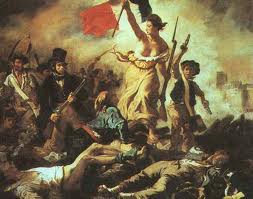 |
| Marianne, Symbol of France, Brandishes the Tricolore, Leading the French People into Battle against the 1%. |
How could that be? Which side is deluded?
Say was an active advocate for the Revolution and participated in its government. But his Say's Law was summarized dismissively by John Maynard Keynes as "supply creates its own demand".
Say's Law is the antecedent of the "supply-siders" who argue that the economy doesn't need Keynesian pump-priming by government to create demand. What an ailing economy needs in order to grow, they say, is less government. In the short-hand of the 2012 election, this means continuing to cut taxes so as to "starve the beast" or shrink government so much that "we can drown it in a bathtub".
The idea of using tax-cutting as a way of forcing less government spending was initiated by David Stockman under President Reagan. What the country got was lower taxes and heavy borrowing to pay for a military buildup. During Reagan's presidency the United States switched from being the world's largest creditor country to being the world's largest debtor country. A long-chastened Stockman has recently called the proposed Ryan budget as a "fairy tale", meaning further tax cuts will end up being financed by further borrowing. He knows from experience.
How did it happen that a man who championed the 99% in revolutionary France is being cited by those who speak for the 1% in present-day USA? Say's Law is embraced by supply-siders to oppose Keynesian monetary and fiscal policy; it is rejected by Paul Krugman along with Keynes because it appears to be incompatible with fiscal deficits and monetary easiness in a recession.
So far as I can determine, this is how it happened. Say wanted to answer the idea promulgated by the aristocrats of the ancien regime that without the aristocracy there would be inadequate spending. This argument had two components:
(1) The aristocrats had the money to spend on luxuries and without spending on luxuries the economy would collapse. It was a kind of trickle-down spending idea promoted by those in power who did not have enough imagination to envision another system.
(2) Only the aristocrats had the skills to make the marketplace function.
Say said, to the contrary:
(1) The supply of goods would create its own demand because the marketplace sets prices so as to clear the supply. If someone supplies less valuable products than someone else, the price these products will fetch will be lower. At some price, everything will sell.
(2) The financial world of the aristocrats is not essential for the French economy to function. Their decapitation or flight will not destroy the markets. The supply of goods and services will continue to find intermediaries to determine the appropriate prices.
So the "starve the beast" folks are deluded on two counts:
(1) Say is no friend of theirs, because his entire theory was designed to show the lack of productivity of the 1%.
(2) In today's economy, there is also no evidence that cutting taxes on the 1% will necessarily ensure more lending and investment will occur. The 1% may just sit on their extra cash. It's the middle class that is more reliably likely to spend money that is created by tax relief.
In his later years, Say became a successful businessman. But his belief in the total ineffectuality of the aristocrats was not borne out in the short term. A huge communication and confidence gap was left in French markets and institutions. After a period of confusion the Revolution gave way to what we might call today a junta under Emperor Napoleon.
The French Army under Napoleon trained its own officers. But the Navy was another matter. One theory explaining Napoleon's defeat at Trafalgar (see animation here courtesy of the late Colin White) by Admiral Lord Nelson is that all the officers in the pre-Revolution French Navy were "quatre quarts noblesse" meaning that all four grandparents had to be in the French nobility. Because the Revolution had killed or chased away all the Navy's officers, Napoleon's was left with underskilled naval leadership.
The French have not, however, looked back. "Liberte, Egalite, Fraternite" is written across the front of the Bourse. The attempt to replace the Tricolore under Napoleon III was one of the things that turned the French people back to a Republic.
Why did Keynes pick on Say? He needed to attack the idea that money markets and business cycles are self-regulating. You may not need the 1% to consume or manage the economy, but the governments must be able to address crises and stimulate the economy. Keynes argued that governments should run deficits in weak economic times, and run surpluses in good economic times.
What Bush 43 did was run deficits in good (low unemployment) economic times. By putting the winter woodpile in the stove in late summer, he stirred up the anti-deficit forces so that Obama had a hard time getting enough wood together for the stimulus he needed after the crisis of 2008.
This is a key message Paul Krugman has been hammering home in his New York Times column for months or years and in his excellent piece with his wife Robin Wells in the July 12 [2012] issue of The New York Review of Books. The NYRB article reviews the relative roles of Larry Summers, CEA Chair Christina Romer, Timothy Geithner et al. in the Bush 43 response to the financial crises of 2008 and then the Obama response to the spreading economic crisis of 2009.
Under Bush 41 and 43, the Federal Government continued to run deficits even through unemployment was very low by historical standards. Only Bill Clinton, during the Democratic interregnum, ran surpluses. I commented on this in September 2008.
At precisely the point where all the anti-deficit armory was assembled, the financial crisis hit and its size and psychological impact had a huge economic impact on the U.S. and world economy. Just as the anti-deficit forces went to work, the need for stimulative spending suddenly became acute. Obama's response fell short because of growing GOP opposition in the Congress. One reason is that state and local government revenues fell with the economic decline (they can't print money) and this offset the national stimulus. So states and localities have been faced with huge deficits in FY09-FY11 and more deficits face most of them in FY12 and FY 13, with no stimulus money left to help.
Steve Malanga of the Manhattan Institute has castigated states and localities for spending too much in good times and not putting away money for bad times. He quotes Keynes. He tells us he asked then-Mayor Koch to put money into a rainy-day fund. Koch correctly responded that elected officials find this difficult to do. So far, rainy-day funds tend to be spent at the first hint of dewfall.
Here are my comments:
1. Keynes was focused on the national level. Counter-cyclical fiscal and monetary policy is meant to be applied at the money-printing level. States and localities just don't have that power. When Greece and Spain gave up the drachma and peseta, they gave up their ability to pursue a counter-cyclical policy for very long - that power has gone to the European Union and the European Central Bank.
2. States and localities have to balance their budgets. Balanced budgets are the law in many states and it's reality in the rest of them. When states and localities talk about deficits they are talking about gaps that must be faced. These gaps must be closed through borrowing or other gap-closing measures.
3. Some counter-cyclical mechanisms work well. Revenue-sharing with states and localities was a good idea. New York City's averaging of assessed values over five years is a hugely successful mechanism that evens out property-tax revenues over the business cycle.
I write about the biographical and economic threads in history. Special interests include symbols of family, such as coats of arms, and the behavior of families in a crisis.
Subscribe to:
Posts (Atom)