Showing posts with label Wall Street Journal. Show all posts

Thursday, May 31, 2018

BOOK BIZ | Healthy, Says Ingram, Citing WSJ

If you don't study your history you are a leaf
disconnected from its tree, said Michael
Crichton. So there.
May 31, 2018 – In its regular emailed newsletter, the book distribution giant Ingram reports that the publishing industry is alive and well, the focus of the attention of several investors with deep pockets.

I was blessed with a copy of the Ingram email because I stopped by their Javits Center booth this morning at BookExpo. Ingram offers a great deal to self-publishers, including hard-cover options in  a variety of sizes.

In support of the thesis that book publishing has a great future, Ingram cites an article from earlier in the month in the Wall Street Journal that names Snap Inc. Chairman, Michael Lynton, billionaire Len Blavatnik, and Ellis Jones, chairman of investment firm Wasserstein & Co., among investors pouring millions of dollars into printed books.

The immediate focus of the WSJ article was the acquisition by Lynton and the investors of the regional publishing company Arcadia, which engages nostalgia buffs by producing collections of high-quality old photographs in heritage books. Arcadia is the largest local-history publishing company in the United States, with 14,000 titles.

Sunday, November 26, 2017

GOP | Cleaning Up

National Review Continues to
Pillory the Imperial Trump Style.
New York City, November 26, 2017 – The current National Review cover shows a regal Donald Trump-like figure sitting on a on gilded hathi howdah (हाथी हौदा) atop a gilt-armored elephant.

I should explain that I have been receiving the National Review for the last few years courtesy of a subscriber who gets an extra subscription every December to send to someone who could use it. 

Proud indeed I am to be her Designated Democrat.

Back to the cover. Following behind the man on the golden hathi howdah are three men in black, carrying spades. Their faces bear the strong likenesses of three key non-family members of King Trump's inner circle.

This put me in mind of re-posting something I originally posted on November 9, 2008, after the election of Barack Obama.

Anyone reading this who is not a New Yorker or a circus follower should know that the elephants have reportedly made their last trip into New York City.

CLEANING UP GOP MESS 
HUFFINGTON POST


BY John Tepper Marlin

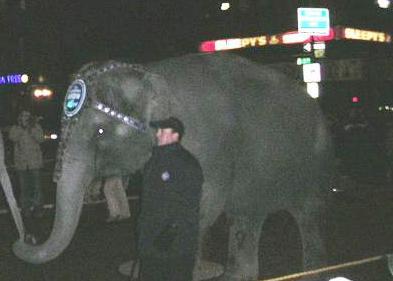
November 9, 2008 – In spring, the Ringling Brothers and Barnum & Bailey circus comes to New York City. A dozen-and-a-half elephants march through the Queens Midtown Tunnel in the early a.m. to report for circus duty at Madison Square Garden. 

Following them warily is a cadre of sanitation workers with shovels, a truck and water to clean up the mess the elephants leave behind.

2008-10-10-elephantwalk1.jpg
Elephants walk into New York City before dawn, followed
by men with shovels, and a truck with a flushing system.
And that’s what Ben Bernanke’s Fed is trying to do with the financial mess left by a series of GOP administrations that have 
- cut taxes on top earners while waging wars,
- pumped up the national debt,
- increased U.S. fiscal dependence on foreign debt buyers.
- dismantled bank regulations tracing back to 1913 and 1933,
- enabled dangerous financial transactions, while they have
- failed to regulate the shadow banking system.
So it’s fair that the percentage-point drops in the Dow translate to drops in voter support for GOP candidates on November 4, 2008. No wonder John McCain has made a lunge for the middle-class vote with his out-of-character and poorly conceived American Homeownership Resurgence Plan. 
The financial crisis of today has long been feared, Greg Ip noted in a Wall Street Journal blog 16 months ago: 
As an academic in the early 1980s, Mr. Bernanke pioneered the idea that the financial markets, rather than a neutral player in business cycles, could significantly amplify booms and busts. Widespread failures by banks could aggravate a downturn, as could a decline in creditworthiness by consumers or businesses, rendering them unable to borrow. Mr. Bernanke employed this “financial accelerator” theory to explain the extraordinary depth and duration of the Great Depression.
Even though bank weakness is less likely to hurt the economy today, given banks’ reduced importance as lenders, the financial accelerator is still relevant. That is because “nonbanks” — lenders, such as standalone mortgage companies, that don’t accept deposits — also “have to raise funds in order to lend, and the cost at which they raise those funds will depend on their financial condition — their net worth, their leverage, and their liquidity.”
Mr. Bernanke doesn’t say it, but the current crisis in the subprime mortgage market may be a perfect illustration of the financial accelerator at work today. Many subprime borrowers are facing bankruptcy because their net worth has collapsed and they can’t get new credit. Similarly, numerous subprime lenders have gone bankrupt because they could not get financing to continue operations from newly skeptical Wall Street lenders.
A prescient comment on this post pointed out that financial crises now have special potential for world-wide catastrophe because of the global reach of the U.S. financial system:
The serious mistakes of modern day economic analysis are to ignore the huge trade imbalance created by the globalization process. The huge trade deficit of US must flow back to US market and be lent to someone. As we know, lending generates more lending and who knows how many trillions this US trade deficit have ballooned to every year. It is this huge liquidity glut that is supporting US Government’s debt spending, US consumers' borrow and spend frenzy, huge borrowings of private equity firms and other M&A activities, enormous borrowings of hedge funds and so on. It is no wonder that the prolonged Fed tightening has lost its punch and takes so long to affect the home mortgage market. CK - June 16, 2007. 
Follow John Tepper Marlin on Twitter: 

Wednesday, January 30, 2013

Krugman vs. Taylor on the Zero-Bound Fed


Here's how I see the Great Debate about monetary policy, with John Taylor opening with an op-ed in the Wall Street Journal (http://on.wsj.com/VY0Iet) on the Fed being a drag on the economy through its continued zero-interest rate FOMC directive and Paul Krugman lambasting him via his NY Times perch for arguing that the low interest rates are inhibiting lending. (http://nyti.ms/VwkXU7):

Taylor is a "hard money" man (consistent with the dour mien of John Calvin, although Krugman says he has Calvin of Calvin & Hobbes in mind), unhappy at low interest rates that don't sufficiently reward prudent savers/debt-holders, so that banks withhold loans. Krugman has maintained consistently that the economy has not been stimulated enough on the fiscal side after the meltdown in 2008 and therefore staying at the zero-interest-rate bound at the short end of the market is a consequence; he is a continued-easy-money man.

Krugman's answer to Taylor's argument is that his theoretical framework is one of a ceiling, which is inappropriate. In fact the FOMC directs open market operations (buying short-term Treasury bills to put cash into the economy), and the equivalent in the longer end of the bond market, Quantitative Easing (buying longer-term Treasurys to bring down longer-term rates) also operates in the open market for debt.

The Fed does not regulate interest rates. It just buys and sells Treasurys.

For those who don't have time to pore through this exchange and its 60+ comments, I excerpt three comments that were posted around 9 am this morning to exemplify the struggle that the commentators have to be fair and to try to figure out who is right.
Justin - Brooklyn, NY: Can anyone kindly explain what this sentence is purporting to say? (I know that Krugman is refuting it, but this went over my head.): "low rates engineered by the Fed are just like a price ceiling that reduces the supply of loans, and therefore reduces overall lending."
AndyfromTucson - Tucson AZ: The reasoning is that the interest rate is the price paid for borrowing money, and so if the government caps the price at an artificially low level then it will reduce the supply of loans. Like if the government put a $5000 cap on the price of new automobiles all the car manufacturers would cut production. What Krugman is saying is that interest rates are not a legal cap, so this analysis doesn't work. Jan. 30, 2013 at 9:41 a.m.
save10percent - Denver, CO: My understanding of it is that as the price goes down (talking about the cost of taking out a loan, which is the interest paid), the quantity demanded goes up, but the quantity supplied goes down (econ 101). Taylor is saying that the fed sets the price ceiling too low and therefore banks aren't lending (less supply). Krugman says that the fed does not set a price ceiling for the interest on loans that banks make, so Taylor's argument doesn't make sense.
I have no doubt that Taylor will be back with an involved explanation why he was misunderstood. Meanwhile the winner of the debate pro tem is Paul Krugman and as one commentator observes, we can be glad that Gov. Mitt Romney did not win the presidential election, because if he had, Prof. Taylor was in line to become his Treasury Secretary.