Showing posts with label East Hampton. Show all posts

Thursday, April 23, 2020

PANDEMIC | Global to Local Data

Global

The map and table below show that the United States is by far the most affected based on confirmed/reported cases of Covid-19.  The first is from the New York Times, April 24.
The second is from Johns Hopkins University's website.
Worldwide, Confirmed and Reported Cases, Johns Hopkins University Map, April 24, 2020.
Total cases confirmed worldwide as of Friday morning, April 24: 2.7 million. The most confirmed/reported cases now are in these five countries:
1. 869,170 United States
2. 213,024 Spain
3. 189,973 Italy
4. 159,460 France
5. 153,129 Germany
6. 139,246 United Kingdom

United States

The map and table below show that New York State and New Jersey have been taking the brunt of the impact of the virus, with nearly 21,000 deaths in New York.


USA Confirmed Cases, Johns Hopkins University Map, April 24, 2020.
Top ten states by confirmed cases (from the The Guardian, April 24, 2020)

New York State


This map and table shows that within New York State, the incidence of cases by county is highest in New York City and surrounding counties, where the density is highest. Nassau and Suffolk both have about 30,000 reported cases of the coronavirus, both about 2,000 cases per 100,000 population (2 percent), but Nassau has many more deaths relative to the number of cases.


New York City and Top Five Counties by Reported Cases and Deaths (New York Times)


Suffolk County (NYS Department of Health), Towns


The map and table below show that the high concentration of Covid-19 cases are on the western end of the county, where the density is higher. The Town of Islip has the highest count of cases.


Source: Bonac TRS, April 23, 2020

East Hampton Town

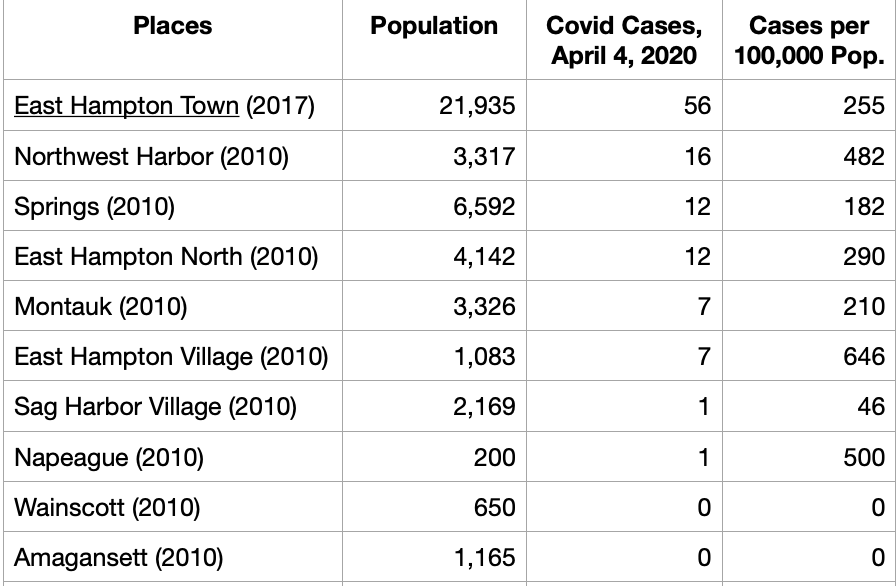
This table shows that East Hampton Town has been spared so far any deaths but the Village has a high number of cases relative to the residential population. This reflects the fact that the Village is a commercial center with continuig interaction.

East Hampton Town, Census Places (Hamlets and Villages)
Compared with Global, U.S., NYS, NYC, Nassau County and Suffolk County
Source: Data from previously cited sources. Computations by CityEconomist.

Sunday, April 5, 2020

NY STATE | County Cases, Deaths from COVID (3)

April 6, 2020—Nassau County's death rate from COVID-19 has nearly caught up with New York City's 29.3 deaths per 100,000 population as of early-morning data.

New York City's five counties and five other counties – Nassau, Rockland, Westchester, Orange and Suffolk – dominate the figures.

Deaths in Large Counties as of April 5. The large population of both New York City's five counties and Nassau County have raised the statewide average death rate to 21.2, as shown int he first table. The only other county in the state to be above the state average is Rockland. Westchester is now just below the state average, followed by Orange County and Suffolk County. No other county in New York State comes close to these ten counties.


This is an update of two earlier posts on NY County data, April 3 and March 27. It utilizes the interactive database of the New York Times. See earlier posts for references and notes.

Deaths by Age Group and Gender. The second table shows how a pattern is already forming in the data, with the largest number of victims being over 70 and male. 11.4 percent of the fatalities were patients 90 and over, 26.9 percent 80 and over, and 53.4 percent were 70 and over. By gender, 61 percent of the deaths were men.

Source: Fatalities from NYS Department of Health. Population data from U.S. Census Bureau (2018). American Community Survey 1-year estimates. Retrieved from Census Reporter Profile page for Suffolk County, NY. Also used data from Towncharts.com and combined data to estimate the population by age ranges.
East Hampton Town. The COVID-19 cases in the hamlets and villages and other designated census places within the Town, as of April 4, 2020, show that the largest concentration of cases are in the Village of East Hampton. So far there are no reported deaths in the Town of East Hampton.


Update, April 8, 2020—The number of cases rose to:

Suffolk County 17,444 (Deaths, 323).

EAST HAMPTON TOWN, 75. (No reported deaths.)
Northwest Harbor, 17Springs, 17East Hampton North, 18Montauk, 10East Hampton Village, 10Sag Harbor Village, 1Napeague, 2Wainscott, 0Amagansett, 0

Wednesday, April 19, 2017

R.I.P. | Sage of Springs, Herb Field (Updated Apr 27, 2017)

Apr 19, 2017 – Herbert E[dwards] (Herb) Field, the Sage of Springs, passed to his eternal reward yesterday at 92 years old, according to his pastor, Rev. Nancy Howarth.

A memorial service for Herb Field will be held at 10 a.m. on Saturday, May 20 at the Springs Community Presbyterian Church, at the intersection of Old Stone Highway and Springs Fireplace Road.

Herb Field's father and two uncles died tending their traps during the 1938 Hurricane when Herb was just 13. (His obituary, based on information from his son Thomas F. Field, was published in the East Hampton Star on April 27.)

Last year, he received a well-earned temporal award at an end-of-summer meeting of the Springs Community Advisory Council in Ashawagh Hall.

East Hampton Town Councilman Fred Overton presented him with a Proclamation testifying to his contributions to the Springs community. Overton's presentation was on behalf of East Hampton Town by its Supervisor, Larry Cantwell.

At the presentation, the crowd attending the meeting gave Herb a standing ovation for his contributions to his country and his community.
The Proclamation.

The citation, signed August 22, 2016 by Supervisor Cantwell, proclaimed that Herbert Edwards (Herb) Field was born at Franklin Farm on August 3, 1924 to Herbert Stone Field and his wife Abigail Rebecca, née Edwards.

Herb was the eldest of four sons. After the death of his father and uncles, he worked for Ferris Talmage to help support his mother and brothers. Talmage remained a lifetime mentor.

Herb enlisted at 17 in the U.S. Navy in April 1943. He served as a motor mechanic on board destroyer escorts.  He was sent on tours in the Pacific, Europe and the Americas. He was honorably discharged on December 18, 1945.

After his military service he managed Sylvester Prime’s farm on Shelter Island and then in 1949 moved to Morrisville, N.Y., where he purchased and managed two dairy farms covering 316 acres.

After 15 years upstate, he purchased the Baker and Baker dairy farm in Amagansett and lived there until his death.

Herb faithfully attended the Springs Community Presbyterian Church starting in the 1970s and sat consistently in the second row behind the organ donated by Robert Mulford.

For what must have been four decades he arrived an hour before the service every Sunday morning and started the coffee pot brewing, until one day not so long ago he announced he couldn't keep doing this any more.

When I first came to Springs in 1981 as a seasonal visitor, I started singing in the Springs Church choir and was invited, faute de mieux, to join "The Men of Springs," a church-related activity. My wife Alice Tepper Marlin was dubious about this. It sounded macho. Who knew what sinister plans these local deer-hunters, who probably looked askance at seasonal families "from away", might not be up to?

Herb Field with Tina Piette and
me, next to Ashawagh Hall. Photo
by Dr Carter Dodge.
Then we found out that the principal public activity of the Men of Springs was to cook and serve a community chicken dinner with no apparent female support. Her attitude to the group mellowed.

So I was a seasonal participant in the program, but over time the number of men who composed the Men of Springs dwindled, lost to illness or death or retirement to a place where they could get assisted living — or unassisted living — at an affordable price.

In time, the remaining men could not keep up the tradition of the annual chicken dinner. The event was continued, like so much else, through the devotion of the hard-working women of the church.

Herb was, I think, the last of the Men of Springs who were there when I arrived in Springs 36 years ago.

Herb earned the title of Sage of Springs because he knew more about the history of Springs than anyone else alive. He commented as an aside that he remembered when Supervisor Cantwell was "in short pants."

Over the years Herb told me more truly funny stories than I can count. He had a keen understanding of farming, canning, clamming, milling and human nature and he communicated it with his dry Bonacker humor, of which he was acutely aware and proud.

For example, during the period of my Men of Springs membership, I was in the kitchen, and everyone there was highly aware that I was a city guy out of my element in the Springs culture, which for centuries was built on faith, farm, fish and family. I came in for a lot of teasing as the country bumpkins enjoyed showing the city slicker how little he knew about what was important.

At one point they explained to me that how nutritious the food was, and that the delicious ginger gravy they were serving with the chicken had no sugar or flour in it.

I was amazed. How could they do that? They swore on the bible they added no sugar or flour. But I saw a glint in Herb's eye, and I demanded that he tell me, based on my rights as a fully vested seasonal member of the Men of Springs,  what the ingredients were.

Herb with Dr Dodge.
Photo by JT Marlin.
He said: "Well now, we have the juice left over from the chicken and we filter out any skin and the heavy fat. We cook it all in a pan and stir in some green onions and celery, and some garlic, about 4 minutes..."

"And...?"

"We add some pepper, thyme and sage..."

"And... what else?" I demanded, getting a little impatient.

I learned over time to look for the signal that Herb was about to deliver the punch line to his story, which he loved doing. He would become super-serious.

"Then, well now, you know, for every quart of gravy," he said, "we mix in five ginger-snap cookies."

After God created Herb, He threw away the mold.

To subscribe to this blog, or its comments, or to search its contents or to forward this post using G+, see the options at top right.

Wednesday, October 12, 2016

CRIME DATA | DWI Accidents and Arrests–East Hampton

I have observed in prior years that East Hampton has more than its share of traffic accidents, and many are related to driving while intoxicated. It's a resort town where one is expected to enjoy oneself and therefore alcohol is readily available.

But last month a police officer in East Hampton was hit by an SUV and had to be airlifted to a hospital. This brought home the current risks of traffic accidents and a probable cause.

This past week saw a high incidence of both accidents and DWI arrests. Long after the summer crowds have left, last week eight arrests were made in the Town of East Hampton or of a resident of the Town.

The alleged drunk drivers were not teenagers. Their ages ranged from 31 to 71, with the median age 43. Therefore the pattern here during the past week is different from that of the nation, where 25 percent of drunk driving arrests are of young people 18-24 and 40 percent are of people 18-29. (It would be interesting to check the arrest data over a longer period to see if this pattern holds up over time.)

Eight DWI arrests in a week is a rate of 416 per year in a population of 21,000, or 19.8 per thousand population. This is four times the national DWI arrest rate of 4.7 per 1,000 population (1.5 million U.S. DWI arrests a year in a population of 319 million). In the summertime one could blame irresponsible people From Away. But in October?

Several of the arrests followed the crashing of one or more vehicles, of which quite a few were large cars or pickup trucks, which should worry people who drive vehicles that would not hold up well against a big SUV or truck.
  1. A 46-year-old local resident with a Washington State driver's license was driving a 2000 Toyota Tundra in the lot when he struck another vehicle. He failed roadside sobriety tests and an open bottle of Smirnoff vodka was in the cabin of the truck.  
  2. Four hours later, a 55-year-old driving a 2014 Chevrolet pickup truck was involved in a three-car accident where Division Street forks into Hampton Street. The local resident failed sobriety tests. Police said they found an open container of alcohol in the cabin of the truck.
  3. A 40-year-old man was arrested after a crash on Cedar Street in East Hampton. He was driving a 2009 Nissan Altima when the vehicle veered off the road.  
  4. Erratic driving by a 71-year-old man resulted in a complaint that resulted in this arrest. From Davenport, Fla., the man was driving a 2004 Dodge pickup truck, who just missed striking several pedestrians crossing Woods Lane in East Hampton Village. He and a passenger had open bottles of Corona beer in the car.
  5. A 31-year-old woman with at least one prior DWI conviction was arrested for speeding on North Main Street in a 2008 Nissan.
  6. A 45-year-old man driving a 1996 Toyota on Montauk Highway was arrested for allegedly swerving across lane lines. Though his license carries a Queens address, he told the court he now lives in Sag Harbor.
  7. A 37-year-old Bridgehampton woman was arrested early Friday morning by East Hampton Town police. She was stopped because her 2014 Chevrolet Cruz, driving west on Montauk Highway near Daniel's Hole Road, had a headlight out. Police said she refused to take the breath test; her license was thereupon revoked by Justice Rana for a year.
  8. Also, a 36-year-old East Hampton man was charged with drunken driving Saturday night by Southampton Town police. He had been pulled over on Lake Avenue in Hampton Bays for an equipment violation.

Sunday, June 19, 2016

ART BIZ | Eternal Springs Hope

Frank Sofo, "Bicycle at Main Beach," East Hampton.
Photo by JT Marlin, by permission of the artist.
June 19, 2016–Last month's 92nd Street Y exhibit at Ashawagh Hall (in Springs, N.Y.–Town of East Hampton) was a huge success, with one art work selling for $1,800, and one artist selling $3,400 worth of art.

By comparison, the Plein Air Exhibition this weekend was a washout.

Only four items sold out of about 75 on the walls and tables. I was responsible for one of the four purchases. The median price of the three paintings sold was $200.

So red dots were prominently absent, even in the middle of the second day. This commercial failure cannot be sloughed off as resulting from a lack of effort by the artists:
  • The exhibit was kicked off with a big opening party, attracting, says one person who was there, 200 people.
  • The artist collective had 30 participants, allowing for a wide range of landscape interpretations.
  • Organizers sent out press releases and posted notices of the exhibit.
  • It's an annual event, so one would expect repeat interest, which is a big plus.
  • Substantial publicity was focused on the plein air painting of connected artists at Pussy's Pond, the Farmer's Market, the Springs Library, the Blacksmith's Shop, the General Store, Gerard Drive, Maidstone Beach, Home Sweet Home and the Pollock/Krasner House.
  • The show was staffed at all times, and refreshments were on hand.
Frank Sofo, caught in the act of painting outside
Ashawagh Hall, Springs, N.Y.
Yet the total take from the sales of paintings was $550. Ashawagh Hall costs $600 to rent for two days and there were the costs of refreshments and publicity in mounting the show. At most three of the 30 artists covered any of their costs.

I talked about the economics of the exhibit with someone who sold two of the four items that were not homeward bound this weekend–Frank Sofo.

He is a competent artist who has illustrated the covers of a dozen or more reissued Hardy Boys and Nancy Drew books. He has written and illustrated several of his own books for children. His plein air sketch of a bicycle on Main Beach is shown at the top of this post, with Red Dot.

Veronica sees Vincent in the starry sky. Illustration
by Frank Sofo from Vincent & Veronica. Photo
by JT Marlin, by permission of the artist.
He was offering for sale a couple of his books. I bought one about Vincent van Gogh, who is related by marriage to my late artist mother, Hilda van Stockum–Vincent's brother Theo worked for a while at the van Stockum bookstore in the Hague. Sofo's invention is that Vincent had a cat named Veronica who loved her master and when he dies–SPOILER ALERT–is consoled by the fact that she sees his face in the sky.

So why was the 92nd Street Y show so successful in selling while the Plein Air show was not?

I suggested to Sofo these possibilities:
  • The 200 people who came to the opening party maybe didn't suspect that the artists want to sell their art and that's why they were invited?
  • Buyers are timid about buying right away
  • Buyers want to take time to make a decision, and a weekend is too short?
  • It takes more than a weekend to get reviews and then be open for post-review sales?
  • The organizers or beneficiary of the exhibition are entitled to a cut and the artists foolishly decide to avoid paying the cut (or split the difference with the buyer) by selling after the show?
  • The art is over-priced? (Not in this case.)
  • Not enough publicity? (Seems not the case here.)
  • Not enough personal word-of-mouth?
  • Artists are not sending their best work to this exhibit?
I would be interested in what you, dear reader, think might be the explanation.

I understand that some people consider art a hobby and they are happy to exhibit without selling. But art is also a profession and if artists are to be compensated as professionals they need functioning marketplaces. Galleries are great, but artist-organized exhibitions are places where artists can get their work directly in front of the public. If the public doesn't buy, it's just sad.

In response to my comments on the exhibition, Frank sent me an email, which I have his permission to quote. He said:
My own feeling about the art market is that since 2008 when the economy crashed the art market was affected badly, and hasn't yet recovered. Buying art has always been a luxury purchase for most people, and in our present economy more so. That of course does not account for the success of the 92nd St NY show. In my own case it has become harder to sell art these days. I was more successful 10 years ago.
It is true that in 2015, world sales of art were down 7 percent from 2014, to $63.8 billion. The number of art transaction decreased to 38.1 million, a 2 percent contraction. Sotheby’s reported a 2015 fourth-quarter loss of $11.2 million and predicted a significant drop in world sales in the first half of 2016.

But in the USA, $27.3 billion of art was sold in 2015, a 4 percent increase over 2014–a smaller increase, certainly, than the 10 percent growth recorded in 2014, but good news given that every other major art center declined. The USA was responsible for a 43 percent share of total sales of art by value in 2015, more than double the share of its next-biggest rival, the UK, where sales contracted by 9 percent to $13.5 billion for a 21 percent stake in the global art trade.

So if the art business seems slow in the USA, don't move somewhere else–because actually the United States is better off than the rest of the world. (And what will happen in the UK if it exits the European Union on Thursday?)

Other ART BIZ stories:
To subscribe to this blog, or its comments, or to search its contents or to forward this post using G+, see the options at top right.

Sunday, August 9, 2015

August 8 - Authors Night with Feiffer, Caro, Baldwin

L to R: Alec Baldwin, Jules Feiffer and Robert Caro
at the Authors Night Cocktail Party, for the East 
Hampton Library. More than 1,000 people 
paid to visit 100 authors, who signed their books.
present their latest books. Photo by JT Marlin.

Saturday, June 27, 2015

MUNI FINANCE | Cantwell and Ravitch (with Postscript)

Larry Cantwell (L) and Dick Ravitch at the East Hampton, NY Library.
This and following photo by JTMarlin.
This year the East Hampton Library initiated a high-quality series of lectures named after the late Tom Twomey, the library's former Chairman.

The lectures are held in the basement of the new addition to  the library and are financed by donations.

Patti Kenner told me she spoke with Twomey the day before he died, and what he wanted to talk about with her was his speaker series.

Yesterday, Larry Cantwell and Dick Ravitch spoke about municipal finance.
  • Ravitch is a national expert on the subject, having overseen financial controls on New York City and Detroit and elsewhere. (Stockton, Calif., is another bankruptcy that was discussed.) His expertise may be in demand in coming months and years as the debt chickens come home to roost.
  • Cantwell is an expert on local finances. Together, they provided a formidable range of expertise on the subject of municipal government and finance that may well be in demand in the coming months if the Federal Reserve goes ahead with its program to raise interest rates above its zero-bound level. Puerto Rico has already announced that it is drowning in its existing debt and can't pay them.
Ravitch was made Chairman of the Municipal Assistance Corporation when New York City became insolvent in 1974. Mayor Beame had been financing annual deficits by borrowing and the banks suddenly stopped lending. Ravitch formed an independent entity to which NYC sales taxes were pledged, and that entity assumed the debts and paid them off. Meanwhile NYC was under strict controls to prevent a return to financing deficits with debt.

Cantwell, who is Supervisor of the Town of East Hampton and was previously Village Administrator of the Village of East Hampton, agreed with a questioner that East Hampton went through something of the same kind of crisis in 2007-2008. The Town borrowed to pay for current-year operating deficits, as described the New York State Comptroller in a scathing report.
Phyllis Italiano (L) and Bridget Fleming at the meeting.

Someone asked about school consolidation, since there are inequities in the school taxes paid by residents of the different school districts in East Hampton Town. One response is to push for consolidation of school districts. Another is to seek to address the inequities through subsidies for the communities with higher school burdens.

Larry Cantwell said that Assemblyman Fred Thiele, who has a district office in Bridgehampton, was the point man for discussion of this issue.

Bridget Fleming followed up by noting that an attempt to pass a law to help burdened school districts was introduced in Albany and lost by only 39 votes. She is continuing to press for such a law. Phyllis Italiano of East Hampton is a big fan of hers.

Postscript (July 1, 2015)

To the list of municipal insolvencies and control boards since New York City's, I should add Yonkers, Nassau County, the District of Columbia and Jefferson County, Alabama.

The National Governors Association has posted a MuniFactSheet questioning the idea that the number of municipal defaults is growing. It says that between 1970 and 2011 there were only 65 defaults on rated debt, excluding technical defaults.

Wednesday, June 17, 2015

JOBS | Is Uber Driver an Employee? Yes and No.

Taxi Union Drivers Protest Über.
Is an Über driver an employee?

  • California says yes.
  • East Hampton says yes.
  • Über says no.

The California Labor Commission has decided that a person who drives for Über is an employee, not a contractor. This has possible implications for Über's operations in other states, and for other emerging services such as Lyft, TaskRabbit, and Homejoy.

The June 3 ruling became better known on Tuesday when Über appealed it in a filing in state court in San Francisco, where the company and driver in the case are based.

Meanwhile, the Town of East Hampton, N.Y. is exasperated with Über drivers who ignore new laws requiring drivers and companies they work for to be licensed with a local office. The word Über in the company's name, from the Town's perspective, seems to translate to "Above the Law". The Town is going after 23 Über drivers and is said to be seeking jail time for them.

Thursday, September 25, 2014

BLOG READS | 100K Pageviews, Sept. 25, 2014–Top Posts Since 2008

Sept. 25, 2014. 

Thanks for reading! - John TM


CityEconomist has had 100,000 page views since 2008–9,000 page views in August 2014.


Top Posts Since Inception
Top Posts in August 2014

How the Clinton Health Care Plan Was Killed Jan 31, 2009, 5 comments

PSEG in East Hampton - Atrocity, Then Outrage
Aug 26, 2014, 3 comments
Causes of the Depression: Real Estate Speculation ... Feb 23, 2009, 2 comments Workplace Innovation - Where Brazil Was #1 in 2014... Jul 29, 2014, 1 comment
What Keynes Said and What Bush Did
Jun 23, 2012, 0 comments
Art Biz - Ottawa - Orange Art Gallery (Comment on ...
Sep 14, 2014, 1 comment
NYC More Catholic, Jewish, Muslim
Feb 15, 2008, 0 comments
Obit - Andrew Kay, the Kaypro and IBM (Comment ...
Sep 7, 2014, 1 comment
BBC Panorama on U.S. Health Care
Jan 25, 2009, 3 comments
U.S. Economy - "Animal Spirits" Poking Out
Jul 30, 2014,1 comment
In the Eye of the Storm: NYC OMB's Mark Page Mar 22, 2009,1 comment PSEG - Long Island Utility 2.0 Plan, Comments by J...
Sep 1, 2014,1 comment
U.S. Financial Regulation 2008
Mar 22, 2008, 0 comments
NYC More Catholic, Jewish, Muslim
Feb 15, 2008, 0 comments
NYC Tax Amnesty: A Good Idea?
Feb 27, 2009, 0 comments
PSEG's Toxic Pole March, NJ to Long Island, N...
Aug 28, 2014,1 comment
Bipartisan Center Takes on Bangladeshi Work... May 31, 2013, 3 comments Obit - Michael Katz, Poverty Historian
Sep 5, 2014, 1 comment
Workplace Innovation - Where Brazil Was #1 in 2014... Jul 29, 2014, 1 comment Wake-Up Call to NYC on SSBs (Guest Post)
Jan 21, 2014, 5 comments

Monday, September 1, 2014

PSEG | Long Island Utility 2.0 Plan (Comments)

We signed up to speak at the Hearing in East Hampton that started at 5 pm, but were not able to wait beyond 8 pm. We sent the following comments to the Secretary of the NY State Department of Public Services.

COMMENTS OF DR. JOHN TEPPER MARLIN AND MRS. ALICE TEPPER MARLIN
ON PSEG LONG ISLAND UTILITY 2.0 PLAN, DPS MATTER NUMBER 14-01299

We have reviewed the PSEG Long Island Utility 2.0 Plan as posted July 1, 2014. Our overall comment is that we find nothing in the plan about the following important topics:
  • The impact of the energy generation plans on local communities on Long Island,
  • Cooperation with local officials in the implementation of the plans,
  • Respect for local environmental and land use provisions.
These omissions are especially serious in light of PSEG's record during the past year in expanding the electricity-transmission capacity of New Jersey and Long Island, NY. It does not seem to have given any weight in this task to local rights, regulations or responsibilities, and the risks to safety that its expansion creates.

The tradition-proud leaderships of some villages in New Jersey and New York are shocked by the way PSEG has recently:
  • Ignored long-standing local environmental and planning processes,
  • Provided little or no notice to the either local governments or affected individuals, before installing poles
  • Installed super-tall poles (70 feet long, says the NY Times), widely viewed as eyesores, that  have been treated with a toxic chemical, Penta or PCP (Pentachlorophenol) an organochlorine compound primarily used for preservation of wooden utility poles. There are no permissible residential uses. The manufacturer says it may be fatal if inhaled or absorbed through skin, harmful if swallowed, and irritating to skin, eye and respiratory tract. It can cause cardiovascular and other effects. PSEG workers who put in the poles are exposed to Penta through inhalation and skin contact. Residents are exposed through contact with ground around the wood, or drinking water contaminated by Penta through leakage into wells. U.S. EPA classifies Penta as a "probable carcinogen".
  • Reduced the attractiveness of properties and therefore their values,
  • Added to existing 26 kV (kilovolt) lines substantially heavier 69 kV lines above ground, posing new storm hazards,
  • Has proscribed local first responders from removing fallen wires, which run in front of the Emergency Services Building in East Hampton. This may halt the ability of local first responders to reach victims in emergencies, with the possibility of long delays in providing emergency services in hurricanes and storms.
Herewith a few notes about three communities from the growing recent record of insults to community planning and regulations - Ridgewood, NJ; Port Washington, NY; and East Hampton, NY.

Ridgewood, NJ (August-November 2013). Ridgewood Mayor Paul Aronsohn complained of PSEG's installing 78 new wooden utility poles, 15 feet higher than standard poles. Residents were opposed to the height of the poles and the new hazards and the project was halted. In July, a tweeter wrote: "If Ridgewood NJ hates the new poles, let them go w/out power next storm.” PSEG retweeted the message to 42,000 followers at @PSEGCares and other accounts. Ridgewood Mayor Aronsohn said the retweets “could be construed as a threat.” (Source: WCBS 880.)

Ridgewood's Mayor went to the NJ Board of Public Utilities (NJ BPU) in Trenton to stop the taller, higher-voltage utility poles. He noted that PSEG did not provide advance notice, was using higher-voltage lines without regard to the increased hazards in an emergency, and the poles would lower property values in a community where the median home price exceeds $700,000.

The bad news in November for Ridgewood was that NJ BPU ruled against Ridgewood. Its president, Robert Hanna, said he had "sympathy" for the citizens and the "aesthetic effect" of the project. But he didn't see the health and safety concerns.  Ridgewood's Mayor reiterated his call for underground lines:
The increasing frequency of destructive storms combined with the increasing demand for electricity suggests that the 'business-as-usual' approach — more poles with higher voltage — must be revisited.
The good news for Ridgewood was that NJ BPU agreed with the Village that PSEG had not given residents or village officials proper advance warning about the pending work:
  • Board of Public Utilities President Hanna observed that during Hurricane Sandy and other storms, NJ utilities had already been criticized for failure to update customers about mass outages. 
  • BPU noted that PSEG never secured required road permits from the Village of Ridgewood.
  • BPU Commissioner Joseph Fiordaliso said:
We’re not talking about rocket science here. You can short-circuit a lot of problems by communicating ... to the municipality and to the individuals who are going to be directly affected.
PSEG spokeswoman Karen Johnson, seemingly chastened, promised to communicate better in a November 2013 email:
This experience has reinforced to us the importance of communications with the communities in which we are building and upgrading facilities. We ... will continue to look at ways to improve the process to better assure that communities understand the rationale for projects and to allay any health and safety concerns in advance.
Port Washington, NY (April 2014).  PSEG installed 200 of the approximately 220 70-foot poles it planned along the five-mile project route to Great Neck. Ten percent of the overhead transmission wire was strung. Then a hearing was held. Residents reacted as follows:
  • We want to protect the identity of the town. The town should look good, and not ugly like this.
  • I’m petrified of this huge pole more than being without electricity.
  • It’s horrible. The issue is do it the right way, and give people the chance to pay... before you start putting it up
David Daly, PSEG-Long Island's president and CEO, told Port Washington that "There is no option to stop the project," and that the lines could be buried later, but the cost of millions more would be passed on to customers, "as long as you want to pay for it." Utilities can "do what they want", said Gerald A. Norlander of New York’s Utility Project, a consumer group. However, he said, the NY State Department of Public Service can place limits on them. As a result of community opposition, Governor Andrew Cuomo's office has asked the Department of Public Service to review the PSEG-Long Island project.

Judi Bosworth, the supervisor of the Town of North Hempstead, which includes the project route, wonders whether Hurricane Sandy recovery funds could be used: "It seems to me that burying the wires is something that could qualify, and we plan to make a strong case for that." Michael Meenan of the Federal Emergency Management Agency said hurricane money could be available if burying the lines would reduce the likelihood of future damage and was cost-efficient. 

East Hampton, April 2014.   In January, PSEG began installing 267 of the 70-foot-long utility poles to cover six-and-a-half miles of transmission from East Hampton Village to Amagansett. The project halted in April when East Hampton Town issued a stop-work order at the Amagansett substation. PSEG failed to obtain site-plan approval or a building permit. PSEG filed a temporary restraining order, which was denied. It also filed for a permanent injunction against the town - decision still awaited at the State Supreme Court’s Appellate Division in Brooklyn. 

East Hampton Town Supervisor Larry Cantwell said East Hampton would not borrow money to bury the lines, but wanted PSEG to give East Hampton the same deal as the Town of Southampton, where PSEG paid for burying 23/33 kV transmission lines by adding a charge to customers’ bills. Cantwell said:
We wanted to be involved in the energy-alternative process, and not be handed a fait accompli. ... There could have been a better job of presenting this to the public for discussion, and perhaps alternatives could have worked out in advance of this happening.
Some Southampton customers have not paid the extra charge and PSEG has sued Southampton Town for the $200,000 in allegedly unpaid charges. 

The Utility 2.0 Plan

East Hampton residents, such as Debra Foster, have organized a "Save East Hampton" group around the “Bury the Lines” issue. We attended the hearing because of her work bringing it to our attention. Her groups entirely right that the Utility 2.0 Plan does not incorporate the promise made by PSEG after the BPU reprimand in 2013. It should do so and PSEG should respect the promise.

This is not our first rodeo. We were at the 820 mW Shoreham plant in the 1980s, protesting the folly of nuclear power in an area where there was no safe escape route in the event of an emergency and no safe exit for nuclear waste. The venerable Long Island Lighting Company (LILCO) was founded in 1911 by Ellis Phillips, an engineer. LILCO spent 20 years building the Shoreham Nuclear Power Plant, but never gave enough credence to community opposition. Ultimately, public pressure brought Shoreham and LILCO to an end in 1989, under Governor Mario Cuomo. The $5.5 billion plant was eventually dismantled before it ever operated.

So it should not be an impossible dream for East Hampton residents to take down all of the 267 poles and bury the lines. The problem is that LIPA and the Governor make environmental commitments to customers that PSEG then mocks. East Hampton has been celebrated in the Governor's Comprehensive Energy Vision as a leader in Renewable Energy and Energy Efficiency. The Town should be treated like a leader.

PSEG's Utility 2.0 plan seems to be moving PSEG toward building seven new fossil-fuel power plants on Eastern Long Island, is inconsistent with decisions by local residents. East Hampton has pledged itself to be 100 percent independent of fossil fuel by 2020, and 100 percent dependent instead on renewable energy - solar, wind, geothermal, batteries. Utility 2.0 should be redesigned to be consistent with East Hampton Town's own plans. 

We urge FEMA to finance the removal of the poles and burial of the transmission wires, and we ask PSEG and the Town and other levels of government to participate in a joint effort to increase public safety and save East Hampton by burying electric, telephone and cable wires.

Thursday, August 28, 2014

PSEG | Toxic Pole March, N.J.-L.I., NY

PSEG advances on its communities like a wild rhino.
The PSEG PR fiasco in East Hampton raises the question: "Was this PSEG's first rodeo?" No, PSEG has been battling complaints about the poles in New Jersey a year ago and in the middle of Long Island at the beginning of 2014.

Based on its record of the past year, PSEG seems to take the view that its job is solely to expand the electricity-transmission capacity of New Jersey and Long Island, NY and this job gives it the right to override and transcend all existing local rights, regulations or responsibilities.

The tradition-proud leaderships of some villages in New Jersey and New York are stunned by what appears a charging rhinoceros through their grassland. PSEG has:
  • Ignored long-standing local environmental and planning processes,
  • Provided little or no notice of its arrival to install poles, either to the local governments or to affected individuals,
  • Installed super-tall poles (70 feet long, says the NY Times), widely viewed as eyesores,
  • Used poles treated with Penta (a "probable carcinogen", according to the US EPA).
  • Reduced the attractiveness of properties and therefore their values,
  • Added to existing 26 kV lines heavier 69 kV lines with new hazards,
  • Perhaps worst of all, proscribed local first-responders from touching the wires, thus impeding their ability to reach victims in emergencies and risking week-long delays in providing emergency services in hurricanes and storms.
Herewith a few pieces from the growing record of community insults.

Ridgewood, NJ - August 2013

Ridgewood Mayor Paul Aronsohn complained of PSEG's installing of 78 new wooden utility poles, 15 feet higher than standard poles, designed to withstand 130-mph winds. The project was halted as complaints mounted. Residents said:
The town needs to do more to rectify this situation. These poles need to be taken out. An eyesore to most, but they are more than just that, they are monstrosities. ... They’re twice the size of our houses. They could fall down, number one; number two, they’re not zoned to be that high, they should only be 35 feet.
In July, a tweeter wrote: "If Ridgewood NJ hates the new poles, let them go w/out power next storm.” PSEG retweeted the message to @PSEGCares and two other accounts with a total of 42,000 followers. Ridgewood Mayor Aronsohn said the retweets  “could be construed as a threat.” (Source: WCBS 880.)

Trenton, NJ - November 2013

PSEG was given a green light by the NJ Board of Public Utilities in Trenton to install the taller, higher-voltage utility poles. The Village of Ridgewood, NJ, had asked for the project to be halted because PSEG did not provide advance notice, was using higher-voltage lines without regard to the increased hazards in an emergency, and would lower property values in a community where the median home price exceeds $700,000).

BPU president Robert Hanna said he had "sympathy" for the citizens and the "aesthetic effect" of the project, but
 I don’t see the health and safety concerns. 
PSEG spokeswoman Karen Johnson said the cost of burying the lines would be too high.

In the wake of the decision, Ridgewood's Mayor said he was disappointed, and reiterated his call for underground lines: "The increasing frequency of destructive storms combined with the increasing demand for electricity suggests that the 'business-as-usual' approach — more poles with higher voltage — must be revisited."

BPU reprimanded PSEG for not giving residents or village officials advance warning about the pending work, and PSEG said they would reform:
  • BPU President Hanna observed that during Hurricane Sandy and other storms, NJ utilities had already been criticized for failure to update customers about mass outages. PSEG never secured required road permits from the Village of Ridgewood.
  • BPU Commissioner Joseph Fiordaliso said:  "We’re not talking about rocket science here. You can short-circuit a lot of problems by communicating ... to the municipality and to the individuals who are going to be directly affected."
  • PSEG spokeswoman Johnson promised to communicate better in a November 2013 email: "This experience has reinforced to us the importance of communications with the communities in which we are building and upgrading facilities. We ... will continue to look at ways to improve the process to better assure that communities understand the rationale for projects and to allay any health and safety concerns in advance."

Port Washington, NY - April 2014

In Port Washington, NY, the new poles rise high above the one-storey businesses along Port Washington Boulevard. The poles are 70 feet high, taller than the old utility poles that averaged 45 feet. PSEG has so far installed 200 of the approximately 220 poles it plans along the five-mile project route from Port Washington to Great Neck. Ten percent of the overhead transmission wire has been strung. Residents said:
  • We want to protect the identity of the town. The town should look good, and not ugly like this.
  • I’m petrified of this huge pole more than being without electricity.
  • It’s horrible. The issue is do it the right way, and give people the chance to pay... before you start putting it up.
Utilities can use public rights of way and may resort to eminent domain. Gerald A. Norlander of New York’s Utility Project, a consumer advocacy group said: “They can take a site and do what they want."  The NY state Department of Public Service can place limits, he said. As a result of community opposition, the Governor’s office has asked DPS to review the project.

The taller poles are stronger and more resilient in storms than the older poles, said David M. Daly, PSEG-Long Island's President and CEO, to a restless town meeting in Port Washington. The lines, he said, could be buried later, but that could cost millions more, and costs would be passed on to customers. He said: "There is no option to stop the project. ... You can do anything you want, as long as you want to pay for it."

But Judi Bosworth, the supervisor of the Town of North Hempstead, which includes the project route, wonders whether Hurricane Sandy recovery funds could be used:
It seems to me that burying the wires is something that could qualify, and we plan to make a strong case for that.
A spokesman for the Federal Emergency Management Agency, Michael Meenan, said hurricane money could be available if burying the lines would reduce the likelihood of future damage and was cost-efficient. (Source: Kia Gregory, "Utility Poles Generate Heat From Long Island Residents", NY Times, April 22, 2014.)

East Hampton, April 2014

In January, PSEG began installing a 23/33 kV transmission line and 267 of the 70-foot long and larger-diameter utility poles to cover six-and-a-half miles of transmission from East Hampton Village to Amagansett. The project was described as an  "upgrade" to provide "reliable" and "redundant" electricity under storm conditions. 

The project stopped in April when East Hampton Town issued a stop-work order at the Amagansett substation, for which PSEG failed to obtain site-plan approval or a building permit. PSEG filed a temporary restraining order, which was denied. It also filed for a permanent injunction against the town, about which a decision is awaited at the State Supreme Court’s Appellate Division in Brooklyn. East Hampton Town Supervisor Larry Cantwell said:
We wanted to be involved in the energy-alternative process, and not be handed a fait accompli. ... There could have been a better job of presenting this to the public for discussion, and perhaps alternatives could have worked out in advance of this happening.
Mr. Cantwell said East Hampton would not borrow money to bury the lines. He wanted PSEG to give East Hampton the same deal as the Town of Southampton, where PSEG paid for burying the lines by adding a charge to customers’ bills. Some customers have not paid the extra charge and PSEG has sued Southampton Town for the $200,000 it claimed the Town owed. (Source: Kia Gregory, "Utility Poles Generate Heat From Long Island Residents"NY Times, April 22, 2014.)

This story continues here.