Sunday, October 14, 2012

FRANCE | Say–Hero of the 99% AND the 1%??

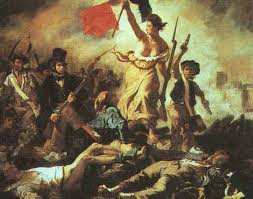
Marianne, Symbol of France, Brandishes the Tricolore,
Leading the  French People into Battle against the 1%.
Jean-Baptiste Say is the de facto Chief Economist of the French Revolution and therefore a champion of the 99%. He is also, via Say's Law, the man associated with the idea of small government and tax relief for the 1%.

How could that be? Which side is deluded?

Say was an active advocate for the Revolution and participated in its government. But his Say's Law was summarized dismissively by John Maynard Keynes as "supply creates its own demand".

Say's Law is the antecedent of the "supply-siders" who argue that the economy doesn't need Keynesian pump-priming by government to create demand. What an ailing economy needs in order to grow,  they say, is less government. In the short-hand of the 2012 election, this means continuing to cut taxes so as to "starve the beast" or shrink government so much that "we can drown it in a bathtub".

The idea of using tax-cutting as a way of forcing less government spending was initiated by David Stockman under President Reagan. What the country got was lower taxes and heavy borrowing to pay for a military buildup. During Reagan's presidency the United States switched from being the world's largest creditor country to being the world's largest debtor country. A long-chastened Stockman has recently called the proposed Ryan budget as a "fairy tale", meaning further tax cuts will end up being financed by further borrowing. He knows from experience.

How did it happen that a man who championed the 99% in revolutionary France is being cited by those who speak for the 1% in present-day USA? Say's Law is embraced by supply-siders to oppose Keynesian monetary and fiscal policy; it is rejected by Paul Krugman along with Keynes because it appears to be incompatible with fiscal deficits and monetary easiness in a recession.

So far as I can determine, this is how it happened. Say wanted to answer the idea promulgated by the aristocrats of the ancien regime that without the aristocracy there would be inadequate spending. This argument had two components:

(1) The aristocrats had the money to spend on luxuries and without spending on luxuries the economy would collapse. It was a kind of trickle-down spending idea promoted by those in power who did not have enough imagination to envision another system.

(2) Only the aristocrats had the skills to make the marketplace function.

Say said, to the contrary:

(1) The supply of goods would create its own demand because the marketplace sets prices so as to clear the supply. If someone supplies less valuable products than someone else, the price these products will fetch will be lower. At some price, everything will sell.

(2) The financial world of the aristocrats is not essential for the French economy to function. Their decapitation or flight will not destroy the markets. The supply of goods and services will continue to find intermediaries to determine the appropriate prices.

So the "starve the beast" folks are deluded on two counts:

(1) Say is no friend of theirs, because his entire theory was designed to show the lack of productivity of the 1%.

(2) In today's economy, there is also no evidence that cutting taxes on the 1% will necessarily ensure more lending and investment will occur. The 1% may just sit on their extra cash. It's the middle class that is more reliably likely to spend money that is created by tax relief.

In his later years, Say became a successful businessman. But his belief in the total  ineffectuality of the aristocrats was not borne out in the short term. A huge communication and confidence gap was left in French markets and institutions. After a period of confusion the Revolution gave way to what we might call today a junta under Emperor Napoleon.

The French Army under Napoleon trained its own officers. But the Navy was another matter. One theory explaining Napoleon's defeat at Trafalgar (see animation here courtesy of the late Colin White) by Admiral Lord Nelson is that all the officers in the pre-Revolution French Navy were "quatre quarts noblesse" meaning that all four grandparents had to be in the French nobility. Because the Revolution had killed or chased away all the Navy's officers, Napoleon's was left with underskilled naval leadership.

The French have not, however, looked back. "Liberte, Egalite, Fraternite" is written across the front of the Bourse. The attempt to replace the Tricolore under Napoleon III was one of the things that turned the French people back to a Republic.

Why did Keynes pick on Say? He needed to attack the idea that money markets and business cycles are self-regulating. You may not need the 1% to consume or manage the economy, but the governments must be able to address crises and stimulate the economy. Keynes argued that governments should run deficits in weak economic times, and run surpluses in good economic times.

What Bush 43 did was run deficits in good (low unemployment) economic times. By putting the winter woodpile in the stove in late summer, he stirred up the anti-deficit forces so that Obama had a hard time getting enough wood together for the stimulus he needed after the crisis of 2008.

This is a key message Paul Krugman has been hammering home in his New York Times column for months or years and in his excellent piece with his wife Robin Wells in the July 12 [2012] issue of The New York Review of Books. The NYRB article reviews the relative roles of Larry Summers, CEA Chair Christina Romer, Timothy Geithner et al. in the Bush 43 response to the financial crises of 2008 and then the Obama response to the spreading economic crisis of 2009.

Under Bush 41 and 43, the Federal Government continued to run deficits even through unemployment was very low by historical standards. Only Bill Clinton, during the Democratic interregnum, ran surpluses. I commented on this in September 2008.

At precisely the point where all the anti-deficit armory was assembled, the financial crisis hit and its size and psychological impact had a huge economic impact on the U.S. and world economy. Just as the anti-deficit forces went to work, the need for stimulative spending suddenly became acute. Obama's response fell short because of growing GOP opposition in the Congress. One reason is that state and local government revenues fell with the economic decline (they can't print money) and this offset the national stimulus. So states and localities have been faced with huge deficits in FY09-FY11 and more deficits face most of them in FY12 and FY 13, with no stimulus money left to help.

Steve Malanga of the Manhattan Institute has castigated states and localities for spending too much in good times and not putting away money for bad times. He quotes Keynes. He tells us he asked then-Mayor Koch to put money into a rainy-day fund. Koch correctly responded that elected officials find this difficult to do. So far, rainy-day funds tend to be spent at the first hint of dewfall.

Here are my comments:
1. Keynes was focused on the national level.  Counter-cyclical fiscal and monetary policy is meant to be applied at the money-printing level. States and localities just don't have that power. When Greece and Spain gave up the drachma and peseta, they gave up their ability to pursue a counter-cyclical policy for very long - that power has gone to the European Union and the European Central Bank.
2. States and localities have to balance their budgets.  Balanced budgets are the law in many states and it's reality in the rest of them. When states and localities talk about deficits they are talking about gaps that must be faced. These gaps must be closed through borrowing or other gap-closing measures.
3. Some counter-cyclical mechanisms work well. Revenue-sharing with states and localities was a good idea. New York City's averaging of assessed values over five years is a hugely successful mechanism that evens out property-tax revenues over the business  cycle.    

Radio Shack Goes Off the Air

In today's New York Times, the consumer advocate, David Segal ("The Haggler"), advises us that he wrote last month to Dorvin Lively, interim CEO of Radio Shack about an irate Radio Shack customer. The point of his letter was that:
[A]fter a few somewhat contentious though perfectly civil e-mails, your spokesman has stopped communicating. Zippo. Silence. Crickets. This hurts the Haggler’s feelings. And it suggests that Radio Shack isn’t all that concerned about its public image. Which is surely not the case. Can you get in touch, please? 
The Haggler asks that "anyone who’d like to help make sure this note reaches Mr. Lively is invited to send an e-mail to media.relations@radioshack.com, the address of the department that is giving the Haggler the cold shoulder."

We need to support the people who support us. I am writing to this email address saying that I am not going to buy anything at Radio Shack until they respond to The Haggler.

Sunday, September 30, 2012

Economic Strength - Nevada vs. North Dakota

 Regional economic strength is partly a matter of luck and partly the result of  bad policies.


The economic data on Nevada and North Dakota illustrate extremes of luck and bad policies. 

Nevada is suffering greatly from high unemployment and high job loss. North Dakota is at the other extreme, with much lower unemployment than other states and high job growth. The numbers are collected conveniently by the Joint Economic Committee in its state-by-state survey of jobs and unemployment (see summary chart on p. 106). The numbers on which the survey is based are from the monthly reports of the Bureau of Labor Statistics.

State
Unemployment, August 2012
Job Growth or Loss since Recession Began
Best: North Dakota
3.0%
+16.7%
Average: USA
8.1%
-3.4%
Worst: Nevada
12.1%
-12.6%


North Dakota is lucky in finding oil. Nevada is partly to blame for its lax mortgage policies that meant it was badly hit by the housing collapse.

An enterprising reporter or regional economist could surely find other contrasts that would help fill out the picture. A Business Week article in 2011 that headlines the contrast doesn't go much beyond the oil vs. housing explanation.

Thursday, September 27, 2012

A Compendium of Knowledge 1793

A neat idea - Librarything.com has posted a list of what was considered general knowledge in 1793, as compiled by a Harvard College librarian. Although Adam Smith's Wealth of Nations had appeared in 1776, economics was not yet a separate field of study. Smith's Theory of Moral Sentiments appears under Ethics below.

There was a time when "knowledge" could be encompassed by one person. That idea is associated with Benjamin Jowett, Master of Balliol College, Oxford from 1870, who became Vice Chancellor of Oxford in 1882. (Adam Smith is perhaps the best-known alumnus of Balliol.) To him is commonly attributed the quote "I am the Master of this College, What I don't know isn't knowledge." The source is actually a poem attributed to Henry Charles Beeching and probably written by several mischievous and clever undergraduates at Balliol.
First come I. My name is J–W–TT (Jowett)
There's no knowledge but I know it
I am the Master of this College,
What I don't know isn't knowledge. 

- H. C. Beeching, "Masque of B-ll--l" (1881).
MEMORY
I. Sacred History
II. Ecclesiastical History
III. Civil History: Including Biography
IV. Natural History
V. Voyages and Travels
VI. Geography and Topography

REASON
I. Theology
II. Mythology
III. Ethics; or the Moral System in General
IV. Grammars, Dictionaries
V. Logic, Rhetoric and Criticism
VI. General and Local Politics
VII. Law
VIII. Metaphysics
IX. Arithmetic, Geometry and Algebra
X. Natural and Experimental Philosophy: Including Astronomy
XI. Chymistry
XII. Agriculture
XIII. Arts and Manufactures

IMAGINATION
I. Poetry and the Drama
II. Works of Fiction
III. The Fine Arts
Miscellanies

Saturday, September 15, 2012

Larry Fink of Blackrock


Great quote from Larry Fink of Blackrock ($3.5 trillion under management) from the McKinsey series (emphasis added by me):
I think probably the most dominant change that we are facing is the growing impact of politics on business. This is an ongoing challenge that has never been greater. We’re witnessing now in China, and in Europe and the United States, is this tug-of-war between a business sector that is looking for a strong message, strong leadership, and a little more consistency from government and what government can realistically provide. The cycle of politicians is just too short. The insecurity around politicians toward their own careers has had a severe impact. Government is not acting swiftly enough.
Only when government is backed against the wall do we see action. And it’s that atmosphere and the binary outcomes that have created an environment in which executives who are running large, interconnected companies are frightened of planning out too far. We see the symptoms of that fear in the increased cash holdings.
Globally, corporations are seeing massive sums of cash—we’re talking trillions of dollars. They’re not hiring, not building as many factories today. They’re not willing to take that risk because the uncertainty around the situation in Europe, the United States, and even China has truncated the decision-making process and in many cases has created an atmosphere in which making no decision is probably the right path.
And so we’re seeing a slowdown globally right now, which is a symptom of all this uncertainty and fear. And yet the fundamentals of most internationally based companies are really quite strong. You know, I have to remind politicians that there is a reason why equity markets are generally doing better than the tone of the economy would have us believe.

Thursday, September 6, 2012

The Ongoing LIBOR Scandal

One way New York City stimulates its residents is with hundreds of educational and cultural events, more in a day than anyone could attend in a year. Today I chose to be educated at a discussion offered by The Zicklin School of Business at Baruch College on the LIBOR scandal, headed "Are They Still Playing Games in London?"

First in the fall 2012 series of the Robert Zicklin Center for Corporate Integrity, the discussion is led  by David Rosenberg, Associate Professor of Law and associate director of the Center. He interviewed Peter Eavis, a business investigative reporter for The New York Times and before that a reporter for  TheStreet.com, Fortune and The Wall Street Journal. He won a Loeb Award for commentary in 2005 for articles spelling out the accounting troubles at Fannie Mae. He was early in spotting problems with Enron's books and he uncovered accounting issues at Conseco, Qwest and Amazon.com.  A British national, Mr. Eavis was born in Canada and graduated from Leeds University in the UK. Here are the highlights of the narrative, delivered mostly by Mr. Eavis:

LIBOR, the London Interbank Offered Rate, is supposed to be the interest rate at which banks lend to one another. Someone calls around in the morning and asks what rate each bank could borrow in different currencies and 15 different maturities, from overnight to 12 months. The "panel banks" are selected by the British Bankers Association. The highest and lowest 25 percent are eliminated and the other 50 percent are averaged by Thomson Reuters.

Trouble is, the loan market dried up in 2007. The concept depends on there being an active market for loans. In 2007, banks began worrying more about their balance sheets and put their money into government bonds instead of riskier loans.

Banks completely stopped lending to one another.  If a bank needed funds, it borrowed from the European Central Bank or the Bank of England. The LIBOR continued to be published, but the numbers were just made up. So what else is new? A lot of indicators are based on surveys that amount to opinions. But it gets worse.

During the banking crisis of 2008, LIBOR was systematically understated. In order to appear more solvent than they were, banks quoted low rates like 1 percent for the 3-month LIBOR whereas in fact they would have to pay a lot more assuming they could get a loan at all.

Reuters journalist Carrick Mollenkamp in April 2008 noted the low-balling problem.  He said it was widely known on Canary Wharf that the LIBOR was fictional. The bank regulators (especially the British financial overseers and the Federal Reserve Bank of NY) started investigation. The low quoted rates gave people confidence that the banks were in better shape than they really were. This bought some time and is the positive side of what happened. Some argue that this was like moving the lines of the football field - it was still a fair game. But people made decisions relying on information that many other players knew was false. And it gets worse.

A much worse problem is that traders were influencing the LIBOR estimates to make profits. The U.S. Commodities Futures Trading Commission suspected something was amiss and demanded an investigation by Barclays. Complying fully with the request, Barclays provided emails of traders talking with one another about modifying the LIBOR to help interest-linked derivatives (options, swaps, futures) make a profit when they came due. When the Barclays report was released it caused a firestorm in the UK. Barclays paid a $450 million fine and senior managers were forced out.

How was corporate integrity compromised so broadly? "Everyone was doing it." (Rosenberg)
"Small differences in rates, no one seemed to be hurt." (Eavis) But others ask: "Why has no one gone to jail?" (Eavis)

Some "very strange" outcomes and messages.
1. LIBOR continues to be published. A commission to replace it hasn't done it yet.
2. The major message for traders - use the phone, not emails. 
3. Another message - maybe don't comply with data requests so energetically. On the other hand, Barclays might have been treated even more harshly if they had not been cooperative.
4. Some feel the crime was victimless, but by creating winners they also created losers. U.S. municipalities are figuring out how they were hurt; in some cases it is obvious and big-time.

What lies ahead.
1. More lawsuits and government action. The NY State Superintendent of Financial Institutions broke from the pack and went after Standard Chartered, sponsor of the Liverpool Football team. He won't be the last.
2. Dodd-Frank requires more transparency. Derivatives will have to be on more transparent platforms.
3. LIBOR will be replaced.