Showing posts with label Dana Chasin. Show all posts

Wednesday, December 2, 2020

BIDEN TRANSITION | Economic Team (Guest Post by Dana Chasin)

The following guest post, on the President-Elect's economic appointments so far, is by Dana Chasin of 20/20 Vision in Washington, D.C.  A fuller list of senior
 Biden appointees, and some contenders for unfilled positions, may be found here. The list is regularly updated.  

Biden’s intent to gather a progressive coalition, perhaps the most diverse in history, is manifest. Janet Yellen was appointed last week as Treasury Secretary. Yellen would be the first woman to fill this position, if she is confirmed. 

Now Biden has chosen to fill out much of his economic team with five talented, experienced policy advisors and researchers. Several of them would also be historic firsts in their roles. However, confirmation struggles loom. 

Neera Tanden (OMB Director). If confirmed, Neera Tanden would be the first woman of color to head the Office of Management and Budget (OMB) in history. Tanden, a longtime Clinton ally and mainstay on cable news, helped found the left-leaning Center for American Progress in 2003 and is its current Chief Operating Officer. Her policy specialty is healthcare, having successfully helped draft the Affordable Care Act and shepherd it through Congress. More recently, her focus has been on the COVID pandemic and its economic fallout. New Jersey Governor Phil Murphy named Tanden to the state’s Restart and Recovery Commission this past April. OMB is a giant executive branch agency, in charge of evaluating performance of federal programs and policies, ensuring they align with the White House’s budget and priorities. Tanden is perhaps the most controversial of nominees put forward by the Biden team so far, never mincing words while critiquing both the right and far left. Her confirmation is no sure thing, and the upcoming Senate fight will be nothing if not engaging; we wish her the best. 

Wally Adeyemo (Deputy Treasury Secretary). Biden has announced his intention to nominate Obama Foundation president and economist Adewale “Wally” Adeyemo to be deputy secretary of the Treasury Department. Under President Obama, Adeyemo served as deputy director of the National Economic Council, assistant secretary for International Markets and Development at Treasury (as well as deputy chief of staff of the Treasury), and chief of staff of the newly formed Consumer Financial Protection Bureau under the leadership of Elizabeth Warren. When Adeyemo left the White House in 2016, he signed on as a senior adviser at the investment firm BlackRock, as well as at the Center for Strategic and International Studies. Adeyemo, a 39-year old Nigerian-born attorney with impeccable academic credentials to match his wealth of expertise, will likely sail through the Senate confirmation and become the first African American Deputy Secretary of the Treasury. 

Cecilia Rouse (Chair, Council of Economic Advisors). The Council of Economic Advisors (CEA) is a three-person team tasked with providing data and advice to the president on domestic and international economic matters. The agency produces the annual Economic Report of the President, which assesses the state of the economy and outlines economic goals for the coming year. Cecilia Rouse would be the fourth woman and first Black woman to serve as Chair of the CEA. Currently dean of the Princeton School of Public and International Affairs, Rouse is well-known for her work on labor economics, education, and workplace discrimination. In a renowned paper with Claudia Goldin, Rouse showed that employers were more likely to hire women applicants when the applicants were judged "blind", i.e., without knowledge of the applicants’ genders. During the Clinton presidency, Rouse served on the National Economic Council. Later, as a member of President Obama’s CEA, she advocated for increased fiscal stimulus in the wake of the 2008 recession. While her past confirmation to the CEA occurred in 2009 when Democrats controlled the Senate, Rouse’s previous experience in presidential administrations should smooth her path to confirmation, although conservative Republican Senators are sure to oppose her nomination. 

Jared Bernstein (Member, CEA). Biden has also nominated the other members of his CEA. Jared Bernstein, currently a senior fellow at the Center on Budget and Policy Priorities, a left-leaning fiscal policy think tank, has been a prominent economic advisor for Biden for years. Bernstein was chief economist to Vice President Biden from 2009-2016 and played a major role in crafting the $800 billion economic rescue package in 2009. During the campaign, he continued to serve as one of Biden’s top economic advisors. A longtime defender of the working and middle class and advisor to 20/20 Vision, Bernstein is also a known critic of free trade agreements, and he will refocus U.S. trade policy to benefit workers and balance trade relations. Further, throughout the pandemic, Bernstein has advocated for increased deficit spending, particularly on enhanced unemployment benefits. Bernstein’s nomination is a concrete indication of Biden’s commitment to smart, focused policymaking. 

Heather Boushey (Member, CEA). Long-time advisor to President-elect Biden, Heather Boushey will serve as another member of Biden’s CEA. Boushey is currently the president and chief executive of the Washington Center for Equitable Growth, a nonprofit she co-founded in 2013. Boushey is best known for her 2019 book, Unbound, in which she identifies the ways that economic inequality undermines economic growth. During the COVID-19 crisis, Boushey has advocated for automatic stabilizers — both for unemployment benefits and state and local aid. Prior to heading the Washington Center, Boushey served as an economist for the Center for American Progress, the Joint Economic Committee, the Center for Economic and Policy Research, and the Economic Policy Institute. Boushey would have served as Chief Economist for Hillary Clinton’s 2016 transition team. At the CEA, Boushey will continue to push for policies that will facilitate an inclusive post-COVID economic recovery. 

Summary.  In strong contrast to the previous administration, Biden’s economic team is characterized by expertise, diversity, and inclusive economic policies. While Biden was perhaps the most moderate of the Democratic presidential candidates during the primary, his nominees are committed to addressing economic inequality and protecting the most vulnerable Americans. Their confirmations will also be among the first tests of Mitch McConnell’s obstructiveness should Republicans keep control of the Senate. If they are confirmed, come 2021, we can expect Biden’s White House to put forward a large relief and stimulus package, which will be crucial to keeping small businesses, states, and families — that is, the economy — afloat until the virus is under control.

Friday, November 30, 2018

CONGRESS IN TRANSITION | Financial Services Committee

The following email from Dana Chasin is posted here by permission. He called it "Update 315 — Rough Waters Ahead for Banks?"

The subject is the takeover of the  House Financial Services Committee by Rep. Maxine Waters (CA). The contrast between her and retiring Rep. Jeb Hensarling (R-TX) is one of the greatest in policy and style in the 116th Congress.

Clear Waters

Rep. Waters’ bedrock issues have long been housing, consumer protection, and big bank regulation. In the 115th Congress, Waters focused on protecting the Community Reinvestment Act, designed to prevent discriminatory credit practices, and guarantee fair housing protections.

Bills introduced by Waters during the Congress now ending (capping a six-year tenure as Ranking Member of HFSC) indicate her priorities:

  • Public Housing Tenant Protection and Reinvestment Act of 2017 — H.R. 3160: The bill reforms the public housing demolition and disposition rules to require one-for-one replacement and tenant protections, and provides public housing agencies with additional resources and flexibility to preserve public housing.
  • Comprehensive Consumer Credit Reporting Reform Act of 2017 — H.R. 3755: The bill enhances requirements on consumer reporting agencies, like Equifax, TransUnion, and Experian, to better ensure that the information on credit reports is accurate and complete.
  • Megabank Accountability and Consequences Act — H.R.3937: The bill would give authority to federal banking regulators to break up banks that mistreat their customers.
  • Consumers First Act —H.R.6972: The bill would reverse the harmful changes to the Consumer Financial Protection Bureau imposed by the Trump Administration and restore the agency’s supervisory and enforcement powers.
  • Restoring Fair Housing Protections Eliminated by HUD Act of 2018 — H.R.6220: The bill would restore several fair housing protections that HUD Sec. Ben Carson eliminated.
Crossing the Party Bar

During her tenure as Ranking Member on the Committee, Rep. Waters supported bipartisan legislation, notably the third iteration of the JOBS and Investor Confidence Act. The bill includes provisions aimed at “decreasing the regulatory burden” for some financial institutions, as well as others that aim to increase protections for consumers.

In a similar vein, she partnered with Sen. Sherrod Brown on S. 1491, the Community Lender Regulatory Relief and Consumer Protection Act of 2015. The bill would give banks and credit unions with under $10 billion in assets relief from the Consumer Financial Protection Bureau’s (CFPB) “Qualified Mortgage” rule.

Appealing to Waters’ passion for housing reform, the measure would make permanent expired provisions that protect tenants from eviction when their landlord or property owner has entered foreclosure. When it comes to her bedrock issues, Waters may be more willing to compromise to ensure she reaches her legislative goals.

She has also reached across the aisle to work with Republicans to reauthorize the Export-Import Bank, and used her political savvy to get Republicans on board with a reauthorization of the National Flood Insurance Program. While she will look to make some strides in these areas as Financial Services Chair, she has expressed firm and progressive stances regarding systemic risk and oversight.

Mitigating Systemic Risk

Importantly, Rep. Waters at the helm of the HFSC means two things for systemic risk:
  • the “tide” of deregulation of the financial sector is “at an end”
  • regulators and agencies should be prepared to will have their feet held to the fire more often
Heading into the next Congress, a key item on Waters’ agenda will be monitoring systemic and other risks in big banks. The financial industry has enjoyed several months of continuous deregulatory activity under an HFSC headed by Rep. Hensarling and a Republican-controlled Congress. Under her leadership, the Committee will be limited in its ability to stall measures at the federal regulator level, but it will be able to increase oversight and change rhetoric to keep a check on agency overreach.

In the words of Waters, “as we saw in the last crisis, it is the average hard-working Americans that will suffer the consequences if Washington deregulates Wall Street megabanks again.”

Oversight

A robust oversight agenda will accompany the legislative priorities of the Committee under Waters. This agenda will likely focus on four distinct areas: firms, rulemaking, agencies, and the presidency.

On the firms, Waters has expressed indignation about the slap-on-the-wrist treatment of Wells Fargo in light of the improper and unfair foreclosures on its customers. Many were erroneously denied loan modifications to lower their mortgage payments.

A Democrat-controlled House cannot do much in the way of affirmative rulemaking, but it will no longer have to play defense against further attempts at deregulation. Much of Waters’ oversight in this area will be over agencies, ensuring that the Trump appointee-controlled CFPB, FSOC, and OFR are operating according to their original statutory purposes and with the resources they need. This will likely take the form of hearings, subpoenas, and investigations.

Waters has been steadfast in her position that investigation into the president’s alleged illegal financial dealings is on her agenda, but it’s not her top priority. In a Bloomberg interview earlier this month, Rep. Waters was clear that she would use her authority to get more information, using subpoenas if necessary, but was far more eager to discuss Wells Fargo and the CFPB.

Summing Up: An Able Veteran

Waters is a skilled and seasoned legislator. Her turn with the gavel at HFSC is very welcome news and signals the end of the tide of deregulation. It also signals an end to a period of free-reign for regulators (or should we say deregulators) dogmatically pursuing an agenda that puts Wall Street megabanks ahead of ordinary Americans. Her agenda will be limited by the Republican-controlled Senate, but it will set the tone and pave the way for future legislation that will curb the rollbacks of Dodd-Frank that have occurred in recent years.

Tuesday, November 27, 2018

AMAZON AND GM | Trumponomics Takes a Hit

From 20 final cities, Amazon chose to locate in two
states, NY and VA, that voted for Clinton in 2016.
Meanwhile, MI and OH, which voted for Trump,
 are taking the brunt of GM's layoffs.
The following is posted by permission of Dana Chasin, who sent this out as Update 314 to his list, under the title: "An Economy Shifting Gears: What do Amazon's new HQs and the GM Layoffs Portend?" GM's layoffs and Amazon's new headquarters expansions show that Trump's bets on revival of car manufacturing, as opposed to embrace of technology, are not paying off. States that voted for Clinton in 2016 are winning and two states that believed in Trump's promises for manufacturing are losing. Trump's beggar-my-neighbor tariff policies are not helping American manufacturing.

Major tidal shifts and cross-currents underlying the changing American industrial landscape have been on full display in recent weeks. Last month, Amazon announced it was going to base its second headquarters out of both New York and Virginia, promising to bring 25,000 jobs to each. [This is a significant economic victory for two states that voted for Hillary Clinton for President in 2016.]

In an equally important but opposite development yesterday, General Motors announced its plan to eliminate up to 14,000 jobs in five plants in three states and Canada. Three of the plants are in Michigan and Ohio, which voted for Trump after campaign promises to revive manufacturing.

GM's surprise decision has rattled the Trump Administration and Republican leadership, challenging the belief that the economy is running fine on high octane fuel and should continue unfettered.

GM’s announcement comes less than two years after it announced it would add or keep 7,000 jobs in the United States. It translates to an expected loss of 14,700 jobs. The decision comes only a month after GM offered buyouts to as many as 18,000 long-time employees, only 4,000 of whom accepted the offer by the November 19 deadline – 3,000 employees short of its 7,000 target. With the buyout program behind schedule, the decision to idle five facilities did not come as a surprise to many. The Lordstown assembly plant in Warren, Ohio, for example, had gone from three shifts per day in January 2017 to one shift this past April.

The United Auto Workers said it would challenge GM’s decision. If GM still hasn’t reached its 7,000 buyout goal by January, further involuntary cuts are likely.

While the Tax Cuts and Jobs Act (TCJA) of 2017 purported to create record tax windfall for corporations to reinvest, the picture with GM is more complicated. In GM’s case, the TCJA did not account for “deferred tax assets” which the company was able to accumulate due to poor performance predating the Great Recession. These assets allow companies to reduce taxable income, meaning GM had already been afforded a low tax bill for over a decade. The newly reduced corporate tax rate therefore rendered these assets less valuable, forcing GM to take a $7 billion charge against earnings during the fourth-quarter of FY 2017.

Executives expected to see an eventual benefit from the new tax law, but not for years to come. It’s hard to claim that in absence of sizable deferred tax assets, GM would have even used their $157 million in federal savings to support American plants and employees. An October survey published by the National Association for Business Economics reported 81 percent of 116 companies surveyed had not changed plans for investment or hiring as a result of the TCJA.

The tariffs put forward by the Trump administration are another possible contributing factor to GM’s financial troubles. The timeline of the trade war is highlighted below:

June 1, 2018: The Trump Administration ended the exemption of Mexico, Canada and the EU from aluminium and steel tariffs. GM representatives warned the White House that these tariffs would drastically hurt the firm, saying that “this could still lead to less investment, fewer jobs, and lower wages for our employees.”

July 25, 2018: GM was forced to reduce its profits forecast for 2018, tanking stock by 4.6 percent. GM’s CFO predicted the original tariffs in March and the ending of exemptions to the US’s most trusted partners in June could add “as much as 700 million to GM’s costs” for FY 2018.

September 24, 2018: The White House compounded the problem by unveiling a new, stringent set of tariffs on Chinese automotive exports, putting in place a 10 percent levy on brakes, car batteries, tires, etc. Analysts predict these new tariffs will lead to higher sticker prices for cars and lower car sales. GM, like all other US car manufacturers, relies on foreign-based subsidiary plants and goods to create finished products, making broad tariffs doubly damaging to an already wounded industry. With GM historically leading the way in moving jobs to Mexico and a less favorable domestic/international tax rate differential introduced in the TCJA, the Trump administration's tariffs have only produced escalated offshoring.

Starting on the campaign trail, President Trump made a series of promises to the American people about jobs, specifically jobs in manufacturing. During a speech in Michigan in October 2016, Trump promised to “bring back ... jobs” and said “the long nightmare of jobs leaving Michigan will be coming to an end.”

He blamed past factory closures on Democratic failures and promised not to let that happen again. The GM decision reflects the fecklessness of Trump’s approach. Many voted for him because of his pledge to save the manufacturing industry.

Instead, he has put forth policies that undermine that goal and expose fears that become self-fulfilling trade prophesies in the form of retaliation. Plants will be closing in two states that were key to Trump's victory – Michigan and Ohio.

The GM closures thwart his guarantees to protect manufacturing and undermine his portrayal of a healthy economy that is growing with no end in sight and equitable for minority groups.

Almost simultaneously, Amazon announced its locations for its new HQ2. After a country-wide tax benefit bidding war, it has pledged to bring 25,000 jobs to both New York and Virginia, as well as an estimated 67,000 and 22,000 indirect jobs to each respectively.

In return, Virginia agreed to give Amazon $819 million and New York agreed to $1.85 billion. Both states believe the benefits accrued from Amazon will far outweigh these costs. Gov. Ralph Northam of Virginia expects “Amazon to invest $2.5 billion in the commonwealth and create $3.2 billion in tax revenue.”

Will this model work? Amazon is encouraged to fulfill its jobs promise through "performance-based direct incentives," meaning that for each pledged job that comes to fruition, they get a certain amount of tax breaks. This kind of city and state tax break is by no means an uncommon way of driving business to invest in a given area, and has been utilized in the past by other tech company giants, such as Google.

Although the model has proven very effective at creating jobs, there are some accompanying flaws. In Seattle, Amazon’s first HQ brought an economic boom and more than 40,000 jobs to the city; it also cost taxpayers hundreds of millions of dollars in ongoing infrastructure and transportation upgrades around the site, while neglecting other areas of the city. Affordable housing underwent a serious crisis. However, Amazon has worked with Virginia and New York governments to try and get in front of some of these issues, pledging money for additional schools and low-income housing.

Moreover, Arlington and Long Island are not Seattle. Bringing 100,000 jobs to these areas is a boon even to these booming coastal metropolises.

Trump has criticized Amazon repeatedly in the past and again following the announcement of HQ2. The economic tide seems to be working against him – 44 cents of every dollar spent online goes to Amazon. As much as Trump wants new jobs in the manufacturing sector, the evidence shows that the tech sector is the one to watch. Tech jobs offer the same, if not better, benefits as traditional manufacturing jobs, such as 401ks for salaried workers. States are quite literally fighting over these Amazon jobs, whereas auto-manufacturing jobs in the rust belt have become more burdensome than beneficial.

Even GM will be using its hefty savings to further bulk up its electric and autonomous vehicle development through R&D programs that already see more than $1 billion a year in company investment. Trump can no longer keep up the facade of a booming economy fueled by the manufacturing industry, and his supporters, especially those in Michigan and Ohio, must adjust to these false hopes and broken promises.

Wednesday, August 8, 2018

PRIMARY RESULTS | Dana Chasin Update

The following is by my friend Dana Chasin, reposted by permission:
Washington, D.C., August 8, 2018–Last night was another exciting Tuesday primary and special election day in the midst of a slow-moving August recess week. 
From Ohio to Michigan, Washington State, and even Kansas, elections were held that set up competitive general elections in November in purple-red districts around the country. Women candidates once again came out on top.  Some economic policy progressives had less-than-impressive showings.  In Democratic primary races with one male and one female candidate, without an incumbent on the ballot, the woman has now won 69 percent of the time; by contrast, Republican women have won only 34 percent of the races. 
The blue wave is taking a recognizable shape.
—————————
Kansas 
KS-03: Davids v. Rep. Yoder (Add)
  • 2016 Pres. Election: Clinton 47/ Trump 46
  • 2012 Pres. Election: Romney 54/Obama 44
  • 2016 House: Yoder (R) 51/Sidie (D) 41
  • Cook PVI: R+4
In KS-03, openly-gay, Native-American attorney and EMILY’s list-endorsee Sharice Davids faced off against Brett Welder, a PCCC-backed progressive candidate. EMILY's List spent $400,000 on an ad campaign for Davids, which highlighted her experience working on economic development programs on the Pine Ridge Reservation in South Dakota and other Native American reservations.
In a close race between two first-time candidates, Davids narrowly came out on top, 37 to 34 percent, and will challenge Rep. Kevin Yoder, who is seen to be the most vulnerable Republican congressman in Kansas, in November. Davids says she chose to focus on the issues that were most relevant to constituents in her district as opposed to campaigning on a purely progressive platform.  Her economic platform focuses on reversing the Republican tax cuts, incentivizing health care benefits for small businesses, creating a childcare tax credit, and supporting efforts to increase broadband access.

Michigan 
MI-01: Morgan v. Rep. Bergman 
  • 2016 Pres. Election: Trump 58/ Clinton 36
  • 2012 Pres. Election: Romney 53/ Obama 45
  • 2016 House: Bergman (R) 55/ Johnson (D) 40
  • Cook PVI: R+9
MI-01 is now a viable pickup chance for Democrats in November.  Matthew Morgan, the only Democratic candidate, was disqualified from running on the ballot in the Democratic primary due to an administrative error by the campaign staff.  Morgan, now having qualified as a write-in candidate, will face incumbent Rep. Jack Bergman in November. A 20-year marine veteran, Morgan is running a campaign focused on healthcare for all.  He also addresses the problems of wage stagnation and crumbling infrastructure -- two important issues for Michigan’s Upper Peninsula.

MI-06: Longjohn v. Rep. Upton 
  • 2016 Pres. Election: Trump 51/ Clinton 42
  • 2012 Pres. Election: Romney 50/ Obama 49
  • 2016 House: Upton 59/ Clements 36
  • Cook PVI: R+4
Dr. Matt Longjohn won what turned out to be an easier-than-expected victory.  Longjohn won 37 percent to moderate George Franklin’s 28 and will now face House Energy Committee Chair Fred Upton, who has been in Congress since 1986. Longjohn will have a tough road, though local Michiganders believe that MI-06 is the third best pickup chance this November. Longjohn will do so with a message on healthcare, an issue he knows well from his experience as the YMCA national health officer.  Though Longjohn has a progressive healthcare message, he has also advocated for some deregulatory policies, saying “community banks must all be supported better by our federal policies by eliminating unnecessary regulations.”

MI-07: Driskell v. Rep. Walberg 
  • 2016 Pres. Election: Trump 56 / Clinton 39
  • 2012 Pres. Election: Romney 51/ Obama 48
  • 2016 House: Walberg 55/ Driskell 40
  • Cook PVI: R+7
In MI-07, former State Rep. Gretchen Driskell easily beat primary challenger and progressive grass roots activist Steven Friday, 85 to 15 percent, to face off once again against Rep. Walberg in November.  The race is a repeat of 2016, but with the blue wave behind her, Driskell is more likely to beat Republican incumbent Tim Walberg this time around. Driskell campaigned on creating jobs, protecting social security and medicare, and investing in public education.

MI-08: Slotkin v. Rep. Bishop
  • 2016 Pres. Election: Trump 51/ Clinton 44
  • 2012 Pres. Election: Romney 51/ Obama 48
  • 2016 House: Bishop 56/ Shkreli 39
  • Cook PVI: R+4
Elissa Slotkin, a formal national security advisor, beat Michigan State University professor Chris Smith, 70 to 29 percent, to become the Democratic challenger to face Rep. Bishop in MI-08 in November.  MI-08 was recently moved from lean Republican to toss-up by Cook Political and is seen as a pickup opportunity for Democrats. Slotkin gained favorable national media attention campaigning on investment in education and infrastructure, ensuring retirement security, fixing the federal budget deficit, and fighting for campaign finance reform.  She has repeatedly called out Rep. Bishop for voting for the Tax Cuts and Jobs Act last year, which she believes was a fiscally irresponsible decision.

MI-11: Stevens v. Epstein
  • 2016 Pres. Election: Trump 50/ Clinton 45
  • 2012 Pres. Election: Romney 52/ Obama 47
  • 2016 House: Trott 53/ Kumar 40
  • Cook PVI: R+4
Haley Stevens emerged as the victor in yesterday’s MI-11 Democratic primary, securing an auspicious win over her other Democratic challengers. Stevens, a former chief of staff of President Obama's Auto Rescue, received a late endorsement from Hillary Clinton, which may have helped tip her over the line.  Stevens campaigned hard on bringing down health care costs in her district and has a strong background in federal economic policy from her experience on the Obama administration's auto bailout task force. Stevens and Slotkin’s races will be the most flippable seats to watch in the Great Lakes State come November.

Missouri 
MO-02: VanOstran v. Rep. Wagner
  • 2016 Pres. Election: Trump 53/ Clinton 42
  • 2012 Pres. Election: Romney 57/ Obama 41
  • 2016 House: Wagner 59/ Otto 38
  • Cook PVI: R+8
MO-02 featured an interesting primary in the only competitive congressional district in the state. The Democrats in MO-02 out-voted the Republicans by 20,000 votes in the primary. Rep. Ann Wagner doesn’t look like she is a candidate on the brink of falling apart, but voters are looking at a more moderate Democratic choice in Cort VanOstran. Having won his primary handily against progressive Matt Osmack, VanOstran will continue to speak against slashing regulations that will hurt our financial system, the Tax Cuts and Jobs Act, and for a progressive policy of raising the minimum wage to a liveable wage.

Washington
WA-03: Long v. Rep. Herrera Beutler 
  • 2016 Pres. Election: Trump 50/ Clinton 43
  • 2012 Pres. Election: Romney 50/ Obama 48
  • 2016 House: Herrera Beutler (R) 62/ Moeller (D) 38
  • Cook PVI: R+4
In another top-two primary, Carolyn Long and Rep. Jaime Herrera Beutler advanced to face off against each other in November. Beutler secured 41 percent of the vote, while the five Democratic challengers in the race secured over 50 percent between them. After the primary election, Cook Political moved this race from Likely Republican to Lean Republican making it a much more viable pickup chance this November. On the issues, Long is a staunch supporter of the ACA, campaign finance reform, Social Security and Medicare, progressive tax reform, and gender equity and security for women. The incumbent Beutler will now face a tight race against the former political science professor in November.

WA-05: Brown v. Rep. McMorris Rodgers 
  • 2016 Pres. Election: Trump 52/ Clinton 39
  • 2012 Pres. Election: Romney 54/ Obama 44
  • 2016 House: McMorris Rodgers (R) 60/Pakootas (D) 40
  • Cook PVI: R+8
In WA-05, the blue wave seems to be crashing-in and may claim a member of Republican leadership. The top-two primary yielded the fourth ranked Republican in the House Rep. Cathy McMorris Rodgers and Fmr. State Sen. Majority Leader Lisa Brown. The most exciting news however was the margin, with 64 percent of precincts reporting McMorris Rodgers leads Brown by a stunning 47.5 to 47.1. A sign that come November, McMorris Rodgers could have her work cut out for her. McMorris Rodgers has yet to claim a majority and is looking at a potential loss. Brown, however boasts a progressive agenda, including expansion of medicare and investing in infrastructure and education. A Democrat win here would suggest more of a tsunami than just a wave.

WA-08: Schrier v. State Sen. Rossi 
  • 2016 Pres. Election: Clinton 48/ Trump 45
  • 2012 Pres. Election: Obama 50/Romney 48
  • 2016 House: Reichert (R) 60/Ventrella (D) 40
  • Cook PVI: EVEN
In WA-08, pediatrician Kim Schrier narrowly beat former prosecutor Jason Rittereiser by 1.5 percentage points to emerge as the Democratic primary winner to face State Sen. Dino Rossi in November. An open seat, WA-08 is one of the more than 20 districts held by Republicans that Hillary Clinton won in 2016, making it a viable opportunity for Democrats. Schrier supports a livable wage, increased investments in STEM and infrastructure, and Medicare-for-all.

Ohio Special Election
In an R+7 district that Donald Trump won by 10 points, Democrat Danny O’Connor came within a percentage point of claiming victory over his GOP rival, Troy Balderson in a special election race in OH-12. There are still provisional ballots to be counted, but it looks like Balderson will be able to cling onto his win. Regardless, the district should not have been competitive in the first place, and the razor-thin margin for the GOP is yet another promising sign for Democrats in November.

Bet the House to Save the House?
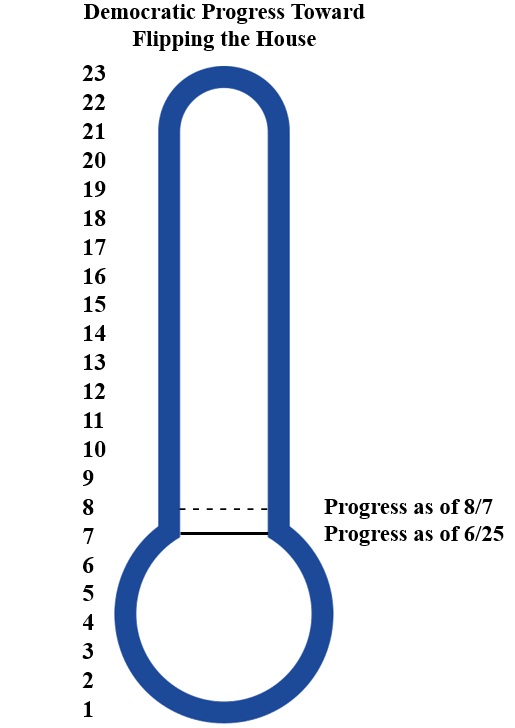
If Ohio’s special election result in an R+7 district tells us anything, it’s that the Republican control of Congress is teetering on the edge. Republicans hold 24 House seats classified as toss-ups and another 10 seats classified as Lean Democrat or better according to Cook Political Report — Democrats only need to flip 23 to regain the majority in the lower chamber.
The GOP spent nearly a million dollars in get-out-the-vote efforts as they frantically scrambled to secure a win in addition to the millions they had already poured into Balderson’s campaign. With many seats up for grabs and Democrats on the charge, the GOP will need to reach deep into their pockets to try and save their House majority.

Friday, July 27, 2018

GOP TAXES | Three House Bills

The following update on new tax bills before the Congress is by Dana Chasin, posted here by permission.

House Ways and Means Committee Chair Brady is on a mission to make tax cuts a winning issue for Republicans in the fall.  His legislative vehicle is “Tax Reform 2.0.”

The problem is that the Tax Cuts and Jobs Act (TCJA) bill [signed last December as the Tax Act of 2017 (after conferencing the original title was made generic)–JTM] has been less popular than expected.

Most Republicans up for re-election have given up even mentioning it on the campaign trail.  The original tax cuts contained embarrassing mistakes and the many and sizable kinks still need to be ironed out with a technical corrections act in the works.
Republicans in the House are now marching on with a new trilogy of tax bills that they hope will resonate with their voters in November, while the Senate leadership sees no urgency.  What comprises this trilogy and what are its prospects?

Recent Legislative Developments
Chair Brady indicates that House Republicans are planning to divide the package into three separate bills: permanency, savings, and innovation.  Dividing the bills increases the chances that they are passed, if not all together, then separately, but creates a false illusion that they won’t aggressively try to pass all three. Ways and Means is set to mark up the bills in mid-September with the intention of passing them by the end of that month. In the Senate, the package is unlikely to be taken up before the lame duck session.
President Trump’s tax cuts, which permanently reduced the standard corporate rate from 35 to 21 percent, have already had a considerable negative revenue effect, with the New York Times reporting this week that “the amount of corporate taxes collected by the federal government has plunged to historically low levels in the first six months of the year, pushing up the federal budget deficit much faster than economists had predicted.”
While corporate tax payments between January and June fell by 33 percent compared with the same period last year, corporate tax receipts as a share of the economy have fallen to 1.3 percent, nearing a 75-year low.
The Road to Hell is Paved with Permanence
Tax Reform 2.0 is a decisively political move by Republicans to make permanent the changes they enacted in 2017 that are set to expire at the end of 2025 and to introduce other tax changes.  Although there is still no bill language, the rhetoric around the release implies that Republican leadership wants to perpetuate all of the individual income tax changes in the TCJA. These changes include:
  • tax cuts for individuals and pass-through businesses
  • SALT deduction cap [$10,000 for married couples filing jointly]
  • Alternative Minimum Tax (AMT) cut
  • standard deduction and child tax credits
Republicans are working on the idea that it will be hard for Democrats to vote against making the individual tax cuts permanent. They believe it is harder for Democrats to vote against individual tax cuts than the corporate ones that were included in TCJA. They also include a variety of new proposals designed to appeal to Democrats.  
A Wolf in Sheep’s Clothing
The new proposals in Tax Reform 2.0 are meant to provide benefits to the middle class at a comparable significance to those in TCJA that clearly favored the wealthiest Americans. These proposals aimed at the middle class are divided into two categories – savings and innovation.

     Savings. Tax savings are generated by three expansions of tax-favored savings accounts:
  • Creating a Universal Savings Account (USA), which is basically a significantly improved Roth Individual Retirement Account (Roth-IRA), that individuals could contribute some of their after-tax income to annually – there is speculation on income contribution limits but nothing has been confirmed yet.  Withdrawals from the USA could be made at any time or for any reason without tax or penalty. Like a Roth-IRA, the USA’s earnings would not be subject to tax. The goal is to incentivize Americans to save more.
  • Expanding the popular, tax-free 529 college savings accounts so it could also be used to pay for apprenticeship fees and home schooling expenses, as well as student debt.
  • Allowing workers to tap into their retirement savings accounts without penalty to cover expenses from the birth of a child or an adoption.
    Innovation. So far there is only one clearly identified idea under this category–permitting start-up businesses to write off more of their initial costs to remove barriers to growth.
Although these measures seem to help the middle class, they are unlikely to be sufficient to offset higher interest rates on mortgages and student and car loans as the result of the ballooning deficit resulting from TCJA’s tax cuts for corporations and the wealthy.

A Tax Cut Catastrophe
Some of the provisions in the Tax Reform 2.0 package would put a further strain on tax revenues at a time when social benefit systems are in dire need of assistance. The Congressional Budget Office (CBO) estimates that extending the individual tax cuts would increase deficits by an additional $650 billion—this at a time when social security had to dip into its trust fund for the first time in 36 years and the federal budget deficit is set to surpass $1 trillion two years earlier than estimated, by 2020.

The TJCA was clear in its “reverse Robin Hood” regressivity. Tax Reform 2.0 is not as blatant, but enacting more provisions that deprive the federal government of vital tax revenue that it needs to fund critical social services is socially irresponsible.

Tax Reform 2.0 also includes provisions that allow for more cuts to the deduction for owners of noncorporate businesses known as “pass-throughs” and larger exemptions to the estate tax and the alternative minimum tax for individuals. Given the predilection of the well-to-do for tax avoidance, this reform makes policies permanent that encourage such activities and suggest that gaming the system is not only good, but recommended. In fact, the lower the pass-through rate, the more attractive abusing the tax code becomes.

Political Lens

With the 2018 midterm election looming, House Republicans are eager to make their individual tax cuts permanent before the Democrats take back control (knock on wood) and they are no longer able to. Were that to happen, at the end of 2025, corporate tax breaks would remain in place and individual tax cuts would expire, making for very bad optics for the Republican party, if it exists then. So even though Chair Brady is planning to introduce the package as three separate bills, passing the permanency of individual tax cuts will be crucial for him and the future of his party.

Sen. McConnell seems to have hit upon a legislative strategy that serves both Senate and House Republicans regarding Tax Reform 2.0.  The House will pass the bills as a package and be able to pick up political capital; Republican senators (who are in un-gerrymandered and therefore more purple jurisdictions) won’t have to take a difficult vote on these bills before the midterms.  Sen. McConnell won’t take the GOP trilogy up until the lame duck session, enabling the House to have its cake (have its vote), while the Senate doesn’t have to eat it too (swallow a tough vote).

Friday, July 20, 2018

THE HOUSE | Meanwhile, Back in Congress, These Bills Passed

L to R: Democrat Maxine Waters Ranking
Member, Financial Services Committee,
and Chairman Jeb Hensarling (GOP).
The following is from Dana Chasin, posted by permission. He calls it "Update 286: If at First You Do Succeed..."

On Monday, a package of financial regulatory measures (deregulatory in aggregate effect), cleared the House overwhelmingly.

These bills have joined other bills passed by the House among bills on the Senate’s post-recess floor time queue. JOBS 3.0 raises non-Dodd-Frank issues. It also also raises S. 2155 on a smaller scale, with something for everyone to loathe or love.

(Next Tuesday, July 24, Americans For Financial Reform sponsors:  “Regulating Wall Street - Ten Years Later.” Senators Sherrod Brown and Elizabeth Warren are among the participants.  To RSVP, click here.)

JOBS Act 3.0

This week, House Financial Services Chair Jeb Hensarling and Ranking Member Maxine Waters announced a bipartisan agreement on the terms of a broad regulatory rollback package.  (Hensarling interview is here: https://www.bloomberg.com/news/videos/2018-05-23/rep-hensarling-says-more-deregulation-by-midterms-is-very-realistic-video.)

The legislation, entitled S.488, the JOBS and Investor Confidence Act of 2018 (or Jobs Act 3.0), is the most comprehensive package of changes to federal securities laws to pass the House with broad and bipartisan support since Congress approved the JOBS Act of 2012.  [NB: in 2015, Congress enacted a much smaller set of tweaks to securities laws as part of broader transportation reauthorization legislation, which some have dubbed “JOBS Act 2.0”.]

S.488 is comprised of 32 previously introduced bills, the vast majority of which have cleared the House or the Financial Services Committee.

This third iteration of the JOBS Act has many of the hallmarks of the JOBS Act of 2012.  It combines a number of disparate and seemingly innocuous pieces of legislation that relax or moderate various existing regulatory requirements relating to U.S. capital markets, in particular, the issuance and sale of securities.

The House passed the package on a 406-4 vote on Tuesday with bipartisan support, including from Ranking Member Maxine Waters and Chairman Jeb Hensarling. It looks like the Senate will consider the bill during the summer.

Public-Private Market Paradox

The JOBS Act 3.0 package contains provisions that simultaneously seek to encourage growth in the public market, while cutting back on regulations in the private market.

The bills include:

H.R.79: The HALOS Act permits issuers of private securities that are exempt from SEC registration requirements pursuant to SEC Rule 506(b) to also be exempt from certain restrictions on the use of general solicitation in the advertising and sale of such securities, further weakening investor protections in a segment of the market that is growing rapidly but plagued by fraud.

Private securities markets are appropriate for certain types of issuers and investors, but they are inherently problematic, given that they are characterized by significant risk -- lack of liquidity, oversight and transparency.  The private nature of these markets also makes it difficult for investors other than large institutional investors or venture funds to obtain information about the security, or otherwise value the security.

H.R.5877: The Main Street Growth Act lays the statutory foundation for the establishment of one or more “venture exchanges.” The Act sets forth a process under which any national securities exchange registered with the SEC can “elect” to become a venture exchange, which is subject to different standards and rules than those that govern all other national securities exchanges in the United States.

The venture exchange provisions in S.488 build upon provisions enacted in Section 501 of S.2155 that dramatically changed the way securities can be recognized as “covered” and exempted from state review by virtue of being listed on a national securities exchange. Taken together, the two provisions will ensure that certain national exchanges in the U.S. will likely operate with significantly lower listing standards than those that currently apply to national exchanges.

H.R.6177: The Developing and Empowering our Aspiring Leaders (DEAL) Act requires the SEC to allow venture capital funds to invest in secondary market shares of venture capital companies instead of primary offerings, complementing the "venture exchange" piece of the larger bill by basically creating an ecosystem for trading shares in private venture companies.

This Act, together with the HALOS and Main Street Growth Acts, further blurs the distinction between public and private securities markets, expanding the “quasi-public” securities market that was the major legacy of the JOBS Act of 2012, and making it more likely that retail investors will soon be solicited and sold securities that are in many respects more speculative and risky than is currently permitted under the securities laws.

H.R.1645: The Fostering Innovation Act ostensibly aims to encourage IPO formation by doubling the time that low-revenue emerging growth companies (EGCs) are exempt from key financial reporting controls. However, the Act is predicted to affect less than 2 percent of publicly traded companies and is therefore unlikely to have a discernible effect on increasing the amount of IPOs. Crucially, the bill gives special treatment to EGCs, opening the door for other issuers to demand the same and potentially precipitating a “special treatment” race to the bottom. The long-term effect of lowering the bar for a few is that the bar gets lowered for all.

A Work in Progress

H.R.1585: The Fair Investment Opportunities for Professional Experts Act sets in statute the definition of an “accredited investor” and codifies the current thresholds for annual income and net worth. The bill would create new qualitative pathways for individuals to become accredited and attempts to address the $1 million asset threshold that was originally set by rule in 1982 by indexing it to inflation every five years. However, even with the inflation adjustments, the bill would see retirees with no experience or sophistication in investment matters qualifying as “accredited investors” by virtue of their retirement savings, or wealth realized from an event such as an inheritance or the sale of a primary residence. This bill could be amended to rectify these important issues in the Senate, but in its current form, it is an example of the unbalanced nature of some of the bills in the JOBS 3.0 package.

Where most bills in the package relate to capital markets access, two pertain to the systemic risk pillars of stress testing and resolution planning.

H.R.4566: The Alleviating Stress Test Burdens to Help Investors Act exempts nonbank financial institutions from DFA company-run stress-testing requirements.

H.R.4292: The Financial Institution Living Will Improvement Act requires banks to submit resolution plans every two years instead of annually. These measures mimic what regulators may already decide with newfound discretion under S.2155.

Improvements to JOBS Act 3.0

JOBS Act 3.0 is modest compared to its predecessors, but underwent significant changes during its crafting. Therefore, in some cases, the bills that have been incorporated in the package are different than the previous iterations. The package has been welcomed by some institutions, such as the Council of Institutional Investors, for its provisions that address insider trading and multiclass share structure disclosure.

Unfortunately, the speed with which the package is and has been moving has made it difficult for those on and off the Hill to properly evaluate its benefits and risks. With so many moving parts, JOBS Act 3.0 needs time to be fleshed out and examined more thoroughly before concrete suggestions can be made. This is likely post-August recess.

Political Developments/State-of-Play

S.488 now moves to the Senate. With the legislative schedule packed with nominations, appropriations bills, and the Farm bill,  Senate Majority Leader McConnell announced that “Senators will continue their ongoing bipartisan discussions as we work towards a vote in the coming months.”

Other Senators have indicated the negotiations and busy schedule could push the floor debate for at least three to four weeks.  Look for the package to reach the Senate floor after the summer recess, perhaps attached to a funding or appropriations bill, or as standalone legislation.


Thursday, May 31, 2018

DANA CHASIN | Postal Banking's Promise (and Pitfalls)

Postal Savings Certificate from
FDR Days (1941).
Last month, Sen. Kirsten Gillibrand introduced S. 2755, the Postal Banking Act.   The bill would establish retail banking services at every U.S. post office and authorize the U.S. Postal Service (USPS) to offer checking and savings accounts, small-dollar loans, debit cards, cash withdrawals and money transfer services in each of its roughly 30,000 offices. – Dana Chasin's Update 275, Guest-Posted by Permission.

In 1910, President William Howard Taft introduced a postal-savings system for new immigrants and the poor that lasted until 1967. The need for postal banking has been revived by several recent events.

The USPS Inspector General (IG) published a report in 2014 in response to the USPS  $2.7 billion deficit, describing how the USPS could implement postal banking policies to address the agency's funding crisis. Postal banking could generate $9 billion profit.  Sen. Elizabeth Warren has been a long time advocate of postal banking since this IG  report and lauded many of the benefits of postal banking. Sen. Bernie Sanders brought postal banking back to the forefront with Sen. Warren during the 2016 primary campaign.

The endorsements by these progressive stars in the Senate led to strong popular support of the idea, but neither Senator introduced legislation. S. 2755 is the first legislative step  since 2014.
Benefit 1. Serving lower income and rural communities

Because of a lack of access to high-quality financial institutions, many Americans take out high interest, high-cost alternative forms of credit, costing them nearly $100 billion a year. The average underserved household pays creditors 10 percent ($2,412) of their gross income in fees and interest. Postal banking would allow more than 80 million lower-income Americans without bank accounts to access essential financial tools and be safeguarded from predatory lenders.

The USPS’s 30,000 office locations would house the retail arm of the bank because they are located in every community. These locations exist in banking deserts. 38 percent are in zip codes with zero banks and 21 percent are in zip codes with only one bank branch. Providing access will help Americans generate savings, wealth and credit, while bringing millions of households into the banking system.


Benefit 2. Eliminating the USPS funding crisis

President Trump recently gave a speech blaming Amazon for the USPS funding crisis. Nevertheless, Congress is the entity most responsible for the funding crisis facing the USPS. This funding crisis has plagued the USPS since the Bush administration passed the Postal Accountability and Enhancement Act of 2006 (PAEA). The USPS has reported losses every year since 2007, losing $2.7 billion in 2017 alone. This can be attributed to the provision in PAEA that requires the Postal Service to prefund its retirees' health benefits up to 2056. Costing $5 billion per year, this is a requirement that no other entity, private or public, has to make. According to the 2014 IG’s report, postal banking would generate $9 billion in profit annually, effectively eliminating the funding crisis the USPS faces.

Benefit 3. Reducing the Need for Payday Lending

The main focus of S. 2755 is to fight payday lending. S. 2755 would implement smaller short term loans as a public option. 12 million people spend a total of $7 billion a year on short term, smaller loans known as payday loans. These loans average $375 initially with an additional $520 (138%) in fees and interest. Payday lenders have been known to charge interest rates in excess of 300 percent. The USPS has estimated that they could provide the same loan for less than 30 percent in interest rates. S. 2755 would set the interest rates around 10 percent.
Payday lending may be a trickier legislative fix than the first two benefits provided by the bill. There would be underwriting issues that would have to be solved and the interest rate would have to be debated. Implementing small dollar loans into postal banking, however, would decrease predatory payday lending and increase the number of low income Americans who have access to loans they can pay back, improving credit scores.

Benefit 4. Expanding Access to Financial Institutions 

S. 2755 would assist millions outside of the banking system who are vulnerable to predatory lenders and other risks, especially those living in rural areas. Many of these people have been denied access to financial institutions simply because of their location.
Although access to financial institutions has not been regarded as a fundamental right in the past, this bill attempts to frame it that way and poses the question: Why haven’t we regarded it that way before? And why isn’t access to financial institutions a fundamental right?
Why the Idea Hasn’t Been Taken up

It should come as no surprise there are opponents to incorporating financial services into USPS operations. The Citizens Against Government Waste has been vocal, publishing a letter arguing the Postal Service should not be trusted to manage money, pointing to it surpassing its statutory debt limit and $120 billion unfunded liability. Anti-government conservatives in the Republican Party are unlikely to warm up to an idea like S. 2755 anytime soon. The bill is something to watch if the Democrats continue to regain power as the midterm elections proceed..

Thursday, March 22, 2018

DANA CHASIN | Omnibus Budget Bill Before the Congress

U.S. Capitol. Photo by JT Marlin.
The following Update 258 from Dana Chasin in Washington, D.C. reports on the Omnibus bill to fund the U.S. government through September. It is posted here by permission.

Update, March 23, 2:30 a.m.: A $1.3 trillion spending bill was passed an hour ago, funding the Federal Government through September 2018. Passed already by the House on Thursday, the bill now goes to President Trump to sign.

Congressional leaders and White House officials reached a deal on H.R. 1625, a 2,232- page, $1.2 trillion [finally $1.3 trillion] fiscal 2018 omnibus spending package.

Top-line figures indicate:
    •    $629 billion in defense discretionary spending
    •    $579 billion in non-defense discretionary spending

The deal increases spending for appropriators by margins not seen since 2010:
    •    $80 billion above prior restrictions for defense-related spending
    •    $63 billion more for non-defense related spending

President Trump’s FY19 budget request proposed cutting $54 billion from the existing non-defense statutory cap. House Republican Appropriations bills were written at a level cutting $5 billion from the total cap.  Following the Republican majorities’ failure to enact Appropriations laws, the Bipartisan Budget Act of 2018 increased non-defense discretionary (NDD) spending by $63 billion.  The omnibus conforms with the Bipartisan Budget Act of 2018 mandate.

Majority Leader McConnell, Minority Leader Schumer, Speaker Ryan, and Minority Leader Pelosi may adjust these spending numbers and strike the final deal to avert a government shutdown before midnight tomorrow.  The bill would extend the government’s spending cliff to September 30, guaranteeing six months without a major budgetary shutdown.

Negotiation Points and Resolution
The debate around the omnibus focused on a few key provisions each with their own nuances regarding funding levels, disbursement schedules, and administrative issues.  Democrats faired fairly well in these negotiations.

One victory was an item to permit the CDC to study gun violence by incentivizing municipalities to update the NICS database, which is used for background checks. Democrats also beat back attempts by Sens. Collins and Alexander to fund high risk pools in the health insurance marketplace.  Similar provisions: limiting the funding for Trump’s wall to narrow projects, primarily reinforcing and updating existing fencing.

But Democrats are not fully onboard with this bill.

—  there are no DACA protections
—  the Gateway, a key infrastructure project in New York and New Jersey is not directly funded
—  massive increases in military spending outstrip domestic discretionary increases

Freedom Caucus Republicans and Rand Paul are not enthused about this bill as it increases spending by $143 billion; they have said that Speaker Ryan and Majority Leader McConnell left too much on the table.

Policy Riders
Packed into this very large omnibus package are numerous policy riders on issues that run the gambit from health care to labor issues, to environment and more. With respect to economic policy, the following policy riders related to tax, infrastructure, and financial regulation were worked in.

    •    Tax Riders: Apparently, the “meticulous” legislative process surrounding the Tax Cuts and Jobs Act missed a few details.

    •    IRS Funding - Despite Trump’s expressed desire to cut IRS funding, this deal increases its budget. The omnibus also allocates $320 million to the Internal Revenue Service to support the agency as it implements the new law. Though the IRS will still be prohibited from auto-completing parts of tax returns, a continued victory for tax preparers like Turbotax. In addition, the base IRS budget was cut by $125 million from 2017 in nominal terms, making the net gain of $195 million.

    •    The Tax “Grain Glitch” Fix - Representatives from farming states have decried a glitch in the Tax Cuts and Jobs Act that gives farmers greater tax savings if they have sold crops to farm cooperatives at a disadvantage to corporate competitors. Agricultural trade groups pushed Senators like Chuck Grassley (R-IA) and Pat Roberts (R-KS) to change this “Grain Glitch”. The proposal, that limits farmers to a 20 percent deduction of their net income from sales to cooperatives, has been included in the omnibus.

    •    Low-Income Housing Tax Credit - In exchange for the “grain glitch” amendment to the GOP tax law, Democrats were able to win an expansion of the low-income housing tax credit by 12.5 percent from 2018 to 2021.

    •    Infrastructure Spending:  The omnibus also includes minimal increases in infrastructure spending. While the funds are badly needed, significantly more funding is needed to address the nation’s crumbling infrastructure.  The American Society of Civil Engineers estimates, conservatively, that Congress will require a $2 trillion investment over the next decade to adequately address the nation’s infrastructure needs.

    •    Spending Increase - The omnibus sets aside $10 billion in new spending for infrastructure including:
           ◦    $2.6 billion more for the Federal Highway Administration
           ◦    $1.2 billion more for the Federal Railroad Administration
           ◦    $600 million for high-speed internet

    •    Dodd-Frank Rider: Just after the Senate passed its bipartisan banking bill, S. 2155, House Republicans continue to take aim at the Dodd-Frank Act in the omnibus bill.  But the financial services rider the GOP won here is of marginal significance, merely requiring the OMB to report on Dodd-Frank’s cost.

    •    Cost Estimates of Dodd-Frank Implementation - The omnibus includes a provision requiring the OMB to report to the Appropriations Committee on the cost of implementing the Dodd-Frank Act.

Tuesday, March 6, 2018

FINANCIAL REGULATION | "Community Bank" Bill, a Trojan Horse?

The following is Update 254 from Dana Chasin and his 20/20 Team, reposted by permission with some small edits:

Washington, D.C., March 6, 2018 – Debate started on the Senate floor today on S. 2155. Is it a rare and shining example of bipartisanship breaking through D.C. gridlock to help community banks? The problem with that view is:

  • The claim that community banks' profit margins are weak today is debatable.
  •  S. 2155’s most significant impact has nothing to do with community banks. [And so the bill in that sense is a Trojan Horse.]

Community Banks – Profitable and Least Regulated 

Community banks reported $6 billion in profits in Fall 2017, a 9.4 percent increase from the year before. Community bank loan balances were up by 7.7 percent over this same period. Loan activity was widely dispersed throughout the community banking population, with 75 percent of community banks increasing their loan balances last year. These strong growth figures hardly paint a picture of an industry that’s drowning in regulatory burden.

Despite this, the community banking lobby has been actively lobbying Congress for regulatory relief for years. Republicans (and now some Democrats) have picked up this banner to argue that Dodd-Frank is crushing community banks.

No one did better in winning exceptions to regulation during the Dodd-Frank negotiating process than the Independent Community Banking Association (ICBA). The Dodd-Frank Act gave community banks regulatory exemptions such as:
  • Flexibility in underwriting when issuing mortgages, allowing community banks to benefit from Qualified Mortgage safe harbor.
  • Complete exemption from enhanced prudential standards including stringent capital rules, the LCR, and stress testing.
  • Less expensive FDIC insurance coverage compared with larger banks.
Through the ICBA, community banks have long insisted that the cost of complying with regulations is too high. This is no more true in the post-Dodd-Frank era as it was prior to its passage. Dodd-Frank is not the problem.

How to Help Community Banks

Local banks are an important part of the small business ecosystem and community banks are four times more likely to operate in rural communities. They are a vital part of the national economy.

According to a GAO report published in February, community banks are mostly concerned about Home Mortgage Disclosure Act (HMDA), Bank Secrecy Act, and TILA-RESPA disclosure regulations.

While S. 2155 does attempt to address some of these concerns (in the case of HMDA requirements, quite controversially), the majority of the bill offers, at best, a bad magic trick for community banks. For instance, banks below $10 billion are exempt from the Volcker Rule which prohibits banking entities from proprietary trading or entering into relationships with equity funds. This is largely an empty gesture – few community banks engage in any of the activities outlawed by the Volcker Rule.

Mergers Incentivized, Costs Increased 

Any marginal gains for community banks will be offset by Title IV’s dismantling of requirements on medium-sized banks, which, paradoxically, could trigger further consolidation in the financial sector. The resulting spike in merger sand acquisitions will reduce in-market competition.

Many Republicans have lamented the original $50 billion SIFI threshold as being arbitrary and, by extension, inappropriate. Even granting the premise does not justify this new legislation. If the number is arbitrary then so is the $250 billion level they are raising it to. However, the change will have clear repercussions as institutions begin swelling their portfolios to raise to the new cap(s). Institutions that have previously floated just below the $50 billion threshold will start to consume community banks without any disincentive.

In a poll conducted by Americans for Financial Reform, 67 percent of people oppose the loosening of banking regulations in S. 2155. Voters have realized that this bill deregulates much bigger banks than the “mom and pop” institutions proponents of the bill like to emphasize. It is evident to 67 percent of voters polled that this bill is not only going to deregulate the same institutions that sent America into a financial crisis, it could also increase the deficit and hurt Americans for years to come.

CBO estimates that enacting the bill would increase federal deficits by $671 million over the 2018-27 period. That deficit increase comes from an increase in direct spending of $233 million and a decrease in revenues of $439 million. Some of that cost and reduction in revenues would be recovered through collections from financial institutions in years after 2027.

CBO also estimates that, assuming appropriation of the necessary amounts, implementing the bill would cost $77 million over the 2018-27 period. Like the tax bill, this act will kick the bill to the grandkids of today’s new voters.

Next Steps

This morning the Senate cloture motion to proceed with debate on S.2155 passed 67-32. The 13 Democratic/Independent cosponsors were joined by four other Democrats:

Senator Debbie Stabenow (MI)
Senator Jeanne Shaheen (NH)
Senator Maggie Hassan (NH)
Senator Bill Nelson (FL)

All in all, 17 Democrats voted in support of the cloture motion. Senate Majority Leader Mitch McConnell will now have to decide whether he will allow an open amendment process to take place. Few expect an open process as it may force some difficult votes onto moderate Democrats. While this is happening, lobbyists are outspending progressives hundreds of dollars to one every day in defense of this bill.

Minority Leader Schumer and the Democratic caucus may be better off with a full tree and a closed amendment process. The next big ticket item to look out for would be the manager’s amendment sponsored by the architect of this bill, Sen. Crapo (R-ID).

Continuing to Watch the Process

See previous post: https://cityeconomist.blogspot.com/2018/03/financial-regulation-s-2155-systemic.html Also "Wall Street on Parade": http://bit.ly/2DeKeJq

Throughout the week, the 20/20 team collects relevant news clips, here: https://goo.gl/forms/7NoJ2CmPTzuSzzVZ2

An archive of past updates is here: https://dc-policyupdate.com/