Friday, August 10, 2018

MILITARY SPENDING | Who Benefits?

RankCountrySpending
($ Bn.)
% of GDP% of World share
World total 1,7392.2
1United States United States610.03.135.0
2ChinaPeople's Republic of China[a]228.01.913.0
3Saudi Arabia Saudi Arabia[a][b]69.4104.0
4Russia  Russia66.34.33.8
5India India63.92.53.7
6France France57.82.33.3
7United Kingdom United Kingdom47.21.82.7
8Japan Japan45.40.92.6
9GermanyGermany44.31.22.5
10South Korea South Korea39.22.62.3
11Brazil Brazil29.31.41.7
12Italy Italy29.21.71.7
13AustraliaAustralia27.52.01.6
14CanadaCanada20.61.31.2
15Turkey Turkey18.22.21.0
List by the Stockholm International Peace Research Institute
2018 Fact Sheet (for 2017), SIPRI Military Expenditure Database


Polly Cleveland comments on a long-ago article by Mason Gaffney that is worth looking at again. 

It was once too heretical to publish, although it is dry and uses standard economic tools of analysis. Now it is in print. https://bit.ly/2w2myq6.

Wednesday, August 8, 2018

PRIMARY RESULTS | Dana Chasin Update

The following is by my friend Dana Chasin, reposted by permission:
Washington, D.C., August 8, 2018–Last night was another exciting Tuesday primary and special election day in the midst of a slow-moving August recess week. 
From Ohio to Michigan, Washington State, and even Kansas, elections were held that set up competitive general elections in November in purple-red districts around the country. Women candidates once again came out on top.  Some economic policy progressives had less-than-impressive showings.  In Democratic primary races with one male and one female candidate, without an incumbent on the ballot, the woman has now won 69 percent of the time; by contrast, Republican women have won only 34 percent of the races. 
The blue wave is taking a recognizable shape.
—————————
Kansas 
KS-03: Davids v. Rep. Yoder (Add)
  • 2016 Pres. Election: Clinton 47/ Trump 46
  • 2012 Pres. Election: Romney 54/Obama 44
  • 2016 House: Yoder (R) 51/Sidie (D) 41
  • Cook PVI: R+4
In KS-03, openly-gay, Native-American attorney and EMILY’s list-endorsee Sharice Davids faced off against Brett Welder, a PCCC-backed progressive candidate. EMILY's List spent $400,000 on an ad campaign for Davids, which highlighted her experience working on economic development programs on the Pine Ridge Reservation in South Dakota and other Native American reservations.
In a close race between two first-time candidates, Davids narrowly came out on top, 37 to 34 percent, and will challenge Rep. Kevin Yoder, who is seen to be the most vulnerable Republican congressman in Kansas, in November. Davids says she chose to focus on the issues that were most relevant to constituents in her district as opposed to campaigning on a purely progressive platform.  Her economic platform focuses on reversing the Republican tax cuts, incentivizing health care benefits for small businesses, creating a childcare tax credit, and supporting efforts to increase broadband access.

Michigan 
MI-01: Morgan v. Rep. Bergman 
  • 2016 Pres. Election: Trump 58/ Clinton 36
  • 2012 Pres. Election: Romney 53/ Obama 45
  • 2016 House: Bergman (R) 55/ Johnson (D) 40
  • Cook PVI: R+9
MI-01 is now a viable pickup chance for Democrats in November.  Matthew Morgan, the only Democratic candidate, was disqualified from running on the ballot in the Democratic primary due to an administrative error by the campaign staff.  Morgan, now having qualified as a write-in candidate, will face incumbent Rep. Jack Bergman in November. A 20-year marine veteran, Morgan is running a campaign focused on healthcare for all.  He also addresses the problems of wage stagnation and crumbling infrastructure -- two important issues for Michigan’s Upper Peninsula.

MI-06: Longjohn v. Rep. Upton 
  • 2016 Pres. Election: Trump 51/ Clinton 42
  • 2012 Pres. Election: Romney 50/ Obama 49
  • 2016 House: Upton 59/ Clements 36
  • Cook PVI: R+4
Dr. Matt Longjohn won what turned out to be an easier-than-expected victory.  Longjohn won 37 percent to moderate George Franklin’s 28 and will now face House Energy Committee Chair Fred Upton, who has been in Congress since 1986. Longjohn will have a tough road, though local Michiganders believe that MI-06 is the third best pickup chance this November. Longjohn will do so with a message on healthcare, an issue he knows well from his experience as the YMCA national health officer.  Though Longjohn has a progressive healthcare message, he has also advocated for some deregulatory policies, saying “community banks must all be supported better by our federal policies by eliminating unnecessary regulations.”

MI-07: Driskell v. Rep. Walberg 
  • 2016 Pres. Election: Trump 56 / Clinton 39
  • 2012 Pres. Election: Romney 51/ Obama 48
  • 2016 House: Walberg 55/ Driskell 40
  • Cook PVI: R+7
In MI-07, former State Rep. Gretchen Driskell easily beat primary challenger and progressive grass roots activist Steven Friday, 85 to 15 percent, to face off once again against Rep. Walberg in November.  The race is a repeat of 2016, but with the blue wave behind her, Driskell is more likely to beat Republican incumbent Tim Walberg this time around. Driskell campaigned on creating jobs, protecting social security and medicare, and investing in public education.

MI-08: Slotkin v. Rep. Bishop
  • 2016 Pres. Election: Trump 51/ Clinton 44
  • 2012 Pres. Election: Romney 51/ Obama 48
  • 2016 House: Bishop 56/ Shkreli 39
  • Cook PVI: R+4
Elissa Slotkin, a formal national security advisor, beat Michigan State University professor Chris Smith, 70 to 29 percent, to become the Democratic challenger to face Rep. Bishop in MI-08 in November.  MI-08 was recently moved from lean Republican to toss-up by Cook Political and is seen as a pickup opportunity for Democrats. Slotkin gained favorable national media attention campaigning on investment in education and infrastructure, ensuring retirement security, fixing the federal budget deficit, and fighting for campaign finance reform.  She has repeatedly called out Rep. Bishop for voting for the Tax Cuts and Jobs Act last year, which she believes was a fiscally irresponsible decision.

MI-11: Stevens v. Epstein
  • 2016 Pres. Election: Trump 50/ Clinton 45
  • 2012 Pres. Election: Romney 52/ Obama 47
  • 2016 House: Trott 53/ Kumar 40
  • Cook PVI: R+4
Haley Stevens emerged as the victor in yesterday’s MI-11 Democratic primary, securing an auspicious win over her other Democratic challengers. Stevens, a former chief of staff of President Obama's Auto Rescue, received a late endorsement from Hillary Clinton, which may have helped tip her over the line.  Stevens campaigned hard on bringing down health care costs in her district and has a strong background in federal economic policy from her experience on the Obama administration's auto bailout task force. Stevens and Slotkin’s races will be the most flippable seats to watch in the Great Lakes State come November.

Missouri 
MO-02: VanOstran v. Rep. Wagner
  • 2016 Pres. Election: Trump 53/ Clinton 42
  • 2012 Pres. Election: Romney 57/ Obama 41
  • 2016 House: Wagner 59/ Otto 38
  • Cook PVI: R+8
MO-02 featured an interesting primary in the only competitive congressional district in the state. The Democrats in MO-02 out-voted the Republicans by 20,000 votes in the primary. Rep. Ann Wagner doesn’t look like she is a candidate on the brink of falling apart, but voters are looking at a more moderate Democratic choice in Cort VanOstran. Having won his primary handily against progressive Matt Osmack, VanOstran will continue to speak against slashing regulations that will hurt our financial system, the Tax Cuts and Jobs Act, and for a progressive policy of raising the minimum wage to a liveable wage.

Washington
WA-03: Long v. Rep. Herrera Beutler 
  • 2016 Pres. Election: Trump 50/ Clinton 43
  • 2012 Pres. Election: Romney 50/ Obama 48
  • 2016 House: Herrera Beutler (R) 62/ Moeller (D) 38
  • Cook PVI: R+4
In another top-two primary, Carolyn Long and Rep. Jaime Herrera Beutler advanced to face off against each other in November. Beutler secured 41 percent of the vote, while the five Democratic challengers in the race secured over 50 percent between them. After the primary election, Cook Political moved this race from Likely Republican to Lean Republican making it a much more viable pickup chance this November. On the issues, Long is a staunch supporter of the ACA, campaign finance reform, Social Security and Medicare, progressive tax reform, and gender equity and security for women. The incumbent Beutler will now face a tight race against the former political science professor in November.

WA-05: Brown v. Rep. McMorris Rodgers 
  • 2016 Pres. Election: Trump 52/ Clinton 39
  • 2012 Pres. Election: Romney 54/ Obama 44
  • 2016 House: McMorris Rodgers (R) 60/Pakootas (D) 40
  • Cook PVI: R+8
In WA-05, the blue wave seems to be crashing-in and may claim a member of Republican leadership. The top-two primary yielded the fourth ranked Republican in the House Rep. Cathy McMorris Rodgers and Fmr. State Sen. Majority Leader Lisa Brown. The most exciting news however was the margin, with 64 percent of precincts reporting McMorris Rodgers leads Brown by a stunning 47.5 to 47.1. A sign that come November, McMorris Rodgers could have her work cut out for her. McMorris Rodgers has yet to claim a majority and is looking at a potential loss. Brown, however boasts a progressive agenda, including expansion of medicare and investing in infrastructure and education. A Democrat win here would suggest more of a tsunami than just a wave.

WA-08: Schrier v. State Sen. Rossi 
  • 2016 Pres. Election: Clinton 48/ Trump 45
  • 2012 Pres. Election: Obama 50/Romney 48
  • 2016 House: Reichert (R) 60/Ventrella (D) 40
  • Cook PVI: EVEN
In WA-08, pediatrician Kim Schrier narrowly beat former prosecutor Jason Rittereiser by 1.5 percentage points to emerge as the Democratic primary winner to face State Sen. Dino Rossi in November. An open seat, WA-08 is one of the more than 20 districts held by Republicans that Hillary Clinton won in 2016, making it a viable opportunity for Democrats. Schrier supports a livable wage, increased investments in STEM and infrastructure, and Medicare-for-all.

Ohio Special Election
In an R+7 district that Donald Trump won by 10 points, Democrat Danny O’Connor came within a percentage point of claiming victory over his GOP rival, Troy Balderson in a special election race in OH-12. There are still provisional ballots to be counted, but it looks like Balderson will be able to cling onto his win. Regardless, the district should not have been competitive in the first place, and the razor-thin margin for the GOP is yet another promising sign for Democrats in November.

Bet the House to Save the House?
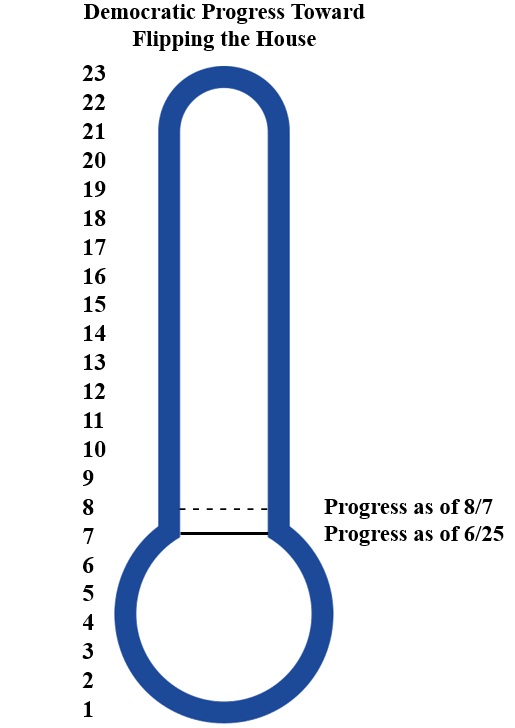
If Ohio’s special election result in an R+7 district tells us anything, it’s that the Republican control of Congress is teetering on the edge. Republicans hold 24 House seats classified as toss-ups and another 10 seats classified as Lean Democrat or better according to Cook Political Report — Democrats only need to flip 23 to regain the majority in the lower chamber.
The GOP spent nearly a million dollars in get-out-the-vote efforts as they frantically scrambled to secure a win in addition to the millions they had already poured into Balderson’s campaign. With many seats up for grabs and Democrats on the charge, the GOP will need to reach deep into their pockets to try and save their House majority.

Friday, August 3, 2018

TARIFFS | How Are They All Working Out?

Tariffs have not lowered the trade deficit so far.
August 3, 2018–The Trump Administration is now more than year and a half into its program to improve the U.S. balance of trade in goods and services.

 The U.S. Bureau of Economic Analysis (BEA) reported this morning that the goods and services deficit was $46.3 billion in June, up $3.2 billion from $43.2 billion in May, revised.

Year-to-date (see chart), the goods and services deficit increased $19.6 billion, or 7.2 percent, from the same period in 2017. Exports increased $103.6 billion or 9.0 percent. Imports increased $123.2 billion or 8.6 percent.

June exports were down from May by $1.5 billion to $213.8 billion. June imports were up from May by $1.6 billion to $260.2 billion. The June increase in the goods and services deficit reflected an increase in the goods deficit of $3.1 billion to $68.8 billion and virtually no change in the services surplus to $22.5 billion.

The full text of the release on BEA's Web site can be found at www.bea.gov/newsreleases/international/trade/tradnewsrelease.htm


Thursday, August 2, 2018

ACT LOCALLY | Support for Candidates, 2018

A recent issue of the East Hampton Star editorialized about a “First District Dilemma for Democratic Voters” (July 5, 2018). I have been thinking about this.

The editorial addresses the problem of deciding where to donate time and money in elections. Does one give and work locally? Or is it better to send the money to national organizations that will allocate the money to where it is most likely to be effective.

I think that depends on how much one knows about the local candidate. How involved are we? For someone with no time to address the issues, sending a check to a national group that is prioritizing its funding of local campaigns for the House and Senate is a good move. If you have enough money to max out in a local campaign and then give more to a national group, there is no dilemma.

However, if a choice is really necessary, I have some experience to offer. I been volunteering for political campaigns for six decades and I have a point of view on what is effective. Just as investing in companies you understand is more likely to pay off than investment in schemes that you don’t, I have found that time or money spent on local campaigns has always been immensely more effective than the same effort or money invested in distant electoral districts.

A concerted local effort is something we can control and evaluate. We can see the results. Bravo if you can help candidates from out of town as well as local ones, but we should not delude ourselves into thinking that money and volunteering spent in areas we don’t understand is as effective–or as appreciated!–as local involvement.

So in New York Congressional District 1, where Perry Gershon is challenging Tea Party incumbent Lee Zeldin, my wife Alice and I are committing time and money to supporting Perry. He is a hugely superior candidate to Zeldin, someone who is on top of the issues that matter to me and apparently not to Zeldin. He won the Democratic Primary and received the support of all four of his opponents. There is a unity of purpose here that is rare in local politics.

So if you are summering on the East End of Long Island, or live here, support Perry. Send an email to declan@perrygershon.com. Perry understands the issues and makes thoughtful decisions about policy, and his staff will respond promptly to your interest in giving money or time to his campaign.

Sunday, July 29, 2018

CHINA | Seeking Influence in Latin America

July 29, 2018–The New York Times today has a three-page lead article on “China’s long, quiet push into Latin America.” 

This was the subject of a post five months ago by Heidi Fiske. Heidi’s article focuses on Mexico.

https://cityeconomist.blogspot.com/2018/03/heidi-fiske-risk-of-trumps-trashing.html.  

Friday, July 27, 2018

GOP TAXES | Three House Bills

The following update on new tax bills before the Congress is by Dana Chasin, posted here by permission.

House Ways and Means Committee Chair Brady is on a mission to make tax cuts a winning issue for Republicans in the fall.  His legislative vehicle is “Tax Reform 2.0.”

The problem is that the Tax Cuts and Jobs Act (TCJA) bill [signed last December as the Tax Act of 2017 (after conferencing the original title was made generic)–JTM] has been less popular than expected.

Most Republicans up for re-election have given up even mentioning it on the campaign trail.  The original tax cuts contained embarrassing mistakes and the many and sizable kinks still need to be ironed out with a technical corrections act in the works.
Republicans in the House are now marching on with a new trilogy of tax bills that they hope will resonate with their voters in November, while the Senate leadership sees no urgency.  What comprises this trilogy and what are its prospects?

Recent Legislative Developments
Chair Brady indicates that House Republicans are planning to divide the package into three separate bills: permanency, savings, and innovation.  Dividing the bills increases the chances that they are passed, if not all together, then separately, but creates a false illusion that they won’t aggressively try to pass all three. Ways and Means is set to mark up the bills in mid-September with the intention of passing them by the end of that month. In the Senate, the package is unlikely to be taken up before the lame duck session.
President Trump’s tax cuts, which permanently reduced the standard corporate rate from 35 to 21 percent, have already had a considerable negative revenue effect, with the New York Times reporting this week that “the amount of corporate taxes collected by the federal government has plunged to historically low levels in the first six months of the year, pushing up the federal budget deficit much faster than economists had predicted.”
While corporate tax payments between January and June fell by 33 percent compared with the same period last year, corporate tax receipts as a share of the economy have fallen to 1.3 percent, nearing a 75-year low.
The Road to Hell is Paved with Permanence
Tax Reform 2.0 is a decisively political move by Republicans to make permanent the changes they enacted in 2017 that are set to expire at the end of 2025 and to introduce other tax changes.  Although there is still no bill language, the rhetoric around the release implies that Republican leadership wants to perpetuate all of the individual income tax changes in the TCJA. These changes include:
  • tax cuts for individuals and pass-through businesses
  • SALT deduction cap [$10,000 for married couples filing jointly]
  • Alternative Minimum Tax (AMT) cut
  • standard deduction and child tax credits
Republicans are working on the idea that it will be hard for Democrats to vote against making the individual tax cuts permanent. They believe it is harder for Democrats to vote against individual tax cuts than the corporate ones that were included in TCJA. They also include a variety of new proposals designed to appeal to Democrats.  
A Wolf in Sheep’s Clothing
The new proposals in Tax Reform 2.0 are meant to provide benefits to the middle class at a comparable significance to those in TCJA that clearly favored the wealthiest Americans. These proposals aimed at the middle class are divided into two categories – savings and innovation.

     Savings. Tax savings are generated by three expansions of tax-favored savings accounts:
  • Creating a Universal Savings Account (USA), which is basically a significantly improved Roth Individual Retirement Account (Roth-IRA), that individuals could contribute some of their after-tax income to annually – there is speculation on income contribution limits but nothing has been confirmed yet.  Withdrawals from the USA could be made at any time or for any reason without tax or penalty. Like a Roth-IRA, the USA’s earnings would not be subject to tax. The goal is to incentivize Americans to save more.
  • Expanding the popular, tax-free 529 college savings accounts so it could also be used to pay for apprenticeship fees and home schooling expenses, as well as student debt.
  • Allowing workers to tap into their retirement savings accounts without penalty to cover expenses from the birth of a child or an adoption.
    Innovation. So far there is only one clearly identified idea under this category–permitting start-up businesses to write off more of their initial costs to remove barriers to growth.
Although these measures seem to help the middle class, they are unlikely to be sufficient to offset higher interest rates on mortgages and student and car loans as the result of the ballooning deficit resulting from TCJA’s tax cuts for corporations and the wealthy.

A Tax Cut Catastrophe
Some of the provisions in the Tax Reform 2.0 package would put a further strain on tax revenues at a time when social benefit systems are in dire need of assistance. The Congressional Budget Office (CBO) estimates that extending the individual tax cuts would increase deficits by an additional $650 billion—this at a time when social security had to dip into its trust fund for the first time in 36 years and the federal budget deficit is set to surpass $1 trillion two years earlier than estimated, by 2020.

The TJCA was clear in its “reverse Robin Hood” regressivity. Tax Reform 2.0 is not as blatant, but enacting more provisions that deprive the federal government of vital tax revenue that it needs to fund critical social services is socially irresponsible.

Tax Reform 2.0 also includes provisions that allow for more cuts to the deduction for owners of noncorporate businesses known as “pass-throughs” and larger exemptions to the estate tax and the alternative minimum tax for individuals. Given the predilection of the well-to-do for tax avoidance, this reform makes policies permanent that encourage such activities and suggest that gaming the system is not only good, but recommended. In fact, the lower the pass-through rate, the more attractive abusing the tax code becomes.

Political Lens

With the 2018 midterm election looming, House Republicans are eager to make their individual tax cuts permanent before the Democrats take back control (knock on wood) and they are no longer able to. Were that to happen, at the end of 2025, corporate tax breaks would remain in place and individual tax cuts would expire, making for very bad optics for the Republican party, if it exists then. So even though Chair Brady is planning to introduce the package as three separate bills, passing the permanency of individual tax cuts will be crucial for him and the future of his party.

Sen. McConnell seems to have hit upon a legislative strategy that serves both Senate and House Republicans regarding Tax Reform 2.0.  The House will pass the bills as a package and be able to pick up political capital; Republican senators (who are in un-gerrymandered and therefore more purple jurisdictions) won’t have to take a difficult vote on these bills before the midterms.  Sen. McConnell won’t take the GOP trilogy up until the lame duck session, enabling the House to have its cake (have its vote), while the Senate doesn’t have to eat it too (swallow a tough vote).