Tuesday, April 7, 2020

BIRTH | Marjory Stoneman Douglas, 1890

Marjory Stoneman Douglas
April 7, 2020—This day in 1890 was born Marjory Stoneman, a writer who told the world about the Florida Everglades.

The Stoneman Douglas High School in Parkland, Florida was named after her. Few people outside Florida know anything about her. More people should. Perhaps Stoneman Douglas the person is inspiring Stoneman Douglas the students, who have become a force of nature as they try to turn into new laws the memory the deaths of 17 from their school on February 14, 2018 by an angry student with an AR-15.

Marjory Stoneman, born in Minneapolis, died in 1998 at 108 years old. She cared deeply about votes for women and the environment. She is best known for using her writing talent to save from development what is now the Everglades National Park.

She was a top student at Wellesley College and was elected the Class Orator, not the last Wellesley student to be selected to speak at the Wellesley Commencement and go on to great things. I have great admiration for Wellesley, having seen how well they and the Baldwin School educated my wife Alice. (We celebrate our 49th wedding anniversary in September.) It was a great moment when former Wellesley President Diana Chapman Walsh in her 1993 inaugural speech cited the work of Marjory Stoneman Douglas (and next that of Alice Tepper Marlin!).

Stoneman Douglas began her postgraduate days with a short marriage to an older man who, alas, turned out to be a con artist. She recovered by joining her father at the Miami Herald, working first as a society reporter, then an editorial writer, becoming increasingly engaged in her profession. Despite the pain he caused her, she retained the name of her ex-husband to the end of her life.

After working for the newspaper for some years, she started writing articles on the civil rights of women and others who were not allowed to vote, and on conservation issues. She won a wide readership and published hundreds of short stories. It was the era of The Masses and hard-hitting writing was in vogue. She was less a feminist than an activist. She said: "I'd like to hear less talk about men and women and more talk about citizens."

She helped preserve the Everglades against efforts to drain this swamp in favor of development, by writing in 1947 the book The Everglades: River of Grass, which had an impact similar to that of Rachel Carson's later book (Silent Spring, 1962) on the overuse of DDT. Stoneman Douglas was called "Grande Dame of the Everglades" and was pilloried by developers.

The book that saved
 the Everglades.

She prevailed over the developers, not for the last time. The same year her book on the subject was published, 1947, Everglades National Park was created. The National Park Service ever since has been her friend.

In the 1950s, however, the U.S. Army Corps of Engineers became her enemy. The Corps was working with developers to drain swampland upriver from the Everglades. She argued persistently that the Everglades was at the end of a long-tailed system. The Park depended on a flow of water from Lake Okeechobee, and that in turn depended on the Kissimmee River's continuing to feed the lake.

To help expand her influence, in 1970 she formed the Friends of the Everglades. She lobbied for her viewpoint as head of the organization. How good was she? In his introduction to her 1987 autobiography, Voice of the River, John Rothchild shows how good. He describes her appearance in 1973 at a public meeting in mosquito-haunted Everglades City:
Mrs. Douglas was half the size of her fellow speakers and she wore huge dark glasses, which along with the huge floppy hat made her look like Scarlett O'Hara as played by Igor Stravinsky. . . . She reminded us all of our responsibility to nature . . .  Her voice had the sobering effect of a one-room schoolmarm's. The tone itself seemed to tame the rowdiest of the local stone crabbers, plus the developers, and the lawyers on both sides. I wonder if it didn't also intimidate the mosquitoes. . . . The request for a Corps of Engineers permit was eventually turned down. This was no surprise to those of us who'd heard her speak.
Stoneman Douglas won again, protecting what she had created, the Everglades National Park. Her book went into a revised edition in 1987, the same year that her biography appeared. Her many awards included the Presidential Medal of Freedom. When she died, the British newspaper The Independent summed up her life by saying: "In the history of the American environmental movement, there have been few more remarkable figures."
Postscript: Stoneman Douglas reportedly donated her Medal of Freedom to her alma mater, Wellesley College.

Sunday, April 5, 2020

NY STATE | County Cases, Deaths from COVID (3)

April 6, 2020—Nassau County's death rate from COVID-19 has nearly caught up with New York City's 29.3 deaths per 100,000 population as of early-morning data.

New York City's five counties and five other counties – Nassau, Rockland, Westchester, Orange and Suffolk – dominate the figures.

Deaths in Large Counties as of April 5. The large population of both New York City's five counties and Nassau County have raised the statewide average death rate to 21.2, as shown int he first table. The only other county in the state to be above the state average is Rockland. Westchester is now just below the state average, followed by Orange County and Suffolk County. No other county in New York State comes close to these ten counties.


This is an update of two earlier posts on NY County data, April 3 and March 27. It utilizes the interactive database of the New York Times. See earlier posts for references and notes.

Deaths by Age Group and Gender. The second table shows how a pattern is already forming in the data, with the largest number of victims being over 70 and male. 11.4 percent of the fatalities were patients 90 and over, 26.9 percent 80 and over, and 53.4 percent were 70 and over. By gender, 61 percent of the deaths were men.

Source: Fatalities from NYS Department of Health. Population data from U.S. Census Bureau (2018). American Community Survey 1-year estimates. Retrieved from Census Reporter Profile page for Suffolk County, NY. Also used data from Towncharts.com and combined data to estimate the population by age ranges.
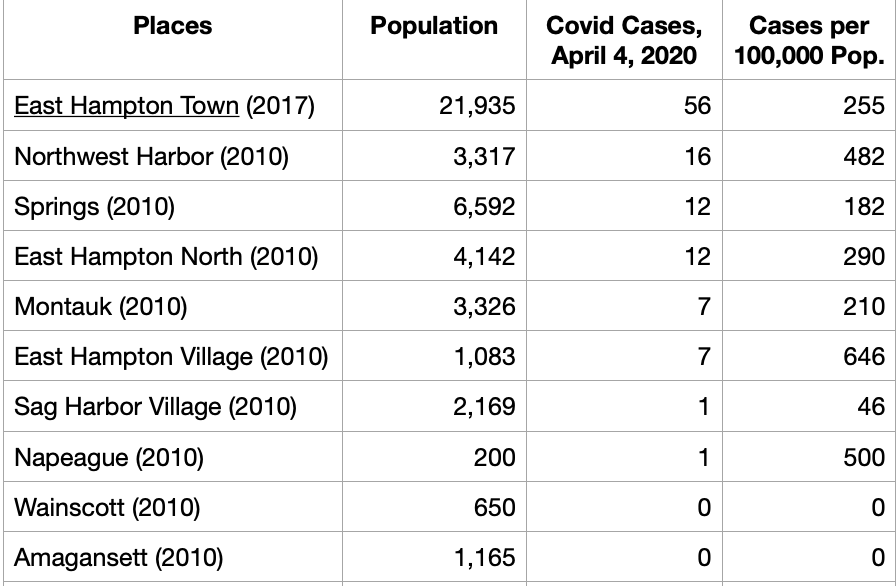
East Hampton Town. The COVID-19 cases in the hamlets and villages and other designated census places within the Town, as of April 4, 2020, show that the largest concentration of cases are in the Village of East Hampton. So far there are no reported deaths in the Town of East Hampton.


Update, April 8, 2020—The number of cases rose to:

Suffolk County 17,444 (Deaths, 323).

EAST HAMPTON TOWN, 75. (No reported deaths.)
Northwest Harbor, 17Springs, 17East Hampton North, 18Montauk, 10East Hampton Village, 10Sag Harbor Village, 1Napeague, 2Wainscott, 0Amagansett, 0

COVID-19 STATUS | U.S. Summary in One Table

April 5, 2020—The largest number of Americans have been suffering from the COVID-19 virus in eight states and the District of Columbia. As of April 4, the states were, in order of death rates: New York, New Jersey, Louisiana, Michigan, Connecticut, Washington, Vermont, Massachusetts. Their death rates all exceed the national average death rate to date of 2.6 per 100,000 population. The list of the worst-hit states underscores the role of social interaction in spreading the disease. New York City was the first big U.S. city to suffer from the pandemic, and its hospitals have quickly been overwhelmed by its spread. Governor Andrew Cuomo provides a daily briefing on his handling of the public health crisis.

Confirmed Cases and Deaths

Two main measures are being used to gauge the progress of the disease: confirmed cases and deaths. Both measures have built-in problems.

Confirmed cases provide an earlier estimate of the extent of the spread of the disease than deaths. It can take a week or more for symptoms to appear, and then it may take another week or more for recovery. Patients can be hospitalized for weeks before recovering or succumbing to the disease.

However, confirmed cases depend on the availability of testing equipment and personnel, and in the early days of the pandemic in the United States tests were in short supply.  

For this reason, a low rate of cases to population may simply mean that fewer people are being tested in a state rather than that the disease is not spreading in a state. For the same reason, the case fatality rate is a less reliable number than deaths relative to population.

Deaths by cause would seem to be a simple enough number to keep track of. In a democracy it is hard to hide a dead body for long. Deaths are closely observed and recorded and whistleblowers historically have not been, as in dictatorships, punished for speaking out. A cause of death must be listed. The course of the COVID-19 disease is easy enough to spot. There are in fact some problems with the data, but let's look first at the reported numbers.

New York State tops the ranked list of deaths per 100,000 population, with 
18.3 recorded as of today. Within New York State, the most densely populated counties are suffering the most.

New Jersey and Louisiana both have half the severity of New York State, about 9 per 100,000. Michigan and Connecticut are 5 per 100,000. These numbers are rising daily.

As a comparison, the average number of deaths in the United States from traffic fatalities in a year is 12.4 per 100,000. (Note that the traffic fatalities number is the sum of events happening over a year's time, whereas we have only three months of pandemic data.) 

The overall U.S. death rate to date from the coronavirus is 2.6 per 100,000 population.

Issues with Cause of Death Data

Two kinds of issues with the data on death rates are emerging: 
  • Underreporting of COVID-19 deaths. Some jurisdictions require that a test for the presence of the virus have been conducted in order to list it as a cause of death. So the absence of testing kits both lowers the number of cases and the number of deaths.
  • Lack of data about victims. Even when the deaths are properly recorded, the hospitals or doctors signing the death certificates may be so pressed for time or staff that they are not recording demographic data about the victims. Ibram X. Kendi, in “Why Don’t We Know Who the Coronavirus Victims Are?” The Atlantic, April 1, 2020, suggests that African Americans are disproportionately the victims, but in many states we don't know. He asks why other states don't report this information—the problems including multiple illnesses and the lack of a test to prove that the victim had the virus; the coroner may be insisting on such proof (here is the Suffolk County, NY procedure for reporting a death). 
Who Are the Victims?

The evidence so far is that more blacks are victims than their proportion of the population, and men are much more likely to be victims than women.

Kendi cites data showing that African Americans are 14.6 percentof the Illinois population, but are 28 percent of confirmed cases of the coronavirus (Latinos, however, are a smaller percentage of deaths than in the population). An even more striking disparity has occurred in Milwaukee, where blacks account for 26 percent of the population but are half of the reported cases and 81 percent of deaths. In Michigan, blacks are 14 percent of the population but 41 percent of the victims.


Support for Masks, Shutdown

Support has been growing for closing meeting places like restaurants and wearing face masks in public. The support for these actions has bubbled up from the states rather than having been led from Washington. The White House at first did not give credence to the pandemic's arrival in the United States and then expressed concern about interfering with economic activity to slow the progress of the disease.

Among the top nine victims of the virus, blue states predominate. Some of the governors of these states have clashed with the President on getting support in the form of supplies, equipment or a national shutdown or mask-wearing policy. 

Democratic New York City and State, with more than 18 deaths per 100,000 population in the state, have supported closing public meeting places. Four other states and D.C. have Democratic leadership. These leaders of these states were early in supporting closing public places until the apex of the disease has passed and in calling for an immediate end to tariffs on medical supplies from China.

The other three states (Louisiana, Vermont and Massachusetts) are purple. Two have Republican governors and one has a Republican senator. Among the next nine states, ranked by death rates, three are red states and two are purple (Colorado and Pennsylvania).

In states with Republican or mixed party leadership, leaders have often appeared to wait for direction from the White House. This has sometimes led to disagreement between Republican Governors and Democratic Mayors over delays in locking down or advice on social distancing.

Note on Data: Confirmed cases and deaths by state are as of April 4, 2020 from the Johns Hopkins University Coronavirus website. A convenient tabular form of the JHU data was posted by The Guardian later on the same day. Total number of U.S. cases and deaths added by JT Marlin. Population data are from the U.S.Census Bureau, Population Division, Table 1. Annual Estimates of the Resident Population for the United States, Regions, States, and Puerto Rico: April 1, 2010 to July 1, 2019 (NST-EST2019-01), December 2019. The Census Bureau documents its estimation methods. Calculations of cases/population, deaths per 100,000 population and case fatality rates by JT Marlin.

Friday, April 3, 2020

NY STATE | County Deaths from COVID (2)

April 3, 2020—In one week, the death rate from COVID-19 per 100,000 population tripled in New York City. It was between 5.5 and 5.8 deaths per 100,000 population in the Bronx, Staten Island (Richmond County) and Queens, and was 3.2 to 3.5 in Brooklyn and Manhattan. See prior post, one week ago.

Rockland again had the highest death rate outside of New York City, rising from 1.6 to 13.5, a huge increase of nearly tenfold. Nassau, which had been behind Suffolk last week, rose from 0.7 deaths per 100,000 to 10.3, an increase of nearly 15-fold. Suffolk's death rate rose five-fold. Westchester's death rate rose from 0.1 per 100,000 to 7.1, a 71-fold increase...
Sources: New York Times Interactive for population data except NYS and NYC, Cases per 100,000 pop. and Deaths. NY State Population from World Population Review as of 2020-02-17, retrieved 2020-04-03.  NY City population as of 2019, Census estimate. Death rates computed by JTM.
The Centers for Disease Control and Prevention (CDC) has found the same pattern emerging in the United States as has prevailed in other countries in Asia and Europe, namely the hardest hit are the older age groups.

Especially vulnerable are those 85 and older, for whom the death rate is more than 10 percent of the number of confirmed cases.

This is why so many cases and deaths are being found in nursing homes.

METRO DEATHS | NY area likely to pass 10,000 deaths

Italy's lockdown.
April 3, 2020—On a Zoom chat this morning, someone asked about the future for the U.S. and New York City economy. I suggested that  it depends on how we manage the pandemic at the NY City, State and Federal level.

The number to watch, I said, is the death rate, because by now everyone is aware that the "confirmed cases" number is dependent on how many tests are done. Shortages of testing kits reduce the number of confirmed cases but also, by delaying proper care and isolation, contribute to higher death rates. The number of cases is not a good measure of the outcome of the disease.

Chart 1. Virus Cases by Country, David
Leonhardt, NY Times, March 31, 2020.
Whichever measure we use, the  prognosis for the United States is for the disease to worsen before it gets better.

Let's look first at the number of cases. Did the United States get ahead of the curve between the time that the disease started in China and then spread to Italy? The chart at right, by David Leonhardt in the NY Times on March 31, suggests not.

In fact, by this point in the progress of the virus, China and Italy and even Spain were both doing better based on cases. But this chart is subject to testing bias. If the United States is "not flattening," the reason may simply be that the United States has stepped up the rate of testing.

Deaths in a democratic country are hard to fake or hide. People are paid to track them. A death from the coronavirus follows a gruesome pattern that should now be not hard to diagnose. Population numbers are closely watched. So, horrible though they are, the death rates are "good"  measures of the spread of COVID-19.

Table 2. Top lines, NY Times Upshot 
table, March 27, 2020.
The table at right shows the top seven lines of a table published as an Upshot in the New York Times. As the accompanying text in the story points out, the death rates lag cases, so they are not the best measure of the challenges being faced at the moment in the hospitals.

Because China was ahead of Europe, and Europe has been ahead of the United States, in facing the coronavirus, the Lombardy and Wuhan death rates are worth looking at as a guide to what might happen in the New York City area.

If there is a bias in the death rates in Lombardy and Wuhan, it is probably on the low side:
  • Yes, Italy has an unusually elderly population, second in the world after Japan. This would tend to raise the death rates relative to New York — the median age in Lombardy is about 45, whereas it is 38 in New York. But Lombardy numbers may be considerably understated because many deaths that did not occur in hospitals were not counted by the health care reporting system — i.e., they might not have been counted if they occurred where people live, even if they were in nursing homes. 
  • The Wuhan numbers may also be undercounted. A classified U.S. report suggests that C.I.A. insiders believe that Chinese cases and deaths from the virus may have been systematically underreported.
What do the death-rate numbers tell us? It is not in the Upshot story, but if the progress of the disease in the New York area matches that of Lombardy, we can expect a death rate of approximately 0.5 per thousand applied to a New York City metro area population of 20 million, or 10,000 deaths.

Chart 2. New York deaths higher than
Lombardy at same point. Upshot,
NY Times, April 3, 2020.
The math is not hard to follow. Lombardy suffered 5,000 deaths, in round numbers. It has half the 20 million population of the New York City Metro Statistical Area.* So one would expect, all else equal, that the New York metro area would end up with double the Lombardy deaths, or 10,000.

Today, April 3, the New York Times published another Upshot chart showing how we are doing on death rates relative to the Lombardy region. It should not make us complacent.

Upshot shows on the chart that the NY City death rate until the last observation has been doubling every two and a half days. It has been on a trajectory well above Lombardy's for a week, until the latest day. Governor Cuomo has noted in his 11 a.m. daily updates a marked improvement in the State trajectory in the last few days. If he is right, it is a breakthrough and he should get credit for it. The Governor's recent moves have improved the odds that the State's hospital system will be able to handle the coming peak load of patients. Meanwhile, we should watch the numbers carefully. It still seems likely that the New York metro area will exceed Lombardy's death rate.

* The NY metro is the statistical area (MSA), not the Combined Statistical Area (CSA), which would add another 3 million people. The NY MSA is composed of four Metropolitan Divisions; one of them is Nassau-Suffolk, two counties that together constitute Long Island as a Metropolitan Division.

Thursday, April 2, 2020

MEDICAL SUPPLIES | Maloney, Axne Call for Lifting Tariffs

Tariffs have slowed imports of medical supplies from China.
Source: Chad Bown, PIIE (Peterson Institute), March 17, 2020.
April 2, 2020 — Backed by 18 of their colleagues in the House, Reps. Carolyn Maloney (D-NY12) and Cindy Axne (D-IA3) have called for the immediate lifting of tariffs on life-saving medical supplies and PPE during the coronavirus pandemic.

In their letter to U.S. Trade Representative Robert Lighthizer and U.S. Ambassador to China Terry E. Branstad, the Representatives write, “While we continue to support American manufacturers and innovation, there simply are not enough medical supplies and PPE domestically to alleviate the burden on our healthcare system.

“The tariffs add substantially to costs and delays in obtaining life-saving equipment and supplies to our healthcare providers who are in a life-and-death struggle. We can – and must – do more to enable those on the front lines to do their jobs effectively and without fear that they might become infected or spread the virus themselves.”

Joining Congresswomen Maloney and Axne on this letter are Representatives Grace F. Napolitano (D-CA), Nydia M. Velázquez (D-NY), Harley Rouda (D-CA), Lizzie Fletcher (D-TX), Danny Davis (D-IL), Vicente Gonzalez (D-TX), Donna E. Shalala (D-FL), Steve Cohen (D-TN), Sharice L. Davids (D-KS), James P. McGovern (D-MA), Ed Case (D-HI), David Scott (D-GA), Raúl M. Grijalva (D-AZ), Charlie Crist (D-FL), Matthew Cartwright (D-PA), Anna Eshoo (D-CA), Bill Foster (D-IL), Abigail Spanberger (D-VA), and Darren Soto (D-FL).

The full text of the letter follows:

Dear Ambassador Lighthizer and Ambassador Branstad:

We write to request that you immediately suspend all tariffs placed on all imports of medical supplies and equipment, including personal protective equipment under Section 301 of the Trade Act of 1974 for the duration of the rapidly developing Novel Coronavirus (COVID-19) pandemic.

The U.S. Trade Representative (USTR) recognized that tariffs on medical supplies and equipment were inappropriate when it announced on March 20 it would open a 3-month comment period for members of the public, businesses, and government agencies “to submit comments if they believe further modifications to the (Section) 301 tariffs may be necessary.”

However, we’re asking for an immediate suspension of these tariffs because we cannot afford to wait any longer. On the day the comment period was announced, there were 15,490 total cases and 201 total deaths in the United States from the coronavirus. Today, there are 209,071 total cases and 4,633 total deaths. In New York, the epicenter of the outbreak in the U.S., hospitals and healthcare systems are nearing their breaking point as the number of new cases continues to exponentially rise.

As the outbreak continues, hospitals, doctors, health care providers, and emergency management coordinators in our districts and across the nation have been sounding the alarm that their systems are being overwhelmed. Our entire healthcare infrastructure is experiencing shortages of medical supplies – like ventilators, gloves, hand sanitizer, and other essentials – and personal protective equipment (PPE) that are critical to fighting the outbreak.

While we continue to support American manufacturers and innovation, there simply are not enough medical supplies and PPE domestically to alleviate the burden on our healthcare system. The tariffs add substantially to costs and delays in obtaining life-saving equipment and supplies to our healthcare providers who are in a life-and-death struggle. We can – and must – do more to enable those on the front lines to do their jobs effectively and without fear that they might become infected or spread the virus themselves. Accordingly, we urge all of you to immediately take steps to suspend all tariffs placed on medical supplies and equipment for the duration of this public health crisis."

Nonprofit groups that have protested the continued tariffs on medical supplies include the Peterson Institute, which wrote on March 13, 2020: "President Donald Trump's trade war with China is threatening to cripple the US fight against the COVID-19 pandemic. The administration's tariffs on Chinese medical products have cut imports of these products from China and may be contributing to shortages and higher costs of vital equipment at a time of nationwide crisis. The administration has announced temporary reductions in some tariffs on Chinese medical products, but only a handful were affected. The US epidemic demands that the administration comprehensively and permanently reverse these policies of self-harm."